
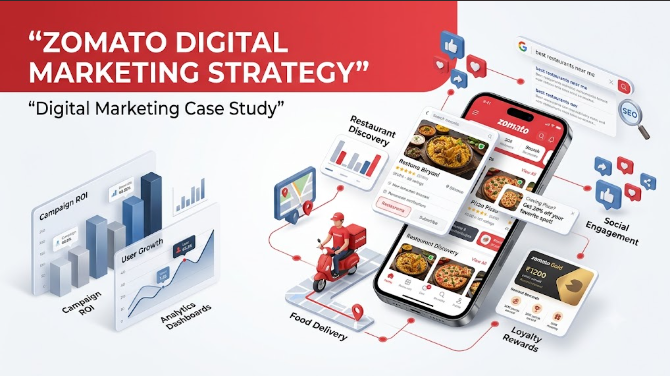
Zomato is more than a food delivery platform. Over the years, it has built a powerful digital ecosystem by combining technology, data, content, social media, search marketing, personalized communication and customer loyalty.
What makes the Zomato digital marketing strategy particularly interesting is that the company does not depend on a single marketing channel. Instead, different channels work together to attract customers, engage them, encourage repeat purchases and increase customer lifetime value.
From witty social media posts and highly recognizable notifications to programmatic SEO and loyalty programs such as Zomato Gold, Zomato has developed a marketing model that connects brand awareness with measurable customer actions.
This Zomato digital marketing case study examines the major strategies behind that growth, the campaigns that generated attention, the mistakes that created backlash and the key lessons businesses can learn from Zomato.
About Zomato
Zomato started as a restaurant discovery platform and gradually evolved into a much broader digital consumer ecosystem.
Its core business has been built around helping customers discover restaurants, order food and interact with the food ecosystem digitally. Over time, the company expanded its presence through food delivery, loyalty programs, quick commerce through Blinkit and its broader “going-out” ecosystem through District.
This expansion has also changed the role of marketing.
Instead of simply promoting food delivery, Zomato increasingly uses customer data, personalization, content and cross-platform engagement to keep users within its ecosystem.
The research reviewed for this case study describes this evolution as a transition from a restaurant directory into a large-scale digital commerce ecosystem.
What Made Zomato’s Marketing Different?
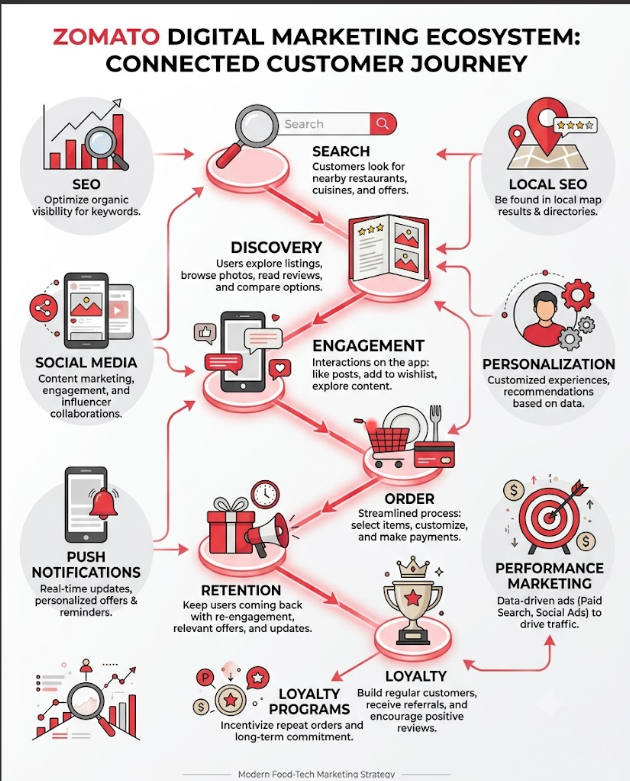
The biggest strength of the Zomato marketing strategy is its ability to combine different stages of the customer journey.
A simplified version of the model looks like this:
Search → Discovery → Engagement → Order → Retention → Loyalty → Cross-Selling
SEO helps users discover Zomato.
Social media creates brand awareness and cultural relevance.
Push notifications bring users back to the platform.
Offers and loyalty programs encourage repeat purchases.
Data helps personalize communication.
And the wider ecosystem creates opportunities to sell additional services to existing customers.
This means Zomato’s marketing is not simply about acquiring a customer.
It is about building a relationship with that customer.
Zomato Digital Marketing Strategy
1. Programmatic SEO Strategy
SEO is one of the most important components of Zomato’s digital acquisition strategy.
A traditional website might create a limited number of pages targeting broad keywords.
Zomato operates at a completely different scale.
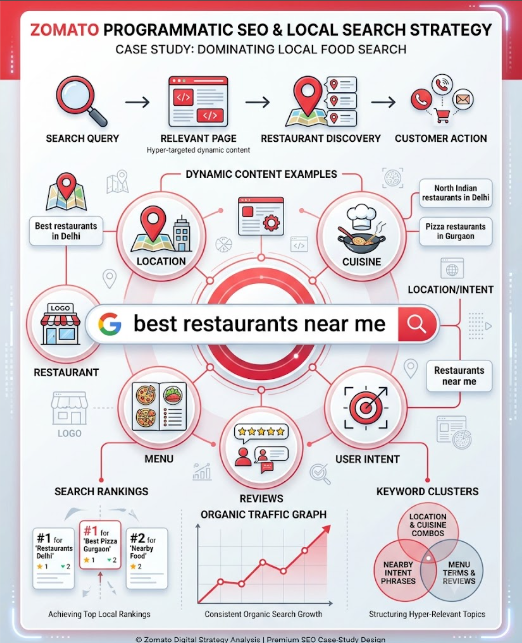
Restaurant information, locations, menus, cuisines, reviews and other structured information create opportunities for thousands or even millions of search-intent combinations.
For example, users may search for:
- Best restaurants in Delhi
- Restaurants near me
- Pizza restaurants in Gurgaon
- North Indian restaurants in Delhi
- Best cafes in Mumbai
- Restaurants open near a particular location
- Restaurant-specific queries
- Menu-related searches
Zomato’s large database allows these search intents to be connected with relevant pages.
The research material describes an extensive organic search infrastructure and cites estimates of hundreds of thousands of keywords. However, these third-party estimates should be treated as estimates rather than official company disclosures.
Why Zomato’s SEO Strategy Works
The strategy is powerful because the content is closely connected with high-intent searches.
Someone searching for:
“best pizza near me”
has a very different commercial intent from someone searching:
“what is pizza?”
Zomato’s pages can potentially capture users when they are already looking for a restaurant, cuisine or food-ordering option.
This creates an important SEO lesson:
The best SEO strategy is not always about creating more content. It is about creating useful pages for real search intent.
2. Local SEO and Search Intent
Zomato’s business naturally aligns with local search.
Food is location-dependent.
A user doesn’t simply want “a restaurant.”
They want:
a restaurant near them, available now, within their budget and matching their preferences.
This makes location-based SEO extremely valuable.
Zomato can connect:
Location + Cuisine + Restaurant + User Intent
For digital marketers, this demonstrates the importance of creating content and landing pages around specific search behavior instead of targeting only generic keywords.
3. Social Media Marketing
One of the most recognizable parts of the Zomato digital marketing strategy is its social media personality.
Instead of communicating like a traditional corporate brand, Zomato frequently uses:
- Memes
- Pop-culture references
- Trending topics
- Short-form content
- Humor
- Relatable situations
- Festival marketing
- Real-time conversations
This strategy makes the brand feel like part of everyday internet culture.
The research identifies meme-driven positioning and moment marketing as important elements of Zomato’s digital presence.
4. Moment Marketing
Zomato has become particularly recognizable for reacting quickly to cultural moments.
Instead of waiting weeks to produce a traditional campaign, moment marketing allows brands to participate in conversations that are already happening.
The basic formula is:
Trending Moment + Brand Relevance + Fast Creative Execution
However, relevance is critical.
A brand cannot simply attach its logo to every trending topic.
The content needs to make sense for the audience and the brand.
Zomato’s success with moment marketing demonstrates how speed can become a competitive advantage in social media marketing.
5. Zomato’s Push Notification Strategy
Another important part of the Zomato marketing strategy is its use of push notifications.
Most companies use notifications to communicate information.
Zomato has often used notifications as a form of micro-copywriting.
Instead of simply saying:
“Order your food now.”
the communication can use humor, curiosity, urgency, personalization or situational relevance.
This transforms a basic notification into a marketing touchpoint.
The research specifically highlights personalized and context-driven push communication as an important retention mechanism.
Why Push Notifications Matter
A customer may have installed the application but not opened it recently.
A well-timed notification can bring the customer back.
The journey becomes:
Notification → App Open → Product Discovery → Order → Repeat Purchase
This is especially valuable because the company is communicating directly with an existing user rather than paying to acquire a completely new customer.
6. Personalization and Customer Data
Personalization is another important component of the Zomato digital ecosystem.
Different users have different:
- Ordering habits
- Food preferences
- Locations
- Spending patterns
- Ordering times
- Restaurant preferences
A personalized marketing system can use these behavioral signals to make communication more relevant.
For example, a customer who frequently orders dinner may respond differently to a message than someone who usually orders lunch.
This creates a fundamental marketing principle:
Relevance increases the probability of engagement.
The research also describes Zomato’s push strategy as increasingly data-driven and behaviorally personalized.
7. Zomato Gold and Customer Retention
Acquiring a customer is only one part of marketing.
The bigger challenge is getting that customer to return.
This is where loyalty becomes important.
Zomato Gold has played a major role in creating a stronger relationship between the platform and frequent users.
The basic objective of a loyalty program is:
More value → More usage → More frequency → Greater retention
A customer who feels they receive additional benefits from remaining within the ecosystem has a stronger reason to continue using the platform.
The research highlights Zomato Gold as a retention mechanism and connects it with the broader economics of customer lifetime value.
8. Performance Marketing
While organic marketing and social media create significant awareness, performance marketing allows a company to focus on measurable actions.
Typical performance objectives include:
- App installations
- Website visits
- Customer acquisition
- Orders
- Retargeting
- Conversions
- Repeat purchases
The real advantage is measurability.
A company can evaluate:
How much did we spend?
How many users did we reach?
How many converted?
How much revenue did those customers generate?
This creates a continuous optimization loop.
Campaign → Data → Analysis → Optimization → Better Campaign
9. Video Advertising and Celebrity Marketing
Zomato has also used mass-reach advertising to strengthen brand awareness.
The research highlights short video advertising and celebrity-led campaigns as part of the broader acquisition and awareness strategy.
Celebrity campaigns can provide:
- Massive reach
- Brand recognition
- Social attention
- Credibility
- Stronger recall
The important strategic point is that large-scale brand advertising and performance marketing can work together.
One creates awareness.
The other captures measurable demand.
10. Zomato’s Content Strategy
Zomato’s content strategy is not limited to promotional messages.
Its communication frequently focuses on situations people recognize.
Food cravings.
Late-night ordering.
Weekend plans.
Rainy-day food.
Office lunch.
Exams.
Festivals.
Relationships.
Pop culture.
This makes the content less like advertising and more like entertainment.
That distinction is extremely important.
Traditional Advertising
“Order food from Zomato.”
Brand-Led Content
Create something people want to share, then connect it naturally with the brand.
This is one reason Zomato’s social content has become such a recognizable part of its brand identity.
11. Crisis Management and Digital PR
A strong marketing case study should not only examine successful campaigns.
It should also examine failures.
Zomato has experienced multiple controversies that demonstrate the risks associated with provocative marketing and fast-moving digital communication.
The “Kachra” Campaign
In 2023, Zomato faced backlash over a campaign involving the character Kachra from the film Lagaan.
The campaign attempted to connect the character with Zomato’s waste-management efforts.
However, the character’s social and cultural context made the campaign highly sensitive.
The campaign was criticized as insensitive, after which Zomato removed the advertisement and apologized.
Marketing Lesson
Creative marketing should never be evaluated only on whether an idea is funny or attention-grabbing.
Brands also need to consider:
Cultural context + Social impact + Audience interpretation
12. “Har Customer Hai Superstar” Campaign
Another example discussed in the research is Zomato’s “Har Customer Hai Superstar” campaign.
The campaign presented customers as VIPs.
However, social media users criticized the contrast between the glamorous portrayal of customers and the difficult working conditions experienced by delivery workers.
Marketing Lesson
Consumers increasingly evaluate whether a brand’s communication matches reality.
A campaign may look positive from a marketing perspective but still create negative sentiment if audiences perceive a disconnect between advertising and real-world experience.
13. Pure Veg Fleet Controversy
In March 2024, Zomato announced a dedicated “Pure Veg Mode” and “Pure Veg Fleet.”
The proposed fleet used green uniforms and delivery boxes to distinguish it from the standard red fleet.
The initiative generated significant public discussion around social, cultural, safety and operational concerns.
The controversy demonstrated another important principle of digital PR:
A marketing decision can create consequences far beyond the original marketing objective.
For a company operating at national scale, even a seemingly simple product or branding decision can quickly become a public conversation.
14. Zomato’s Ecosystem Strategy
Perhaps the most interesting evolution in Zomato’s strategy is that the company is no longer focused only on food delivery.
The broader ecosystem includes businesses such as:
- Food delivery
- Restaurant discovery
- Loyalty
- Quick commerce through Blinkit
- Going-out experiences through District
The District strategy is particularly interesting.
The research explains that District was positioned around the broader “going-out” market, including dining, movies, live events and entertainment.
This represents an important marketing strategy:
Use an existing customer base to enter adjacent categories.
Instead of acquiring every customer from zero, an established ecosystem can introduce existing users to new products and services.
15. Cross-Selling Through the Existing Audience
Imagine a customer already trusts a platform for food.
That platform can potentially introduce the customer to:
Restaurant booking → Movies → Events → Entertainment → Other lifestyle services
This creates a powerful ecosystem effect.
The customer stays within a familiar digital environment.
From a marketing perspective, the company can potentially reduce the friction associated with discovering a completely new service.
This is one of the most important strategic lessons from Zomato’s expansion.
Zomato vs Traditional Digital Marketing
The difference can be summarized simply.
| Traditional Approach | Zomato Approach |
|---|---|
| One-way advertising | Continuous customer interaction |
| Generic communication | Personalized communication |
| Limited content | Always-on content |
| Broad targeting | Behavioral targeting |
| Single conversion | Repeat transactions |
| Campaign-focused | Ecosystem-focused |
| Acquisition-focused | Acquisition + Retention |
The result is a marketing system where different channels support each other.
Zomato’s Digital Marketing Funnel
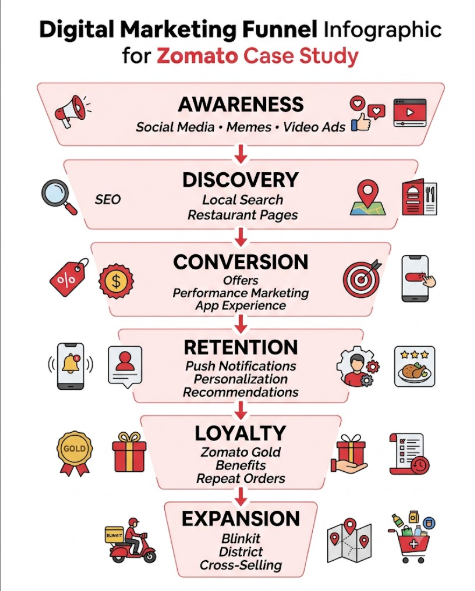
The entire strategy can be visualized as a funnel:
1. Awareness
Social media
Meme marketing
Celebrity campaigns
Video advertising
↓
2. Discovery
SEO
Local search
Restaurant pages
Search intent
↓
3. Conversion
Offers
Performance marketing
Restaurant discovery
App experience
↓
4. Retention
Push notifications
Personalization
Recommendations
↓
5. Loyalty
Zomato Gold
Benefits
Repeat ordering
↓
6. Expansion
Blinkit
District
Cross-selling
This interconnected approach is the real strength of the Zomato digital marketing strategy.
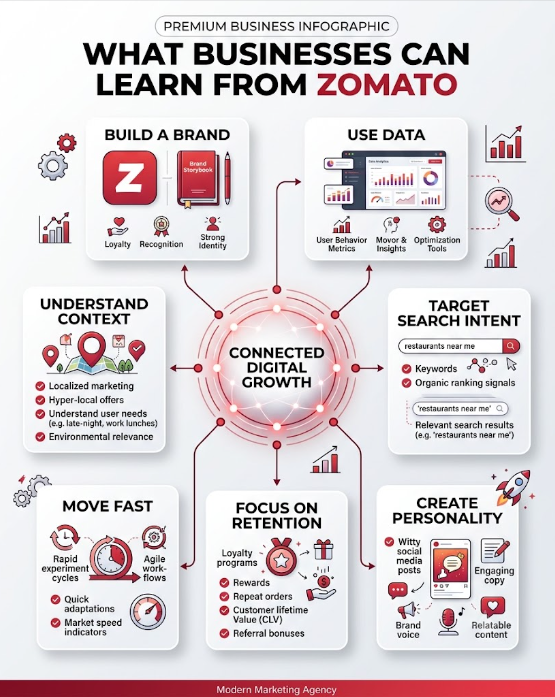
Key Digital Marketing Lessons From Zomato
1. Build a Brand, Not Just an Advertisement
Zomato’s strongest marketing asset is not a single campaign.
It is the brand personality built over years.
Businesses should focus on creating a recognizable voice rather than producing disconnected promotional posts.
2. Use Data to Improve Relevance
Customer data becomes valuable when it improves the customer experience.
Instead of sending the same message to everyone, businesses can use behavioral information to make communication more relevant.
3. SEO Should Target Search Intent
Zomato demonstrates how powerful SEO can become when content is aligned with specific user searches.
Instead of targeting only:
“restaurant”
a business can target:
“best restaurant in [location]”
“best [cuisine] near me”
“[service] in [city]”
The more closely content matches intent, the stronger its commercial value can become.
4. Social Media Needs Personality
People do not follow brands simply because they sell something.
They follow brands because the content entertains, educates, inspires or connects with them.
Zomato’s social strategy demonstrates the power of personality and cultural relevance.
5. Retention Is as Important as Acquisition
Getting a new customer is valuable.
Getting that customer to return repeatedly can be even more valuable.
Businesses should therefore build:
Acquisition + Engagement + Retention
rather than focusing only on lead generation.
6. Speed Matters in Social Media
Moment marketing depends on timing.
A trend may be relevant today and irrelevant tomorrow.
Brands need processes that allow creative teams to identify opportunities and respond quickly without sacrificing brand safety.
7. Creativity Needs Context
Zomato’s controversies demonstrate that creativity without cultural awareness can become a liability.
Before publishing a campaign, brands should ask:
- Could this message be misunderstood?
- Does it touch a sensitive topic?
- Could the visual create an unintended association?
- Does the campaign reflect the brand’s actual values?
- How might different audiences interpret it?
What Businesses Can Learn From Zomato
A small or medium-sized business does not need Zomato’s budget to learn from its strategy.
The principles can be applied at almost any scale.
A local business could build its own marketing funnel:
Google Search → Website → Social Media → WhatsApp/Email → Retargeting → Repeat Customers
For example, a jewellery business could create:
- Location-based SEO pages
- Educational jewellery content
- Instagram reels
- Festival campaigns
- Personalized WhatsApp communication
- Customer remarketing
- Loyalty offers
A real estate company could use:
- Local SEO
- Property landing pages
- Google Ads
- Instagram reels
- Lead forms
- Retargeting
- Email/WhatsApp follow-ups
The lesson is not to copy Zomato’s exact campaigns.
The lesson is to build an interconnected digital marketing system.
Conclusion
The Zomato digital marketing strategy is a strong example of how modern digital marketing goes beyond advertising.
Zomato combines SEO, social media, content, personalized notifications, performance marketing, loyalty and ecosystem expansion to create multiple interactions with the same customer.
Its programmatic SEO approach helps capture search demand, while social media builds cultural relevance. Push notifications encourage users to return, and loyalty programs strengthen retention. At the same time, expansion into businesses such as Blinkit and District creates opportunities to increase the value of an existing customer relationship.
However, Zomato’s journey also demonstrates that aggressive creativity carries risks. Campaigns such as the Kachra advertisement and the Pure Veg Fleet controversy show why cultural sensitivity, authenticity and crisis management are essential parts of modern digital marketing.
The biggest takeaway is simple:
Don’t use digital marketing channels separately. Connect them.
SEO can bring the customer.
Social media can make the brand memorable.
Personalization can bring the customer back.
Loyalty can increase retention.
And a strong ecosystem can increase customer lifetime value.
That is what makes Zomato’s approach more than a collection of marketing campaigns—it is a connected digital growth strategy.
Frequently Asked Questions
What is Zomato’s digital marketing strategy?
Zomato’s digital marketing strategy combines SEO, social media marketing, content marketing, personalized push notifications, performance marketing, loyalty programs and ecosystem-based cross-selling.
How does Zomato use SEO?
Zomato uses its large database of restaurants, locations, cuisines, menus and reviews to create search-relevant pages that can target highly specific local and commercial search queries.
Why is Zomato successful on social media?
Zomato uses humor, memes, cultural references, trending topics and relatable content to develop a recognizable brand personality and maintain audience engagement.
How does Zomato use push notifications?
Zomato uses contextual and personalized notifications to re-engage users, promote relevant offers and encourage customers to return to the platform.
What can businesses learn from Zomato’s marketing strategy?
Businesses can learn the importance of search intent, brand personality, personalization, customer retention, real-time content and connecting multiple digital marketing channels into one growth system.
What are the risks of Zomato’s marketing strategy?
Fast and provocative marketing can create backlash if cultural context, authenticity or audience sentiment are not considered. Zomato’s past campaign controversies demonstrate the importance of digital PR and crisis management.
How does Zomato retain customers?
Zomato combines personalized communication, recommendations, offers and loyalty mechanisms such as Zomato Gold to encourage repeat usage.
Why is Zomato’s SEO strategy important?
SEO can provide a scalable source of high-intent organic traffic. Zomato’s large amount of location and restaurant-related information gives it many opportunities to match specific user searches.
What is the biggest lesson from Zomato’s digital marketing strategy?
The biggest lesson is to build an interconnected marketing funnel instead of treating SEO, social media, advertising and retention as completely separate activities.

Leave a Reply