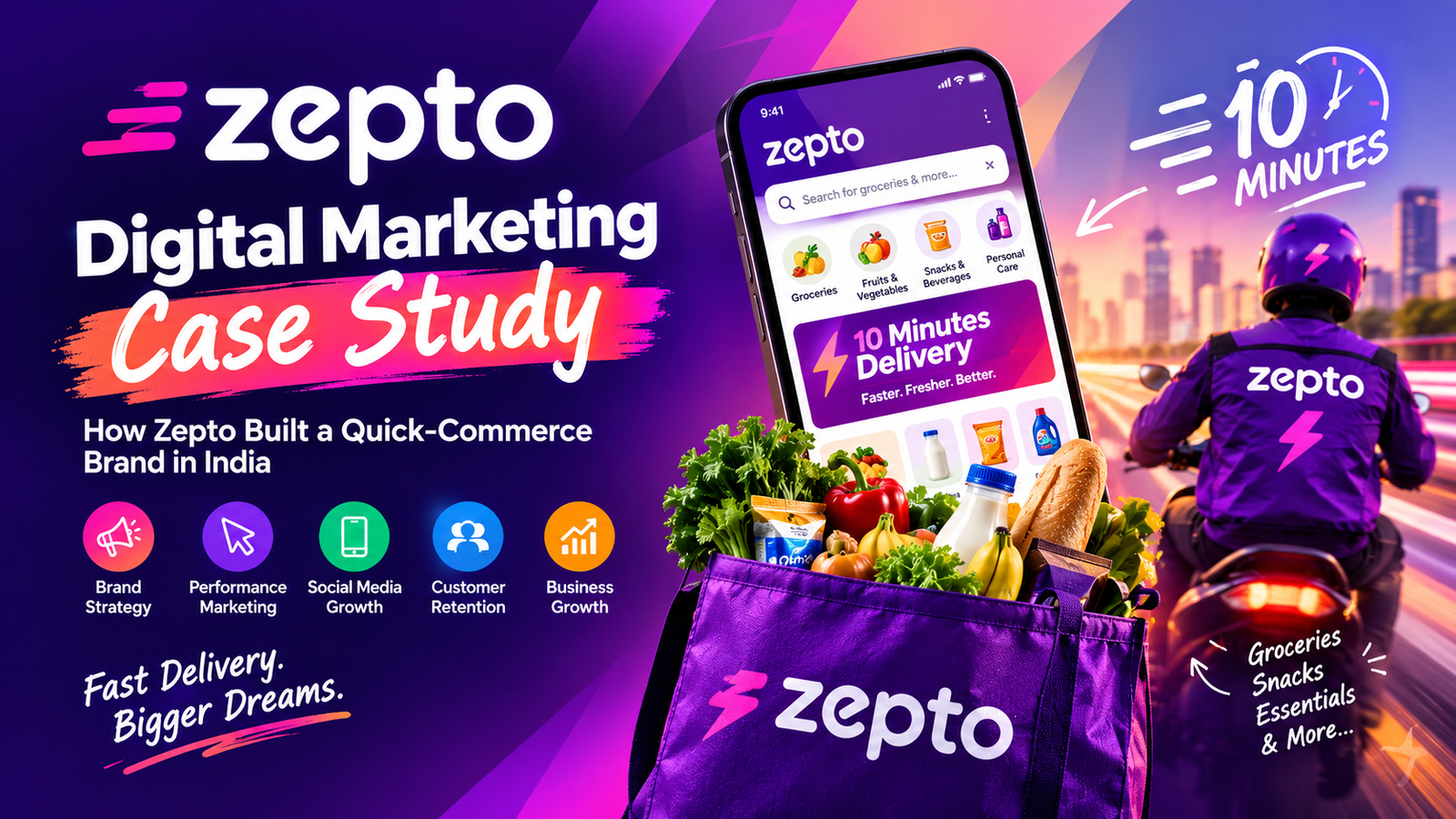
Zepto Digital Marketing Strategy: How Quick Commerce Drives Growth
Explore how Zepto combines speed-focused positioning, performance marketing, memorable campaigns, social content, and customer retention to compete in India’s quick-commerce market.
On this page · Contents
Imagine running out of milk just before breakfast, craving snacks late at night, or realizing that an essential household item is missing when you need it most. Traditionally, solving these problems meant visiting a nearby shop or waiting for a scheduled grocery delivery. Zepto built its brand around a different idea: making everyday shopping faster, easier, and more convenient.
Founded in 2021 by Aadit Palicha and Kaivalya Vohra, Zepto entered India’s growing quick-commerce market with a compelling proposition: groceries delivered in as little as 10 minutes.
But speed alone does not explain Zepto’s marketing success. The company built its identity around convenience, combined memorable advertising with digital customer acquisition, and developed a business model designed to encourage frequent purchases.
This Zepto digital marketing case study explores how the company uses brand positioning, performance marketing, social media campaigns, customer retention strategies, and hyperlocal operations to compete in India’s quick-commerce industry.
For digital marketers, startups, and business owners, Zepto offers an important lesson: successful marketing is not just about attracting attention. It is about connecting a clear customer promise with an experience that encourages people to return.
1. Understanding Zepto’s Business Model and Target Audience
Zepto’s growth strategy begins with understanding a simple consumer problem: people often need everyday products immediately, not several hours or days later.
The company’s approach combines digital ordering with neighbourhood-based fulfilment infrastructure. Instead of relying entirely on conventional, centralized warehouses, quick-commerce platforms use smaller facilities positioned closer to customers.
These facilities, commonly called dark stores, help businesses prepare orders and dispatch them within a limited local delivery area.
Who is Zepto targeting?
Zepto’s core audience includes urban consumers who value convenience and quick access to everyday essentials.
People with busy schedules who want to reduce the time spent shopping for groceries and household essentials.
Consumers who may order snacks, beverages, personal care products, and quick meals throughout the day.
Families and individuals who need last-minute ingredients, dairy products, fresh produce, and other daily necessities.
Customers ordering snacks, drinks, gifts, or celebration essentials during festivals, sporting events, and social gatherings.
The key marketing insight
Zepto is not simply marketing groceries. It is marketing the convenience of getting something when it is needed.
This distinction matters because customers often make quick-commerce purchases in response to an immediate situation. Marketing that connects with these moments can make a product or service more relevant to the customer.
For other businesses, the lesson is straightforward: identify the problem that motivates a purchase before deciding what your advertising should say.
2. Zepto’s Brand Positioning: Making Speed Its Identity
One of the most recognizable elements of Zepto’s marketing strategy is its emphasis on rapid delivery.
Instead of introducing itself as another online grocery store, Zepto established a specific promise around speed. This helped create a clear point of difference in a competitive market.
Traditional grocery shopping often emphasizes assortment, value, or planned delivery. Zepto’s early positioning emphasized immediacy.
How Zepto makes its brand memorable
- A clear value proposition: Fast delivery is easy to understand and directly connected to a customer need.
- Distinctive visual identity: Its vibrant pink and purple branding helps distinguish the brand across digital and physical touchpoints.
- Conversational communication: Informal, humorous messaging makes advertising feel closer to everyday consumer conversations.
- Consistent brand associations: Its app, delivery packaging, advertising, and outdoor campaigns reinforce the same broad identity.
The brand subsequently expanded its positioning beyond delivery speed to encompass broader daily convenience, with additional categories and services.
This is an important principle of brand building. A business can attract customers with one strong benefit, then develop a broader relationship by consistently delivering value.
3. Zepto’s Digital Marketing Strategy
Zepto’s marketing approach combines multiple channels rather than depending on a single advertising platform. Each channel serves a different purpose, from introducing the brand to potential customers to encouraging existing users to order again.
Performance marketing
Digital advertising across platforms such as Google and Meta can reach consumers in relevant service areas and direct them towards the app.
Search marketing and app store optimization
Search campaigns target customers actively looking for grocery delivery, while app store optimization helps improve how the app is discovered and presented.
Social media and viral marketing
Humour, relatable situations, creator-friendly formats, and campaign-specific content help the brand participate in online conversations.
Customer retention marketing
Push notifications, personalized offers, and subscription benefits encourage repeat purchases and continued app usage.
Hyperlocal marketing
Geographic targeting can connect promotions with nearby customers, provided the relevant products and delivery capacity are available.
The strength of this approach lies in coordination. Brand advertising can create awareness, search can capture existing demand, social content can generate engagement, and retention campaigns can help convert one-time users into repeat customers.
4. Performance Marketing: Reaching Customers at the Right Moment
Performance marketing plays an important role in a business where customers frequently make immediate purchasing decisions.
For Zepto, the opportunity is not limited to reaching people interested in groceries. It is also about reaching relevant consumers within areas the business can serve.
Hyperlocal advertising
A broad national campaign may generate impressions from people who cannot place an order in their location. Hyperlocal targeting helps reduce this mismatch by focusing advertising on selected geographic areas.
For example, a campaign could promote snacks and beverages to customers within a serviceable neighbourhood during a major cricket match.
The underlying strategy involves three considerations:
- Location: Is the customer within a serviceable delivery area?
- Relevance: Does the advertisement match a current need or occasion?
- Availability: Can the business actually fulfil the demand generated by the campaign?
The supplied research describes an inventory-linked approach in which local advertising can be coordinated with product availability and operational capacity. However, it does not independently establish the extent to which Zepto uses every specific automated integration described.
Search engine marketing
Search advertising targets consumers who express a clear need through queries such as online grocery delivery or instant grocery delivery.
These searches can signal stronger purchase intent than a general interest in food or shopping. However, keyword selection should reflect actual service availability, competition, and conversion economics.
App store optimization
App store optimization (ASO) focuses on improving an app’s discoverability and conversion potential through relevant keywords, descriptions, screenshots, ratings, and other listing elements.
For a mobile-first company like Zepto, the app listing is an important part of the customer acquisition journey. An advertisement may create interest, but the app store page must help turn that interest into an installation.
Performance marketing works best when advertising reach, customer intent, local availability, and the actual user experience are aligned.
5. Zepto’s Viral Marketing and Advertising Campaigns
Zepto’s creative strategy is notable for combining large-scale advertising with internet-native humour and everyday situations.
Rather than communicating only through conventional product advertisements, the brand has used cultural references and relatable experiences to make its delivery proposition more memorable.
Campaign 1: Indian Stretchable Time
The campaign played on the familiar Indian expression that someone will arrive in “two minutes,” even when the wait turns out to be much longer. Featuring Kailash Kher, Shankar Mahadevan, and Usha Uthup, the campaign used humour and exaggerated musical moments to contrast everyday delays with Zepto’s rapid-delivery promise.
Why the idea works: It starts with a recognizable cultural frustration and connects that experience to the brand’s central benefit. This makes the advertising easier to understand and remember.
Campaign 2: Groceries Delivered at Bumrah Speed
Zepto partnered with Indian fast bowler Jasprit Bumrah for a campaign connecting his speed and precision with the company’s delivery proposition.
The association gave the brand an opportunity to communicate speed through a familiar sporting personality during the cricket World Cup period.
Why the idea works: Celebrity partnerships are more effective when the personality’s recognizable attributes support the message the brand wants to communicate. Here, the creative connection was between speed, precision, and fast fulfilment.
Campaign 3: Nahi Milega
The “Nahi Milega” campaign used a fictional, cynical character and reverse psychology to promote Zepto’s value proposition. The humour came from the character suggesting that desirable benefits were unavailable, before the campaign revealed the offer.
Why the idea works: A recurring character and recognizable phrase can give social content a consistent identity. This format is also well suited to short videos, memes, and audience participation.
What marketers can learn from these campaigns
- Cultural humour makes the message relatable.
- Celebrity partnerships connect the brand with a recognizable public figure.
- Meme marketing adapts the message to the way audiences consume and share social content.
The important point is not that every brand should copy Zepto’s style. It is that creative execution should match the target audience, platform, and message.
A local business, for example, might use a relatable customer problem and a short, humorous reel instead of investing in an expensive celebrity campaign.
7. Customer Retention Strategy: The Role of Zepto Pass
Acquiring a new customer is only one part of growing a digital business. If customers place a single order and never return, the business may struggle to recover its acquisition and fulfilment costs.
Zepto’s Zepto Pass subscription programme was designed to encourage repeat purchases by offering delivery-related benefits to eligible members.
The research supplied for this case study describes the programme’s launch in February 2024 and its use of subscription pricing and qualifying basket thresholds to encourage customers to continue ordering through the platform.
How the retention model works
- A customer discovers Zepto and places an initial order.
- Subscription benefits create an incentive to use the platform again.
- Repeat orders help establish a purchasing habit.
- More frequent engagement creates opportunities to promote other categories.
- Higher customer lifetime value can improve the economics of customer acquisition, provided servicing costs remain controlled.
The underlying idea is to reduce the friction associated with repeat purchases.
This principle applies to many businesses, although the best retention mechanism depends on the buying cycle. A subscription may suit a frequently used service, while a loyalty programme, maintenance reminder, membership benefit, or personalized follow-up may work better elsewhere.
Why customer retention matters for SEO and digital growth
SEO can help attract potential customers who are actively looking for products or services. But acquisition alone does not guarantee sustainable business growth.
A stronger growth strategy connects discovery with a useful website or app experience, conversion, follow-up, and repeat business.
For service businesses, that may mean improving landing pages, responding quickly to enquiries, providing transparent pricing, and following up with relevant information.
8. Data-Driven Marketing and Personalization
Digital platforms generate behavioural signals that can help businesses understand what customers want, when they engage, and which offers are relevant.
Zepto’s research describes the use of behavioural notifications and time-sensitive promotions to connect marketing messages with different consumption occasions.
For example, snack promotions may be relevant in the evening, while breakfast essentials may be more useful early in the day. The broader marketing principle is to align the timing and content of a message with a genuine customer need.
However, personalization must be handled carefully.
In October 2024, Zepto faced criticism over an inappropriate automated push notification referencing an emergency contraceptive product. The incident illustrates how automated marketing can damage trust when sensitive product references or overly familiar language cross personal boundaries.
Three principles for responsible personalization
- Respect privacy: Do not make customers feel that sensitive personal information is being exposed or exploited.
- Maintain relevance: A notification should offer genuine value rather than create unnecessary interruptions.
- Review automation: Test messaging rules, establish safeguards for sensitive categories, and provide clear notification controls.
Personalization should improve the customer experience, not make customers uncomfortable. In the long term, trust is an important part of customer retention.
9. Zepto’s Business Growth and Financial Challenges
Zepto’s expansion demonstrates the scale of the opportunity in quick commerce, but it also highlights the cost of competing in a business built around rapid fulfilment.
The supplied research reports substantial revenue growth alongside significant net losses, reflecting investments in fulfilment infrastructure, customer acquisition, delivery operations, and market expansion.
It also describes retail media advertising as an increasingly important revenue stream. Because consumers often browse quick-commerce apps with immediate purchase intent, brands can pay for sponsored product placements and other in-app advertising opportunities.
This creates a second commercial opportunity: the platform can generate revenue not only from facilitating product sales but also from providing advertising access to shoppers.
Important financial context
The source document includes FY26 figures and estimates for valuation, dark-store scale, and advertising revenue. These figures should be checked against company filings and reliable financial reporting before publication, especially where they are labelled estimates or relate to periods whose reporting status may be uncertain.
Revenue growth alone does not prove profitability. A business must also manage fulfilment expenses, promotional spending, customer acquisition costs, and the contribution margin of individual orders.
For digital marketers, the lesson is equally important: a campaign that generates clicks or orders is not automatically successful if the cost of acquiring and serving those customers exceeds the value they generate.
10. SWOT Analysis of Zepto’s Marketing Strategy
Strengths
- Clear and memorable speed-focused positioning
- Distinctive visual identity and humour-led campaigns
- Multiple digital acquisition channels
- Subscription-led retention opportunities
Weaknesses
- High operational and infrastructure costs
- Dependence on consistent fulfilment quality
- Promotional spending can pressure margins
- Aggressive messaging can damage customer trust
Opportunities
- Expansion into additional convenience categories
- In-app advertising and retail media
- Improved personalization and local relevance
- Stronger loyalty and repeat-order experiences
Threats
- Competition from Blinkit and Swiggy Instamart
- Rising customer acquisition costs
- Regulatory and worker-safety scrutiny
- Service failures can undermine brand promises
This SWOT analysis is a strategic interpretation of the supplied research, rather than a company-issued assessment.
11. Key Lessons from Zepto for Digital Marketers
Zepto’s journey offers practical lessons for startups, D2C brands, e-commerce companies, and service businesses.
Lesson 1: Build marketing around a clear value proposition
Customers should quickly understand why they should choose a business over its competitors. Zepto made speed central to its early identity. Other businesses can build their own positioning around service quality, expertise, convenience, transparent pricing, or a clearly defined customer outcome.
Lesson 2: Match advertising with operational capability
A business should not promise something it cannot consistently deliver. Marketing and operations need to work together so that campaigns generate demand the business can actually fulfil.
Lesson 3: Combine brand building with performance marketing
Performance campaigns can target customers who are ready to buy, while brand campaigns build recognition and familiarity over time. Using both approaches can help a business balance immediate conversions with longer-term demand generation.
Lesson 4: Create content that people can relate to
The most useful creative ideas often begin with a customer problem, frustration, aspiration, or familiar situation. Businesses do not necessarily need celebrity endorsements or large production budgets. A relevant idea, clear message, and suitable platform can be a strong starting point.
Lesson 5: Make retention part of the growth strategy
Customer acquisition is more valuable when customers have reasons to return. Loyalty programmes, useful follow-ups, improved service experiences, and relevant communication can all support repeat business.
Lesson 6: Measure business outcomes, not vanity metrics
Impressions, views, and likes are useful indicators, but they do not tell the entire story. A digital marketing team should also monitor qualified leads, conversion rate, customer acquisition cost, repeat purchases, revenue, and profitability.
12. How UPMARKE Applies These Lessons to Business Growth
At UPMARKE, we believe effective digital marketing begins with understanding the business, its customers, and the problem it solves.
Zepto’s case study shows why a business needs more than advertising alone. A strong value proposition, relevant creative content, a suitable acquisition strategy, and a consistent customer experience need to work together.
For a jewellery brand, the priority might be building trust through local SEO, product-focused content, and a well-designed website. For a real estate business, it might be generating qualified enquiries through location-specific landing pages and search campaigns. For a service business, it could involve improving Google visibility, demonstrating expertise, and converting website visitors into leads.
The tactics will differ, but the underlying process remains similar:
Analyse the business, target audience, competition, and existing digital presence.
Find the gaps in visibility, positioning, content, website experience, and lead generation.
Select the right combination of SEO, content marketing, social media, website design, and paid advertising.
Implement campaigns and create useful, audience-focused digital experiences.
Track meaningful metrics, learn from campaign performance, and improve the strategy over time.
Learn more about UPMARKE’s digital marketing services at upmarke.in or contact our team to discuss your business goals.
Frequently Asked Questions (FAQs)
1. What is Zepto’s digital marketing strategy?
Zepto’s digital marketing strategy combines performance marketing, search advertising, app store optimization, social media campaigns, brand advertising, customer retention initiatives, and hyperlocal relevance. These channels support customer acquisition and repeat usage.
2. How did Zepto build brand awareness?
Zepto established a distinctive identity around rapid grocery delivery and reinforced it through memorable advertising, recognizable visual branding, celebrity campaigns, humour, and digital communication.
3. What is the role of social media in Zepto’s marketing?
Social media allows Zepto to communicate through relatable situations, humour, short-form content, and timely cultural references. These formats help make its brand promise easier to recognize and discuss.
4. What can businesses learn from Zepto’s marketing strategy?
Businesses can learn to establish a clear value proposition, align advertising with operational capabilities, combine brand building with performance marketing, create relevant content, and develop customer retention strategies.
5. How does Zepto use customer retention marketing?
Zepto has used initiatives such as Zepto Pass to encourage repeat purchases through subscription benefits. More broadly, customer retention involves reducing friction, providing ongoing value, and giving customers reasons to return.
6. Why is performance marketing important for quick-commerce companies?
Performance marketing helps quick-commerce businesses reach customers with relevant offers, capture high-intent searches, and evaluate campaign efficiency. Geographic targeting can also help align demand with serviceable delivery areas.
7. What are the main challenges in Zepto’s business model?
Major challenges include fulfilment costs, competition, promotional spending, customer acquisition economics, delivery operations, regulatory scrutiny, and the need to improve profitability while maintaining service quality.
8. Is Zepto’s marketing strategy suitable for every business?
Not every tactic is suitable for every business. The transferable principles are understanding customers, differentiating the brand, choosing appropriate channels, measuring results, and building trust. The specific execution should depend on the industry, audience, budget, and business model.
Conclusion: What Zepto Teaches Us About Modern Marketing
Zepto’s journey illustrates how a clearly defined customer benefit can become the foundation of a recognizable brand. Its marketing combines a memorable positioning strategy with performance-led acquisition, creative campaigns, digital engagement, and initiatives designed to encourage repeat purchases.
At the same time, its business model highlights the importance of connecting marketing with operational execution and financial discipline. Advertising can attract customers, but long-term success depends on delivering value consistently and building a sustainable relationship with them.
For businesses looking to grow online, the most important takeaway is not to copy Zepto’s campaigns. It is to understand the thinking behind them: identify a real customer need, communicate a meaningful benefit, select the right channels, and keep improving based on results.
That is how digital marketing can move beyond visibility and become a driver of sustainable business growth.

Daksh Toor
Founder & Growth Strategist, UPMARKE
Daksh focuses on understanding how businesses can use SEO, social media, content and digital experiences as part of a connected growth system. At UPMARKE, the approach starts with understanding the business, identifying growth opportunities and connecting the right digital channels to those objectives.
Ready to build a smarter digital growth strategy?
UPMARKE starts by understanding your business, identifying the opportunities, and connecting the right digital channels to your goals.
Discuss your business goals ↗
Leave a Reply