
Spotify Digital Marketing Case Study: How Spotify Built a Global Brand

Spotify has become one of the world’s most recognizable digital audio platforms by doing something more powerful than simply promoting music: it uses data to create personalized experiences that people want to engage with and share.
Its digital marketing strategy combines personalization, social media, content marketing, email, push notifications, influencer partnerships, programmatic advertising, SEO, experiential marketing and data-driven campaigns.
Among all of its marketing initiatives, Spotify Wrapped has become the clearest example of how a company can turn customer data into a global marketing phenomenon.
This Spotify digital marketing case study explores how Spotify attracts users, keeps them engaged, converts free users into Premium subscribers and turns its audience into voluntary brand promoters.
Spotify Digital Marketing Case Study: Company Overview
Spotify was founded in 2006 and launched publicly in 2008. The Swedish audio-streaming company operates globally and offers music, podcasts and audiobooks.
Its core business model is freemium.
Users can access a free, advertising-supported version of Spotify, while Premium users receive benefits such as an ad-free experience, offline listening and additional features.
The company’s mission is centered around unlocking human creativity by connecting creators and listeners.
Spotify’s Core Business Model
Spotify essentially operates through two major user groups:
- Free, ad-supported users
- Premium subscribers
The free tier helps Spotify reduce the barrier to acquisition, while the Premium tier creates recurring subscription revenue.
This model also creates an important marketing funnel:
Free User → Engagement → Personalization → Premium Consideration → Conversion → Retention
The uploaded case study identifies acquisition, engagement, retention and monetization as central objectives of Spotify’s marketing strategy.
What Is Spotify’s Digital Marketing Strategy?

Spotify’s digital marketing strategy is built around one fundamental idea:
Understand the user and make the experience feel personal.
Instead of delivering exactly the same marketing message to everyone, Spotify uses user behavior, listening patterns, preferences and engagement signals to create highly personalized experiences.
This makes Spotify marketing different from traditional mass advertising.
Key Elements of Spotify’s Marketing Strategy
Spotify’s digital marketing strategy includes:
- Social media marketing
- Personalized content
- Email marketing
- Push notifications
- In-app marketing
- SEO and SEM
- Content marketing
- Influencer marketing
- Partnerships
- Programmatic advertising
- Experiential marketing
- Data-driven OOH advertising
These channels work together rather than operating independently.
Spotify Digital Marketing Objectives
A successful digital marketing strategy needs measurable objectives.
Spotify’s marketing objectives can broadly be divided into four stages.
1. User Acquisition
Spotify needs to continuously attract new listeners.
Its free tier provides a low-friction entry point, while social media, advertising, partnerships and word-of-mouth help increase awareness.
Acquisition Goals
The major acquisition goals include:
- Increasing brand awareness
- Increasing app installations
- Growing free-tier users
- Reaching younger audiences
- Expanding into new geographic markets
2. User Engagement
Getting someone to download an application isn’t enough.
Spotify needs users to keep listening.
Personalized playlists such as Discover Weekly, Daily Mix and Release Radar help encourage repeated usage.
The more users interact with Spotify, the more the platform can understand their preferences.
3. User Retention
Spotify uses personalization to create a habit around listening.
When users consistently receive relevant music, podcasts and recommendations, Spotify becomes part of their everyday routine.
Push notifications, personalized playlists, new releases and customized recommendations contribute to this retention strategy.
4. Monetization
Spotify’s next objective is turning engagement into revenue.
The platform monetizes users through:
- Premium subscriptions
- Advertising
- Podcast advertising
- Other creator and audio-related opportunities
Therefore, Spotify’s digital marketing funnel isn’t simply about traffic.
It is about creating long-term customer value.
Spotify Target Audience and Customer Segmentation
One of the strongest aspects of Spotify’s marketing strategy is its segmentation.
Spotify has a broad global audience, but its marketing can become highly individualized at the user level.
Demographic Segmentation
Spotify can segment audiences based on factors such as:
- Age
- Location
- Device
- User status
- Market
The platform particularly appeals strongly to Gen Z and Millennials.
Behavioral Segmentation
This is where Spotify becomes particularly powerful.
User behavior can include:
- Songs played
- Songs skipped
- Songs saved
- Search behavior
- Playlists created
- Artists followed
- Listening frequency
- Podcast consumption
- Engagement level
This information contributes to a user’s individual taste profile.
Engagement-Based Segmentation
Spotify can also distinguish between:
Casual Users
People who use Spotify occasionally.
Active Users
People who regularly listen to music or podcasts.
Power Users
Highly engaged listeners with significant listening activity.
Lapsed Users
Previously active users whose engagement has declined.
Each group can receive different marketing messages.
Spotify Digital Marketing Channels
Spotify doesn’t depend on a single digital marketing channel.
Instead, it operates an interconnected marketing ecosystem.
Social Media Marketing
Spotify’s social media marketing strategy is one of its biggest brand-building tools.
The company uses platforms such as Instagram, TikTok, X, Facebook and Snapchat to communicate with audiences.
But Spotify doesn’t simply publish advertisements.
Its social strategy often uses:
- Memes
- Trending conversations
- Artist content
- Music culture
- Humor
- User-generated content
- Personalized statistics
- Reactive marketing
Why Spotify’s Social Media Strategy Works
Spotify understands that social media users don’t want to feel like they’re watching advertisements all day.
Instead, its content is designed to feel native to the platform.
This makes people more likely to:
See → React → Share → Discuss → Create Content
That creates organic reach beyond Spotify’s original post.
Spotify Email Marketing Strategy
Email is another important part of Spotify’s digital marketing strategy.
Spotify uses personalized emails for:
- Recommendations
- Product updates
- New playlists
- Promotions
- Re-engagement
- Personalized yearly summaries
The Year in Music concept helped establish the foundation for what later became the highly recognizable Wrapped experience.
Spotify can also segment emails based on user behavior and status.
Why Personalized Email Works
A generic email might say:
Discover new music today.
A personalized communication can instead be based on what the individual listener actually enjoys.
That difference increases relevance.
Spotify Push Notification Marketing
Push notifications allow Spotify to communicate directly with users.
Examples include:
- New music from followed artists
- New podcast episodes
- Personalized playlists
- Concert information
- Listening recommendations
The important point is timing + relevance.
A notification becomes much more valuable when it is connected to something the user actually cares about.
Spotify’s case material describes personalized push campaigns using Braze and reports significant engagement improvements.
Spotify In-App Marketing Strategy
One of Spotify’s biggest marketing channels is actually its own application.
The Spotify interface continuously promotes:
- Recommended music
- Playlists
- Podcasts
- Audiobooks
- New releases
- Premium features
- Personalized experiences
This makes the product itself part of the marketing strategy.
Personalization Inside the Spotify App
Spotify’s home experience is dynamically personalized.
Different users can see different recommendations based on their listening behavior.
This creates a powerful marketing principle:
The product becomes the advertisement.
Instead of constantly telling people why Spotify is useful, Spotify demonstrates its value through the user experience.
Spotify SEO and SEM Strategy
Search engine optimization also contributes to Spotify’s digital presence.
Spotify can benefit from search visibility through:
- Podcast pages
- Artist-related content
- Playlist pages
- Creator resources
- Spotify blogs
- Search engine advertising
Spotify’s creator-focused resources also provide guidance around discoverability and keyword usage.
SEO Marketing Lesson
Spotify demonstrates that SEO doesn’t always have to focus only on traditional blog articles.
Search-optimized product, podcast and creator content can also contribute to organic visibility.
Spotify Content Marketing Strategy
Spotify operates content platforms such as For the Record, Spotify for Artists and Spotify for Podcasters.
These resources serve different audiences.
For Listeners
Spotify produces entertainment-oriented content and personalized experiences.
For Artists
Spotify provides resources and insights designed to help creators understand their audience.
For Podcasters
Spotify provides educational and creator-focused resources.
For Businesses
Spotify’s advertising ecosystem provides marketers with audience and advertising opportunities.
This creates an ecosystem where Spotify isn’t simply a streaming service.
It becomes a source of information for the broader audio industry.
Spotify Influencer Marketing Strategy
Spotify has historically benefited from word-of-mouth and influencer amplification.
Artists, creators, celebrities and influencers can naturally become distribution channels for Spotify.
The strongest example is Spotify Wrapped.
When users share their personalized results, they effectively become micro-promoters of Spotify.
This creates a powerful loop:
Spotify creates the content → User shares it → Friends see it → Friends become curious → More users join Spotify
Spotify Partnership Marketing Strategy
Partnerships help Spotify extend its reach beyond its own channels.
The company has worked with brands, sports organizations, events and technology platforms.
Examples discussed in the case study include partnerships and integrations involving sports, events, automotive systems and connected devices.
The strategic benefit is simple:
Two audiences can be combined to create a larger marketing opportunity.
Spotify Programmatic Advertising Strategy
Spotify also operates an advertising ecosystem for brands.
Its advertising products allow marketers to reach audiences using characteristics such as:
- Demographics
- Location
- Listening interests
- Content preferences
- Behavioral signals
Spotify’s advertising model therefore works in two directions:
Spotify markets itself to users.
And:
Spotify provides marketers with a platform to market to users.
This creates an additional monetization engine.
Spotify’s Most Powerful Marketing Campaign: Spotify Wrapped
If there is one campaign that represents Spotify’s marketing strategy, it is Spotify Wrapped.
Spotify Wrapped transformed a user’s listening history into a personalized story.
Instead of simply telling customers:
“You listened to music this year.”
Spotify gives users something much more valuable:
A personalized identity built from their listening behavior.
How Spotify Wrapped Works
The basic mechanism is:
User Data
↓
Listening Analysis
↓
Personalized Insights
↓
Visually Attractive Story
↓
Social Sharing
↓
Organic Reach
↓
New Users
↓
More User Data
↓
Better Personalization
This is one of the most effective examples of a digital marketing viral feedback loop.
Why Spotify Wrapped Went Viral
Spotify Wrapped works because it combines several psychological and marketing principles.
Personal Identity
People are naturally interested in understanding themselves.
Wrapped answers questions such as:
- What did I listen to?
- Which artists defined my year?
- What genres did I prefer?
- How much did I listen?
Social Comparison
Users can compare their results with friends.
This creates conversation.
One person posts their Wrapped.
Another person checks theirs.
Then another joins.
The campaign spreads organically.
Shareability
Spotify designed Wrapped content specifically for social platforms.
The visual format makes sharing extremely easy.
That removes friction from the viral process.
Exclusivity
Every user’s Wrapped is different.
That creates a feeling of uniqueness.
The content isn’t:
“Spotify’s annual report.”
It feels like:
“My year on Spotify.”
That distinction is extremely important.
Spotify Wrapped Marketing Strategy: The Viral Loop
The most important lesson from Spotify Wrapped is that Spotify didn’t make users simply consume the campaign.
It made users participate in the campaign.
Traditional Advertising
Brand → Advertisement → Audience
Spotify Wrapped
Brand → Personalized Experience → User → Social Share → Audience → New User
The customer becomes part of the distribution network.
The case study reports major engagement and sharing figures around Wrapped, including 120 million users engaging with the experience in 2021 and approximately 60 million shares.
Spotify’s Data-Driven Marketing Strategy
Data is at the center of Spotify’s marketing strategy.
Spotify uses behavioral signals to understand what users want.
What Data Can Tell Spotify
Listening behavior can reveal:
- Music preferences
- Listening frequency
- Favorite artists
- Genre preferences
- Podcast interests
- Engagement patterns
- Potential churn
- Content discovery patterns
Spotify’s recommendation system uses these signals to power personalized features such as Discover Weekly, Release Radar and Daily Mix.
Spotify Personalization Strategy
Personalization is arguably Spotify’s biggest competitive advantage.
The platform doesn’t want every user to experience Spotify in exactly the same way.
Instead:
Your Spotify ≠ My Spotify
That principle creates a highly individualized product experience.
Examples of Spotify Personalization
Discover Weekly
Personalized music discovery.
Daily Mix
Customized mixes based on listening habits.
Release Radar
Recommendations around new releases.
AI DJ
A personalized radio-style experience built around the listener’s taste.
These features make personalization both a product feature and a marketing strategy.
Spotify A/B Testing and Experimentation
Spotify also has a mature experimentation culture.
The company has developed internal experimentation tools, including its Confidence platform.
These systems allow teams to test product and marketing changes rather than relying entirely on assumptions.
What Spotify Can A/B Test
Marketing teams can test:
- Email subject lines
- Push notification timing
- Ad creatives
- Copy
- Calls-to-action
- Landing experiences
- Offers
- User-interface changes
The fundamental principle is:
Don’t guess. Test. Learn. Improve.
Spotify Martech Stack
Spotify’s marketing technology ecosystem supports its data-driven approach.
The case study identifies several important components.
Braze
Used for customer engagement and automated communication such as push and email.
BigQuery
Used as part of Spotify’s large-scale data and analytics environment.
Confidence
Spotify’s experimentation and A/B-testing platform.
Analytics
Internal dashboards and campaign analytics help teams evaluate performance.
Spotify Growth Hacking Strategy
Spotify’s growth strategy isn’t dependent only on paid advertising.
It uses product features to encourage organic growth.
Shareable Personalization
Wrapped is the strongest example.
Collaborative Experiences
Features such as collaborative playlists and Blend encourage users to interact with others.
Referral Mechanics
Spotify has also experimented with referral and Premium gifting mechanisms.
Freemium Model
The free tier reduces the barrier to entry.
These mechanisms work together to create network effects.
Spotify Freemium Conversion Funnel
Spotify’s marketing funnel can be simplified into seven stages.
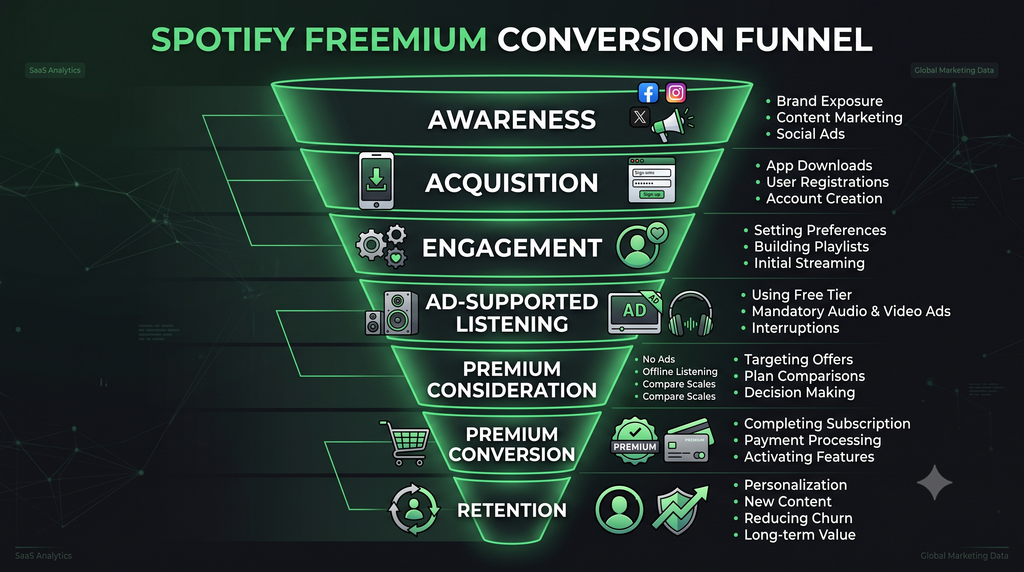
Stage 1: Awareness
Users discover Spotify through:
- Social media
- Advertising
- Influencers
- Partnerships
- Search
- Word of mouth
Stage 2: Acquisition
The user installs Spotify and creates an account.
Stage 3: Engagement
Personalized playlists and recommendations encourage repeated listening.
Stage 4: Monetization
Free users generate advertising revenue.
Stage 5: Premium Consideration
Spotify promotes Premium benefits.
Stage 6: Conversion
The user becomes a Premium subscriber.
Stage 7: Retention
Spotify continues delivering personalized value to keep the customer subscribed.
The source case study summarizes this journey as a progression from awareness to free usage, engagement and Premium conversion.
Spotify Digital Marketing Campaigns
Spotify has developed several notable campaigns and activations.
“Thanks 2016 — It’s Been Weird”
This campaign used real listening data and cultural moments to create humorous advertising.
Instead of generic advertising, Spotify connected actual listener behavior with events and conversations happening in the real world.
The campaign helped establish Spotify’s recognizable data-driven and humorous advertising style.
Wrapped OOH Campaign
Spotify took its data-driven approach offline through billboards and outdoor advertising.
The campaign combined:
Data + Humor + Culture + Creativity
This helped bridge traditional OOH advertising with digital and social media.
AUX Live
Spotify also used experiential marketing through music events.
The case study highlights the AUX Live “Music Depot” activation in Manchester as an example of community-oriented marketing.
AI DJ and New Mobile Experience
Spotify’s redesigned mobile experience and AI DJ demonstrated another important marketing principle:
Product innovation itself can become a marketing campaign.
Instead of only promoting discounts or subscriptions, Spotify can market new experiences that increase engagement and differentiation.
Spotify vs Apple Music vs Amazon Music vs YouTube Music
Spotify operates in an extremely competitive market.
Its major competitors include Apple Music, Amazon Music and YouTube Music.
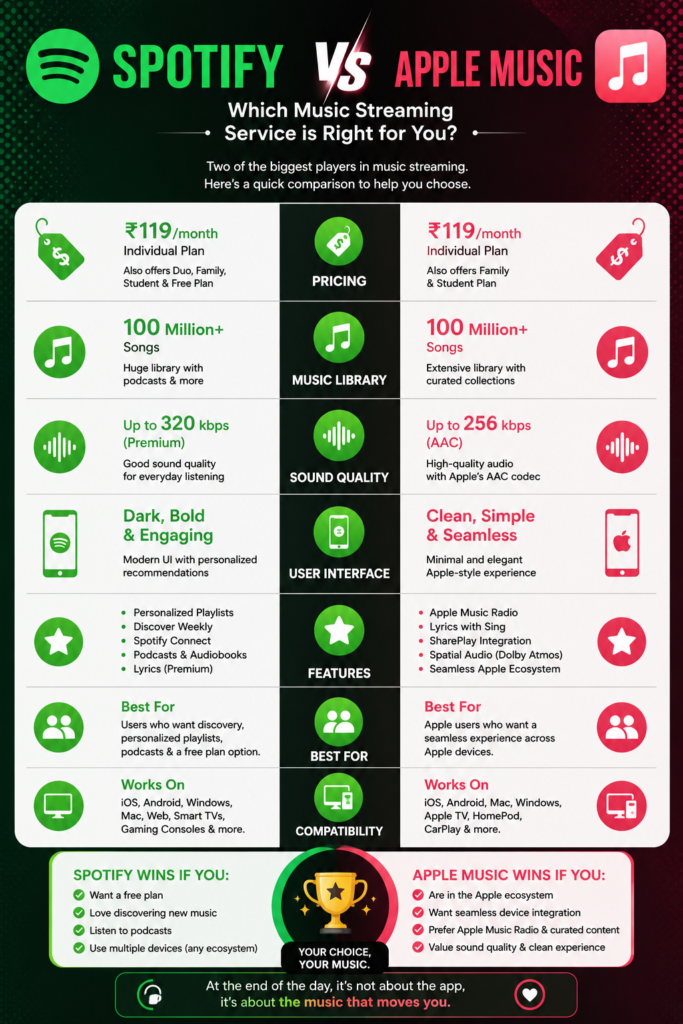
Spotify vs Apple Music
Spotify’s major advantages include:
- Freemium model
- Strong personalization
- Wrapped
- Social sharing
- Global reach
Apple Music’s strength comes from Apple’s broader ecosystem and hardware integration.
Spotify vs Amazon Music
Amazon Music benefits from Amazon Prime and Echo integration.
Spotify differentiates itself through discovery, personalization and social engagement.
Spotify vs YouTube Music
YouTube Music benefits from the massive YouTube ecosystem and video content.
Spotify’s differentiation comes from its audio experience, recommendation features and strong listening culture.
The uploaded comparison identifies Spotify’s social-viral ecosystem and personalization as important differentiators.
Challenges in Spotify’s Digital Marketing Strategy
Even a highly successful marketing strategy has risks.
Data Privacy
Spotify’s heavy use of user data creates privacy concerns.
Personalization can be powerful, but consumers need to understand how their information is being used.
Spotify therefore needs to balance:
Personalization ↔ Privacy
The source case study specifically identifies privacy backlash as a strategic risk.
Increasing Competition
Large technology companies can bundle music with other services.
This creates pressure on Spotify to continuously differentiate its product.
Market Saturation
In mature markets, acquiring completely new users becomes increasingly difficult.
Spotify therefore needs to focus on:
- Retention
- Product innovation
- New markets
- New content categories
- Better monetization
Advertising Growth
Spotify also needs to maximize the value of its free user base without damaging the user experience.
The case study identifies advertising growth as another important challenge.
What Businesses Can Learn From Spotify’s Digital Marketing Strategy
Spotify’s success provides valuable lessons for businesses of every size.
1. Personalization Beats Generic Marketing
Don’t communicate with everyone in exactly the same way.
Use customer behavior and preferences to make your marketing more relevant.
2. Turn Data Into Content
Data doesn’t have to remain hidden inside analytics dashboards.
Spotify turned listening data into a product people wanted to share.
Businesses can do the same with:
- Customer insights
- Annual reports
- Usage statistics
- Personalized recommendations
- Customer milestones
3. Make Your Customers Part of Your Marketing
The strongest marketing doesn’t always come from the brand.
Sometimes it comes from customers.
Create experiences that people naturally want to share.
4. Build Shareability Into the Product
Don’t wait for customers to create content.
Make sharing easy.
Spotify’s Wrapped experience demonstrates the power of built-in social distribution.
5. Test Before You Scale
Spotify’s experimentation culture shows the importance of A/B testing.
Instead of asking:
“What do we think will work?”
Ask:
“What does the data show works?”
6. Build a Marketing Ecosystem
Spotify doesn’t rely exclusively on Instagram, Google Ads or email.
It connects:
SEO + Social + Content + Product + Email + Push + Influencers + Partnerships + OOH
That creates a stronger customer journey.
How UPMARKE Can Apply Spotify’s Marketing Lessons
Spotify’s strategy provides a useful framework for modern businesses.
At UPMARKE, the broader lesson is not that every business needs to copy Spotify.
The lesson is that marketing should be built around understanding the customer.
A strong digital marketing strategy can combine:
- SEO
- AEO
- Social Media
- Performance Marketing
- Web Design
- Branding
- Content Strategy
- Data Analysis
- Conversion Optimization
The objective should not simply be more impressions.
It should be:
More relevant traffic → Better engagement → More leads → More conversions → Stronger brand growth.
Key Takeaways From the Spotify Digital Marketing Case Study
Spotify’s growth demonstrates several powerful principles.
Personalization Creates Relevance
When marketing feels personal, users are more likely to engage.
Data Can Become Marketing Content
Spotify turned user data into one of its most recognizable campaigns.
Virality Can Be Designed
Shareable experiences can create organic distribution.
Product and Marketing Can Work Together
Spotify’s product features themselves drive discovery, engagement and retention.
Experimentation Reduces Guesswork
A/B testing helps marketers make decisions based on evidence.
Freemium Can Drive Growth
A free entry point can reduce acquisition friction while creating opportunities for advertising and Premium conversion.
Conclusion: What Makes Spotify’s Digital Marketing Strategy So Successful?
Spotify’s digital marketing strategy is successful because it goes beyond traditional advertising.
It combines data, personalization, technology, creativity, social media and product experience into one connected growth system.
The most powerful lesson from Spotify isn’t simply Wrapped.
It’s the philosophy behind Wrapped:
Understand your audience. Turn that understanding into something valuable. Make it personal. Make it easy to share. Then let your customers help distribute your brand.
That is what transforms digital marketing from a collection of advertisements into a growth engine.
For businesses looking to build a stronger digital presence, Spotify provides a powerful example of how customer data, creative marketing and technology can work together to create long-term brand growth.

Leave a Reply