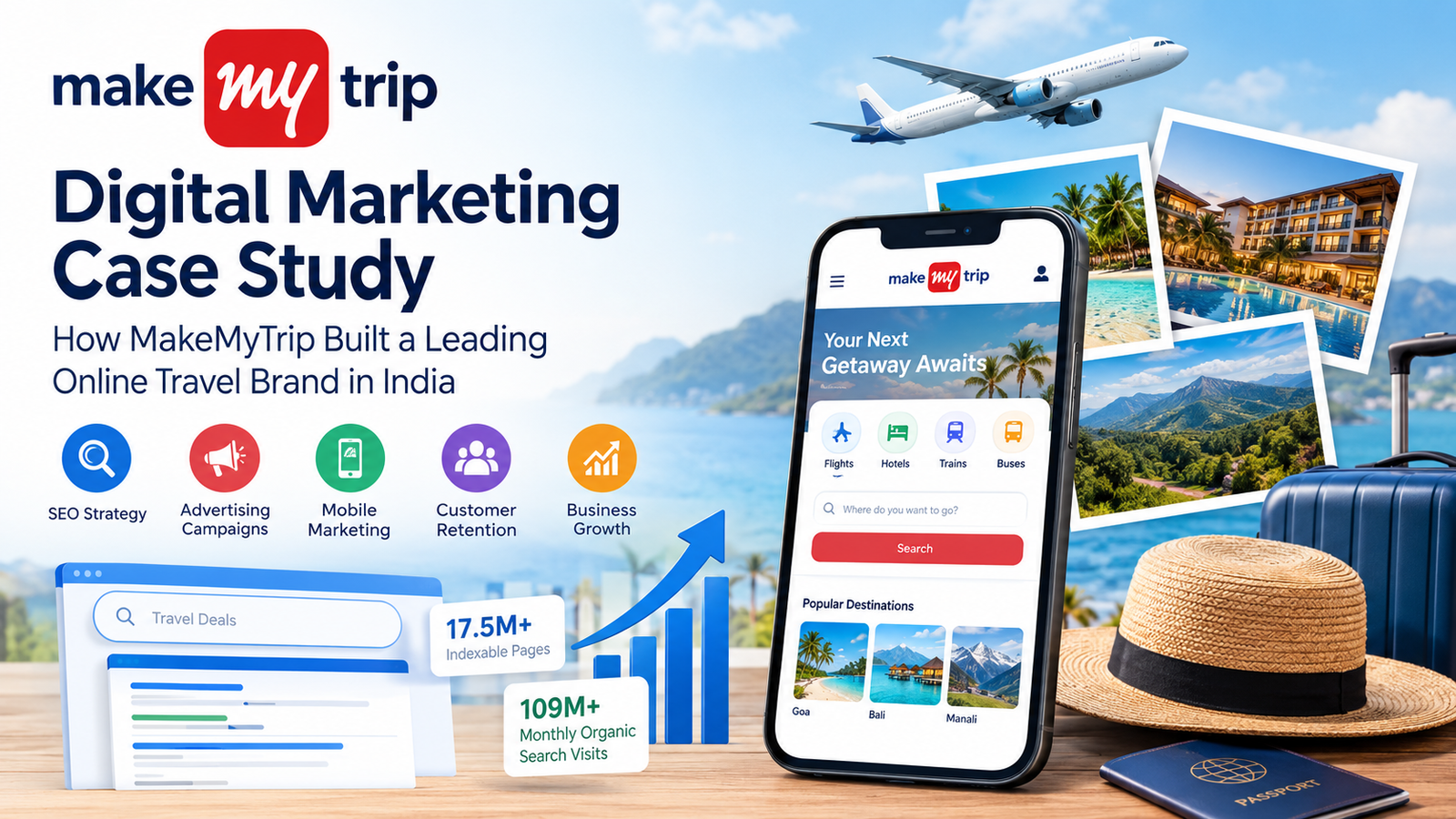
MakeMyTrip Digital Marketing Case Study: How MakeMyTrip Built a Leading Online Travel Brand in India
A closer look at the connected growth model behind MakeMyTrip—from search visibility and brand advertising to mobile experiences, customer retention and AI-assisted travel planning.
Introduction: The Digital Marketing Strategy Behind MakeMyTrip
Imagine planning a holiday, comparing flight prices, booking a hotel, reserving a bus ticket, and organizing an entire trip without visiting a travel agent. Today, this experience feels normal. However, when online travel booking was still unfamiliar to many Indian consumers, convincing people to trust a digital platform with their travel plans was a significant challenge.
This is where MakeMyTrip built its opportunity.
Founded in 2000 by Deep Kalra, MakeMyTrip evolved from an online ticketing service initially serving Non-Resident Indians travelling between the United States and India into a major online travel platform serving customers across multiple travel categories.
Its growth story is not simply about advertising more or offering cheaper tickets. It demonstrates how a business can combine search engine optimization (SEO), customer trust, performance marketing, mobile technology, strategic acquisitions, and customer retention to build a strong digital presence.
The MakeMyTrip digital marketing case study offers valuable lessons for businesses that want to attract customers online, convert website visitors into paying customers, and encourage repeat purchases.
Rather than depending on a single marketing channel, MakeMyTrip developed an interconnected growth model in which search visibility attracts potential travellers, advertising builds brand awareness, convenient booking experiences support conversions, and related services create opportunities for additional revenue.
1. The Beginning: Identifying an Opportunity in Online Travel
MakeMyTrip was established in April 2000. During its early years, the company focused on the US–India travel corridor, serving NRIs who were comparatively comfortable with online transactions and international payment systems.
This initial focus addressed a practical business problem. Online payments and consumer confidence in digital transactions were less developed in India at the time, making a broad domestic launch more challenging.
Instead of trying to serve every traveller immediately, the company started with a customer segment that was better suited to its online booking model.
In September 2005, MakeMyTrip launched its India-facing travel portal. Its timing coincided with the emergence of low-cost airlines, which made air travel accessible to more consumers.
Travellers could increasingly compare fares and flight schedules online instead of relying entirely on traditional travel agents.
MakeMyTrip positioned itself as a convenient platform for discovering and booking flights. It subsequently expanded into hotel reservations, holiday packages, rail bookings, and bus ticketing.
The marketing lesson: Growth begins with understanding the customer and the problem being solved. Businesses do not always need to target the largest possible audience from day one. A clearly defined customer segment can provide a practical starting point for building a scalable digital business.
2. MakeMyTrip’s Business Expansion and Brand Evolution
MakeMyTrip’s growth involved several important milestones that expanded both its services and its digital reach.
| Year | Major development | Strategic significance |
|---|---|---|
| 2000 | Company founded | Established its online travel business |
| 2005 | Domestic Indian portal launched | Entered the growing Indian online travel market |
| 2010 | Listed on NASDAQ | Accessed public-market capital |
| 2013 | Mobile applications expanded its reach | Supported the shift towards mobile bookings |
| 2015 | Introduced the “Dil Toh Roaming Hai” brand platform | Encouraged more frequent, spontaneous travel |
| 2016 | Acquired the ibibo Group, including Goibibo and redBus | Expanded its consumer brands and transport categories |
| 2022 | Acquired a majority stake in BookMyForex | Extended services into travel-related foreign exchange |
| 2024 | Acquired corporate expense platform Happay | Expanded its corporate travel and expense management capabilities |
These developments illustrate an important distinction: a digital marketing strategy does not operate independently of the business model. A broader range of services creates more opportunities to acquire customers, satisfy different needs, and encourage repeat transactions.
By maintaining MakeMyTrip, Goibibo, and redBus as distinct consumer-facing brands, the group could serve different travel preferences while benefiting from a wider business ecosystem.
3. MakeMyTrip’s SEO Strategy: Capturing Customers Through Search
Search engine optimization is one of the most interesting aspects of the MakeMyTrip digital marketing case study.
Travel planning naturally generates a large number of search queries. People search for flight prices, specific routes, hotels near landmarks, budget accommodation, holiday destinations, and travel itineraries.
Each query represents a different customer need.
A person searching for “Delhi to Mumbai flights” may be close to booking a ticket. Someone searching for “best places to visit in Munnar” may still be researching destinations.
MakeMyTrip’s search strategy is designed to serve users across these different stages of the travel journey.
Programmatic SEO: Creating Pages for Specific Search Intent
Programmatic SEO uses structured data and repeatable page templates to create useful landing pages for large numbers of related search queries.
For example, a travel platform may develop dedicated pages for:
- Flights between Delhi and Mumbai.
- Hotels in Goa.
- Hotels near Baga Beach.
- Family resorts in Munnar.
- Pet-friendly accommodation in Lonavala.
- Places to visit in a particular destination.
Instead of creating every page manually, the platform can use databases containing destinations, routes, accommodation information, and amenities to populate appropriate page templates.
This approach allows a website to address many specific searches without relying entirely on a small number of broad landing pages.
The research dossier estimates that MakeMyTrip has more than 17.5 million indexable URLs and receives over 109 million monthly organic search visits. These are third-party estimates, not figures that should be treated as independently verified company-reported website analytics. <FileCite ref_id="turn0file0" />
How MakeMyTrip’s Programmatic SEO Model Works
The underlying approach can be understood through four stages:
Step 1: Identify search demand
Find the routes, destinations, accommodation types, and travel questions that users search for.
Step 2: Organize structured information
Maintain relevant data about locations, available services, property features, transport routes, and other useful attributes.
Step 3: Build targeted landing pages
Create pages that answer specific searches and help visitors move towards comparing or booking travel options.
Step 4: Connect related pages
Use contextual internal links to connect destination guides, hotel listings, flight pages, and booking interfaces.
The objective is not simply to publish more pages. It is to make relevant information discoverable and help visitors complete the task that brought them to the website.
What Businesses Can Learn from This SEO Strategy
The same principle can be adapted to smaller businesses, including digital marketing agencies, jewellery brands, real estate companies, and local service providers.
For example, a digital marketing agency could create useful pages for:
- SEO services for jewellery businesses.
- Digital marketing for real estate companies.
- Local SEO services in specific cities.
- Social media marketing for restaurants.
- Website design for professional service providers.
However, every landing page must offer genuine value. Publishing hundreds of nearly identical pages with little original information can create quality problems instead of sustainable search visibility.
For UPMARKE, the practical lesson is to build focused service pages around real customer needs, support them with relevant articles, and connect them through a logical internal-linking structure.
4. Brand Advertising: Turning Customer Concerns into Marketing Opportunities
Search visibility helps customers discover a platform, but discovery alone does not guarantee a booking.
Travel involves financial commitments and uncertainty. A customer may find an attractive hotel online but hesitate because of concerns about room quality, unexpected charges, cancellation policies, or the possibility of a denied check-in.
MakeMyTrip’s advertising strategy increasingly addressed these concerns directly.
From “Wish Click Go” to “Dil Toh Roaming Hai”
The company’s brand messaging evolved as online travel became more familiar to Indian consumers.
“Wish Click Go”
The early positioning emphasized the convenience of booking travel online. It helped communicate the basic proposition that customers could search for and purchase tickets digitally.
“Memories Unlimited”
The brand subsequently connected travel with family holidays, celebrations, and memorable experiences. This shifted its communication beyond transactions towards emotional associations.
“Dil Toh Roaming Hai”
Introduced in 2015, this campaign encouraged people to view travel as something they could enjoy more frequently, rather than an activity reserved for one major annual holiday.
These campaigns illustrate how a brand can evolve its messaging as its audience’s expectations and habits change.
“Befikar Book Kar”: Addressing the Fear of Booking Online
In 2016, MakeMyTrip introduced its “Befikar Book Kar” campaign, featuring Ranveer Singh and Alia Bhatt.
The creative approach used humour and character-driven situations to address common concerns about booking accommodation online.
Rather than relying only on beautiful destination imagery, the campaigns focused on the practical questions travellers might have before making a reservation.
The broader marketing principle is straightforward: customers are more likely to consider a product when a business clearly explains how it addresses their concerns.
For an online retailer, that might mean explaining delivery timelines and return policies. For a digital marketing agency, it might mean demonstrating the work process, communicating realistic expectations, and showing how performance will be measured.
The strongest message is not necessarily the loudest one. It is the one that answers the customer’s most important question.
5. Performance Marketing: Balancing Customer Acquisition and Profitability
Performance marketing allows businesses to target people who are actively searching for products or services and measure the results of their campaigns.
For a travel platform, paid search can help attract users looking for specific flights, hotels, or holiday packages.
However, the economics of these categories are different.
A flight booking may generate a relatively small margin, while a hotel reservation or bundled holiday package may offer greater earning potential.
According to the supplied research, MakeMyTrip’s FY2025 adjusted margin percentages were approximately 6.1%–6.5% for air ticketing and 17.7%–17.9% for hotels and packages. These figures describe the research dossier’s reported adjusted-margin measure, not the company’s net profit margin. <FileCite ref_id="turn0file0" />
This difference helps explain why customer acquisition should be evaluated in the context of the broader business.
How the Strategy Works
Consider a simplified customer journey:
- A traveller discovers MakeMyTrip while searching for a flight.
- The traveller books a ticket through the platform.
- The platform offers relevant hotel options for the destination.
- The customer may later book airport transfers, activities, or a holiday package.
- A positive experience may encourage another booking.
The initial flight booking can introduce the customer to the platform, while relevant additional services create further opportunities to generate revenue.
This is a cross-selling strategy: using an existing customer relationship to introduce complementary products.
Why This Matters for Digital Marketers
A campaign should not be evaluated solely by the number of clicks, impressions, or leads it generates.
Businesses should also examine:
- Cost per acquired customer.
- Conversion rate.
- Average order value.
- Revenue and margin per customer.
- Repeat purchase rate.
- Customer lifetime value.
For example, an agency that generates 100 leads is not necessarily performing better than one that generates 40 leads. If the second agency attracts more qualified prospects who become paying clients, its acquisition strategy may be more effective.
The objective is profitable growth, not traffic for its own sake.
6. Mobile Marketing and Customer Retention
The expansion of smartphones changed how people discover, compare, and book travel.
MakeMyTrip introduced its mobile applications in 2013, positioning itself to serve customers who increasingly preferred completing transactions through their phones.
Mobile applications offer several retention opportunities that traditional website visits may not provide as directly.
Push Notifications and Relevant Recommendations
After a flight booking, a customer may need a hotel, airport transfer, or local activity. Timely recommendations can help users discover these services without starting a completely new search.
The value of this approach depends on relevance. A recommendation that matches the customer’s destination and travel plans can be useful, while excessive or poorly timed notifications can become intrusive.
Loyalty and Repeat Bookings
MakeMyTrip’s MMT Black programme is another example of a retention-oriented approach.
Loyalty programmes encourage customers to continue using a platform by offering benefits linked to their booking activity and relationship with participating suppliers.
For businesses in other industries, the same principle can be applied through membership benefits, service upgrades, exclusive offers, or rewards for repeat purchases.
The key is to give customers a meaningful reason to return beyond repeatedly offering discounts.
7. AI-Powered Travel Planning: The Role of Myra
Travel planning can be complicated. Customers may have a budget, preferred amenities, family requirements, location preferences, and several possible travel dates.
Traditional search forms often require users to enter these preferences into separate filters.
MakeMyTrip’s Myra assistant aims to make travel discovery more conversational. The supplied research describes a 2026 upgrade involving OpenAI APIs, enabling natural-language trip-planning interactions. <FileCite ref_id="turn0file0" />
For example, a traveller might ask:
“Find a family-friendly resort in Munnar with a swimming pool, tea plantation views, and a budget below ₹6,000 per night.”
A conversational booking experience can interpret these preferences and help the traveller explore relevant options.
Why Conversational AI Matters in Digital Marketing
AI-assisted discovery can reduce friction during the research stage and help users express their needs in everyday language.
It also illustrates a wider shift in digital marketing: businesses are increasingly expected to make information easier to discover, compare, and act upon.
For brands, useful AI applications may include:
- Answering common customer questions.
- Recommending relevant products or services.
- Helping visitors navigate large catalogues.
- Supporting customer service.
- Simplifying the process of comparing available options.
AI is most useful when it improves the customer experience and provides reliable information. Adding a chatbot without solving a real customer problem does not automatically create a competitive advantage.
8. Moment Marketing: Connecting Travel with Current Events
Moment marketing involves creating campaigns around relevant events, cultural conversations, seasonal trends, or changes in public interest.
MakeMyTrip’s “Beaches of India” initiative, launched in January 2024, promoted Indian coastal destinations, including Lakshadweep and the Andaman Islands, during heightened interest in domestic beach tourism.
The research dossier reports a 3,400% increase in platform searches for Lakshadweep associated with this initiative. This should be understood as a reported campaign-related search increase, not as proof that the campaign alone caused every additional search. <FileCite ref_id="turn0file0" />
What Made the Approach Relevant?
The initiative connected an existing consumer interest with destinations that travellers could explore through the platform.
For a travel business, this creates a natural connection between current interest, destination discovery, and booking opportunities.
Other businesses can apply a similar approach by responding quickly to relevant events, seasonal demand, or emerging customer interests.
However, moment marketing also carries risks. A campaign linked to a sensitive event can attract criticism if its tone is perceived as inappropriate or opportunistic.
MakeMyTrip’s 2023 World Cup “Open Letter” campaign, directed towards visiting Pakistani cricket fans, received attention but also faced public criticism, according to the supplied research.
The lesson is that reach and engagement should not be the only measures of campaign success. Brand reputation, audience sentiment, and contextual sensitivity matter too.
9. MakeMyTrip’s Financial Growth: What the Numbers Reveal
The company’s reported financial performance provides context for its broader business strategy.
The following figures are taken from the supplied research dossier, which attributes the financial metrics to company disclosures and earnings releases.
| Financial metric | FY2023 | FY2024 | FY2025 |
|---|---|---|---|
| Gross bookings | $6,566.2 million | $7,954.4 million | $9,803.1 million |
| IFRS revenue | $593.0 million | $782.5 million | Approximately $993.4 million |
| Adjusted operating profit | $70.3 million | $124.2 million | $167.3 million |
Source basis: supplied MakeMyTrip research dossier. Figures are in US dollars; fiscal years end on March 31. Adjusted operating profit is a non-IFRS performance measure. <FileCite ref_id="turn0file0" />
The reported figures show growth in gross bookings, recognized revenue, and adjusted operating profit between FY2023 and FY2025.
Gross bookings increased from approximately $6.57 billion to $9.80 billion during this period.
Adjusted operating profit also rose, from $70.3 million to $167.3 million.
These results are consistent with a business benefiting from recovering travel demand, a broad service portfolio, and greater operating efficiency. They do not, by themselves, establish that any single marketing campaign or SEO initiative caused the financial improvement.
The Important Marketing Takeaway
Marketing investment should be assessed alongside business outcomes.
More traffic is valuable when it attracts relevant visitors. More bookings are valuable when they contribute to sustainable economics. More customers are valuable when the business can serve them effectively and encourage repeat transactions.
MakeMyTrip’s reported performance highlights the importance of connecting acquisition, monetization, and operating efficiency rather than treating marketing as an isolated activity.
10. Challenges and Risks in MakeMyTrip’s Growth Strategy
Even a leading digital platform faces competition and regulatory scrutiny.
The supplied research identifies several challenges that provide important lessons for businesses building digital marketplaces.
Regulatory and Partner Relationships
In October 2022, the Competition Commission of India imposed a ₹223.48 crore penalty on MakeMyTrip-Goibibo over competition-related concerns involving hotel rate parity and the exclusion of competing accommodation providers.
The research notes that the company challenged the order and that the Delhi High Court granted an interim stay on most of the penalty after a deposit. The final legal outcome should not be inferred from that interim relief. <FileCite ref_id="turn0file0" />
For digital platforms, the broader lesson is that commercial agreements and ranking systems can affect suppliers, competitors, and consumer choice. Growth strategies must account for fair competition, transparency, and regulatory requirements.
Rising Customer Acquisition Costs
Digital advertising can become more expensive as competitors bid for the same search terms and audiences.
A business that depends entirely on paid acquisition may find it increasingly difficult to maintain profitability.
Search visibility, brand recall, customer retention, and referral traffic can diversify acquisition channels, although each requires ongoing investment.
Direct Competition
Travellers can book directly with airlines and hotels or compare offers through competing platforms.
This means MakeMyTrip must provide value beyond simply displaying available inventory. Convenience, customer support, useful discovery tools, booking flexibility, and a strong user experience all matter.
The broader lesson is that digital growth requires continuous improvement. A strong market position today does not remove the need to earn customers’ trust tomorrow.
11. Five Digital Marketing Lessons Businesses Can Learn from MakeMyTrip
MakeMyTrip’s strategy offers several principles that businesses of different sizes can adapt.
Lesson 1: Build SEO Around Customer Intent
Understand what potential customers search for at different stages of their buying journey.
Create useful service pages, comparison content, destination guides, and FAQs that address those needs.
Prioritize relevance and quality over publishing a large volume of repetitive pages.
Lesson 2: Address Objections Before Asking for a Sale
Identify the reasons customers hesitate before purchasing.
These may include pricing uncertainty, unclear terms, limited trust, poor communication, or concerns about the quality of the service.
Use website content, testimonials, transparent policies, and clear explanations to address those concerns.
Lesson 3: Connect Customer Acquisition with Long-Term Value
Do not measure every campaign only by its initial conversion.
Think about how the first purchase can lead to a repeat purchase, a complementary service, or a longer-term customer relationship.
Build relevant cross-selling opportunities rather than sending generic promotions to every customer.
Lesson 4: Make the Customer Journey Easier
Simplify navigation, reduce unnecessary steps, make important information easy to find, and provide timely assistance.
A well-designed website or application can support conversions by removing friction that might otherwise cause customers to abandon the process.
Lesson 5: Measure What Contributes to Business Growth
Track organic traffic, qualified leads, conversion rates, acquisition costs, revenue, and repeat purchases.
Use these measures to understand which channels and activities contribute to sustainable results.
Marketing decisions should be guided by evidence rather than vanity metrics alone.
12. How UPMARKE Can Apply These Lessons to Business Growth
For UPMARKE, the MakeMyTrip digital marketing case study demonstrates how SEO, customer understanding, and conversion-focused marketing can work together.
The same principles can be adapted for jewellery brands, real estate businesses, professional services, local businesses, and other companies looking to grow online.
A practical framework is to follow five stages.
Understand: Study the business, its audience, competitors, services, and customer concerns.
Identify: Determine the search opportunities, conversion barriers, and marketing channels most relevant to the business.
Strategise: Build an integrated plan covering SEO, content, website experience, social media, and performance marketing.
Execute: Publish useful content, develop focused landing pages, run appropriate campaigns, and improve the customer journey.
Measure: Review traffic quality, qualified enquiries, conversion rates, and business outcomes. Refine the strategy based on what the data reveals.
This approach reflects an important principle: effective digital marketing starts with understanding the business rather than applying the same tactics to every client.
For a jewellery brand, that may mean building trust through product information, local SEO, and visual content. For a real estate business, it may involve location-specific landing pages and qualified lead generation. For a professional service provider, it may mean demonstrating expertise through educational articles, clear service pages, and credible customer reviews.
The channels may differ, but the underlying objective remains the same: attract the right audience, earn its trust, and make it easier to become a customer.
Conclusion: What Makes MakeMyTrip’s Digital Marketing Strategy Effective?
MakeMyTrip’s journey from an online ticketing service to a broad travel platform illustrates how digital growth can emerge from several connected strategies rather than one isolated campaign.
Its evolution combines targeted customer acquisition, search visibility, brand advertising, mobile engagement, complementary services, and customer retention.
Its advertising campaigns addressed concerns about booking online. Its SEO approach targets a wide range of travel-related search intent. Its broader service portfolio creates opportunities to introduce customers to complementary products. Its reported financial performance highlights the importance of connecting business growth with operating economics.
At the same time, its competitive and regulatory challenges show why scale alone is not enough. Sustainable growth requires transparency, a reliable customer experience, continuous improvement, and responsible business practices.
For businesses seeking to strengthen their digital presence, the central lesson is clear: successful digital marketing is not just about attracting more visitors. It is about understanding customer needs, earning trust, converting attention into action, and building relationships that create long-term value.
At UPMARKE, this is the foundation of a growth-focused approach to SEO, website design, content strategy, social media, and performance marketing.
We don’t just market businesses. We understand them.
Frequently Asked Questions (FAQs)
1. What is the MakeMyTrip digital marketing case study about?
The MakeMyTrip digital marketing case study examines how the company developed its online travel business through search engine optimization, advertising campaigns, mobile marketing, customer retention, cross-selling, and technology-led customer experiences.
2. What SEO strategy does MakeMyTrip use?
Its search strategy includes programmatic landing pages for routes, destinations, hotels, and travel-related queries, supported by structured information and internal linking. The objective is to help users discover relevant travel options through organic search.
3. What made MakeMyTrip’s “Befikar Book Kar” campaign important?
The campaign used humour and character-driven advertising to address concerns about hotel quality, payment safety, and booking reliability. It illustrates how marketing can reduce customer hesitation by addressing specific objections.
4. How does MakeMyTrip use cross-selling?
The platform can introduce customers who initially book flights or other transport services to complementary offerings, such as hotels, holiday packages, and airport transfers. This creates additional opportunities to serve customers and generate revenue.
5. Why is programmatic SEO useful for travel websites?
Travel websites can target a wide variety of specific searches involving routes, locations, accommodation types, and amenities. Programmatic SEO can help create relevant pages at scale when the pages contain useful information and serve distinct search needs.
6. What can small businesses learn from MakeMyTrip?
Small businesses can learn to target specific customer needs, build useful SEO landing pages, communicate trust clearly, improve their website experience, develop repeat-customer relationships, and measure marketing performance against business outcomes.
7. How does MakeMyTrip use AI in travel planning?
The supplied research describes Myra as a conversational trip-planning assistant designed to help users express preferences in natural language and explore relevant travel options. The practical goal is to simplify discovery and reduce friction in the booking journey.
8. What is the biggest lesson from MakeMyTrip’s growth?
The biggest lesson is that sustainable digital growth requires an integrated strategy. SEO, advertising, customer experience, cross-selling, retention, and profitability should support one another instead of operating as disconnected marketing activities.
About UPMARKE
UPMARKE is a digital marketing and growth agency focused on helping businesses strengthen their online presence through SEO, website design, social media, content strategy, and performance marketing.
The agency’s approach begins with understanding the business, identifying growth opportunities, developing a strategy, executing the plan, and measuring results.
Explore UPMARKE’s services at https://upmarke.in/ or get in touch at https://upmarke.in/contact-us/.

Daksh Toor
Daksh Toor focuses on how businesses can use SEO, social media, content and digital experiences as part of a connected growth system. At UPMARKE, the approach starts with understanding the business, identifying growth opportunities and connecting the right digital channels to those objectives.
We don’t just market businesses. We understand them.
Explore how a business-first approach can connect SEO, website experience, content and performance marketing around your goals.
Talk to UPMARKEEditorial note: This article presents the supplied research dossier’s figures and campaign interpretations as reported in the source material. Third-party traffic estimates and campaign-related figures should not be treated as independently verified company analytics or proof of sole causation. Financial and regulatory details should be checked against primary company disclosures and official records before being relied on for formal decisions.

Leave a Reply