If you want your website to stay visible as search evolves, learning how to optimize content for ChatGPT should be part of your 2026 content strategy.
People are increasingly using AI-powered tools to research topics, compare businesses, discover products, and answer questions. This means brands need to think beyond traditional Google rankings and create content that is useful for both search engines and AI-powered answer experiences.
But optimizing content for ChatGPT isn’t about stuffing keywords into an article or trying to trick an AI system. The better approach is to publish accurate, useful, well-structured, authoritative content that directly answers the questions your audience is asking.
In this guide, you’ll learn how to optimize content for ChatGPT while strengthening your SEO, AEO, and GEO strategy.
What Does Optimizing Content for ChatGPT Mean?
How to optimize content for ChatGPT essentially means creating online content that is clear, useful, trustworthy, relevant, and easy for AI-powered search experiences to understand.
Traditional SEO focuses on improving a website’s visibility in search engines.
AEO, or Answer Engine Optimization, focuses on providing direct answers to questions.
GEO, or Generative Engine Optimization, focuses on improving the visibility and usefulness of content within generative AI search experiences.
These strategies overlap.
The objective is to create content that genuinely deserves to be discovered, referenced, and recommended.
Can You Rank in ChatGPT?
ChatGPT doesn’t work exactly like a traditional Google search results page.
There isn’t a universal “position #1” that you can guarantee for a website inside every ChatGPT answer.
When AI-powered search experiences use online information, the sources considered can vary depending on the query, relevance, authority, freshness, and available information.
That means there is no secret keyword density or guaranteed technique for appearing in ChatGPT.
However, businesses can improve their chances of being discovered by creating high-quality content that clearly answers real user questions and provides useful information.
How to Optimize Content for ChatGPT
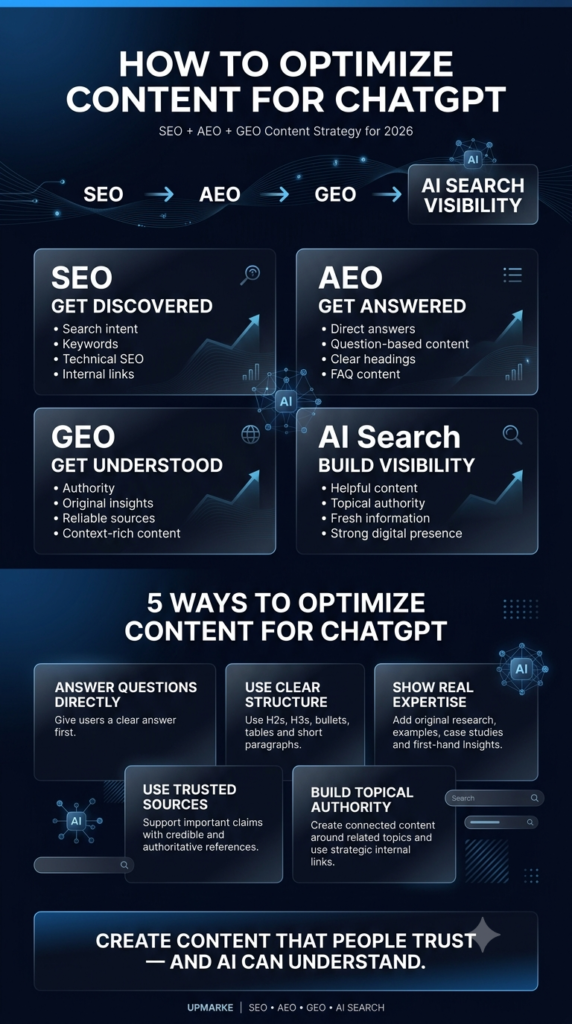
1. Answer the Main Question First
One of the simplest ways to improve your content is to answer the reader’s main question immediately.
For example:
How do you optimize content for ChatGPT?
Optimize content for ChatGPT by creating accurate, authoritative, well-structured content that directly answers user questions and follows strong SEO and content-quality practices.
Then explain the topic in greater detail.
This answer-first structure benefits readers because they don’t have to search through several paragraphs to find the information they need.
2. Use Clear Headings
Your article should have a logical hierarchy.
Use one H1 for the primary topic and organize the rest of the content with H2 and H3 headings.
For example:
- What Is ChatGPT Content Optimization?
- Can You Rank in ChatGPT?
- How to Optimize Content for ChatGPT
- SEO vs AEO vs GEO
- Common Mistakes
- Frequently Asked Questions
Clear headings help readers navigate long content and make the subject of each section easier to understand.
3. Target Real Questions
AI users often search using complete questions rather than short keywords.
Instead of only targeting:
ChatGPT SEO
you could answer questions such as:
- How can I optimize my website for ChatGPT?
- How does AI search find websites?
- Can SEO help my website appear in AI answers?
- How do I create AI-friendly content?
Research the questions your customers actually ask.
Then build useful sections around those questions.
4. Demonstrate First-Hand Expertise
Generic content is easy to produce.
Useful expertise is much harder to replicate.
Add information that demonstrates genuine experience, such as:
- Original research
- Case studies
- Campaign examples
- Screenshots
- Data
- Expert opinions
- Practical processes
- Lessons from real projects
For example, a digital marketing agency can explain how it approaches keyword research, technical SEO, content strategy, conversion optimization, and AI-search visibility.
This makes the content more valuable than a generic definition copied from dozens of other websites.
5. Support Claims With Reliable Sources
Whenever you include statistics, research findings, industry data, or important factual claims, use trustworthy sources.
Good sources can include:
- Official documentation
- Government websites
- Academic research
- Industry organizations
- Original studies
- Recognized publications
Don’t add links just to make an article look authoritative.
Every important source should genuinely support the statement you’re making.
6. Make Important Information Easy to Understand
AI-friendly content doesn’t need to sound robotic.
It simply needs to be organized.
Use:
- Short paragraphs
- Bullet points
- Numbered steps
- Tables
- Definitions
- Examples
- FAQs
- Direct answers
For example:
What is AEO?
AEO, or Answer Engine Optimization, is the practice of creating content that clearly answers questions users ask through search engines and AI-powered answer platforms.
Then expand on the concept.
7. Build Topical Authority
Don’t rely on one article to cover an entire subject.
Create a connected content cluster.
For example, if your main topic is AI search optimization, publish supporting articles such as:
- What Is AEO?
- What Is GEO?
- SEO vs AEO vs GEO
- How to Optimize for Google AI Overviews
- How AI Search Is Changing SEO
- How to Create AI-Friendly Content
Connect relevant articles using internal links.
This creates a stronger topical structure and gives readers more useful information.
8. Optimize for Conversational Search
People often phrase questions differently when speaking to an AI.
Traditional search:
digital marketing agency Delhi
Conversational search:
What should I look for when choosing a digital marketing agency in Delhi?
Create content that naturally answers these longer questions.
This can help you target long-tail searches while making your content more useful for conversational AI experiences.
9. Keep Content Updated
AI search and digital marketing change quickly.
Don’t publish an article and forget about it.
Review important pages periodically and update:
- Statistics
- Dates
- Examples
- Screenshots
- Tools
- Strategies
- Industry developments
- Internal links
If an article contains outdated information, update it when the underlying facts or recommendations have changed.
10. Continue Doing Traditional SEO
Optimizing content for ChatGPT doesn’t mean abandoning Google SEO.
Your foundation should still include:
- Search intent
- Keyword research
- SEO titles
- Meta descriptions
- Internal links
- Technical SEO
- Mobile usability
- Page speed
- Image optimization
- Helpful content
- Clear site structure
Think of modern search optimization as an ecosystem.
SEO helps people discover your content.
AEO helps your content answer questions.
GEO helps you think about visibility in generative AI experiences.
SEO vs AEO vs GEO for ChatGPT
| Strategy | Primary purpose |
|---|---|
| SEO | Improve visibility in traditional search |
| AEO | Provide direct answers to questions |
| GEO | Optimize for generative AI search experiences |
You don’t necessarily have to choose one.
A modern content strategy can combine all three.
Create content that satisfies search intent, answers questions directly, demonstrates expertise, and provides enough depth to be genuinely useful.
How to Structure an AI-Friendly Article
A simple structure can make your content easier to understand.
Start with the primary question.
Give a short direct answer.
Then provide detailed explanations, examples, supporting evidence, and actionable steps.
Finish with related questions and FAQs.
For example:
H1: How to Optimize Content for ChatGPT
H2: What Does ChatGPT Content Optimization Mean?
H2: Can You Rank in ChatGPT?
H2: How to Optimize Content for ChatGPT
H3: Answer the Main Question First
H3: Use Clear Headings
H3: Build Topical Authority
H2: SEO vs AEO vs GEO
H2: Common Mistakes
H2: ChatGPT Optimization Checklist
H2: FAQs
This structure creates a logical journey for both readers and search engines.
Common ChatGPT SEO Mistakes
Avoid assuming that AI search optimization means publishing hundreds of AI-generated articles.
Common mistakes include:
- Keyword stuffing
- Publishing generic AI-generated content
- Rewriting competitors without adding value
- Making unsupported claims
- Using outdated statistics
- Ignoring search intent
- Creating unnecessary long-form content
- Trying to manipulate AI systems
- Ignoring traditional SEO
The goal isn’t to create content that sounds like it was written for an AI.
The goal is to create content that is genuinely useful to people and easy for modern search systems to understand.
ChatGPT Content Optimization Checklist
Before publishing, check the following:
✓ Does the article answer the main question?
✓ Is the information accurate?
✓ Is the focus keyword used naturally?
✓ Are the headings descriptive?
✓ Are important answers easy to find?
✓ Does the content demonstrate expertise?
✓ Are important claims supported?
✓ Does the article satisfy search intent?
✓ Are related questions answered?
✓ Are internal links included?
✓ Is the page mobile-friendly?
✓ Are the title and meta description optimized?
✓ Is the content original and useful?
Conclusion
Learning how to optimize content for ChatGPT is becoming increasingly relevant as people change how they discover information online.
There isn’t a magic keyword density, secret prompt, or guaranteed method that makes ChatGPT recommend a particular website.
Instead, focus on fundamentals that remain valuable across search platforms.
Answer questions clearly. Demonstrate expertise. Use reliable information. Structure content logically. Build topical authority. Keep important pages updated and maintain strong SEO fundamentals.
The future of search isn’t simply traditional SEO versus AI search.
It is about creating content that can serve users across the entire search ecosystem.
For businesses, combining SEO, AEO, and GEO principles can create a more resilient content strategy for the changing search landscape.
Frequently Asked Questions
How do I optimize content for ChatGPT?
To optimize content for ChatGPT, create accurate, authoritative, well-structured content that directly answers user questions and provides useful information supported by credible sources.
Can SEO help my website appear in ChatGPT?
Strong SEO can help make your website discoverable online, but there is no guaranteed method for appearing in every ChatGPT answer. Relevance, authority, content quality, freshness, and the specific search experience can influence which information is surfaced.
What is ChatGPT SEO?
ChatGPT SEO generally refers to strategies for making website content more useful and discoverable in AI-powered search experiences while maintaining traditional SEO best practices.
What is the difference between SEO and AEO?
SEO primarily focuses on visibility in search engines, while AEO focuses on creating content that directly answers questions users ask through search and answer engines.
What is GEO in digital marketing?
GEO, or Generative Engine Optimization, refers to optimizing content and digital presence for visibility within generative AI and AI-powered search experiences.
Does keyword stuffing help ChatGPT optimization?
No. Keyword stuffing can make content unnatural and reduce its usefulness. Use relevant keywords and variations naturally while prioritizing helpful, accurate information.
How long should content optimized for ChatGPT be?
There is no universal word-count requirement. Content should be long enough to answer the topic thoroughly without adding unnecessary information. For competitive topics, comprehensive coverage is generally more useful than an arbitrary word count.

Leave a Reply