
Duolingo Digital Marketing Case Study: How a Green Owl Became a Viral Global Brand
Explore how Duolingo connects character-led branding, TikTok storytelling, gamification, SEO, app-store optimization and product-led growth to turn attention into repeat engagement.
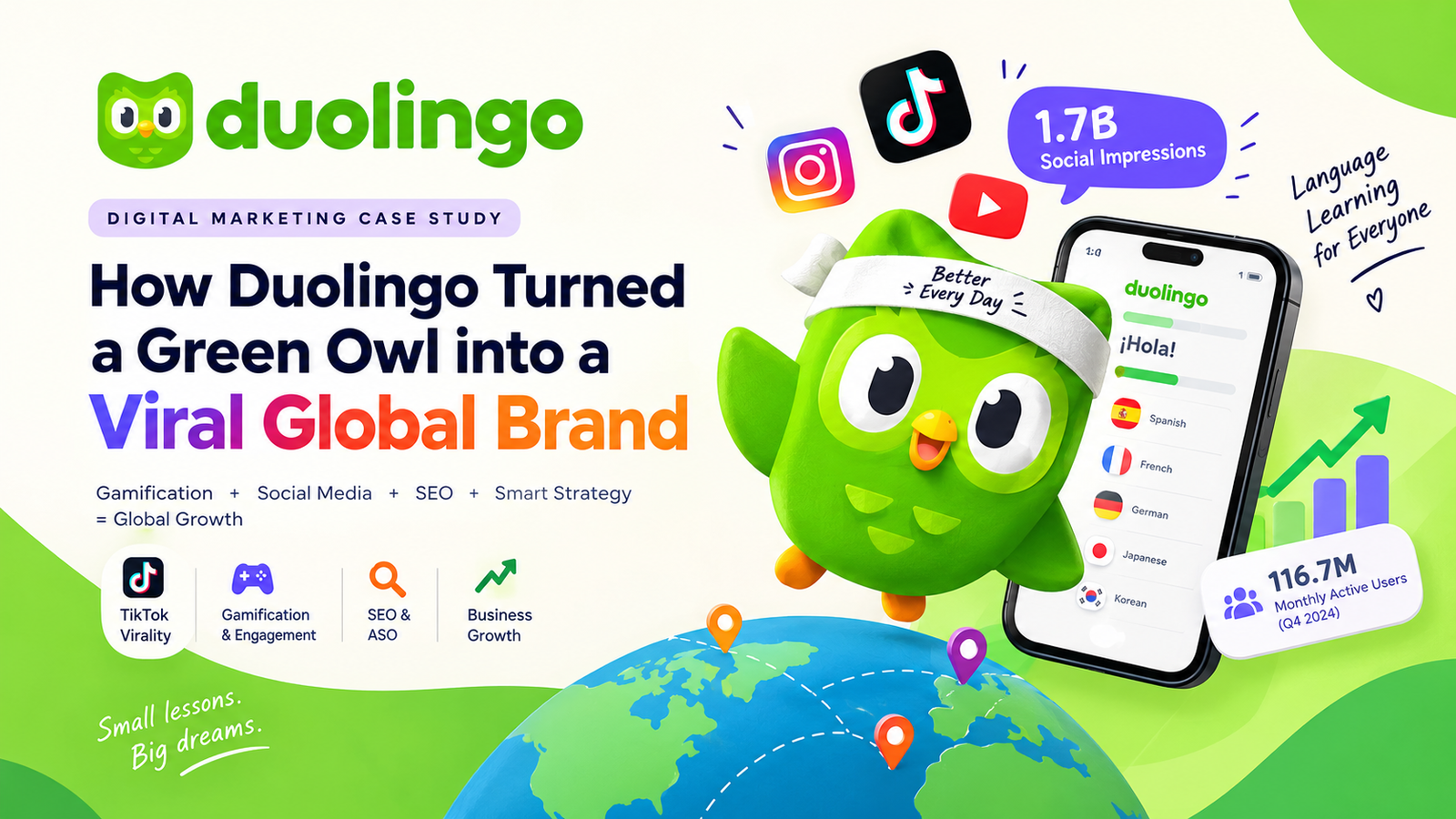
Duolingo Digital Marketing Case Study: How Duolingo Turned a Green Owl into a Viral Global Brand
Introduction: How Duolingo Made Language Learning a Part of Internet Culture
What happens when a language-learning application stops behaving like a traditional education company and starts communicating like an internet personality?
Duolingo provides one of the most interesting examples of this transformation. Instead of relying exclusively on conventional advertising, celebrity endorsements, or expensive customer acquisition campaigns, the company built a distinctive digital presence around gamification, short-form video, humorous storytelling, and its instantly recognizable green owl mascot, Duo.
The result is a brand that people do more than use. They talk about it, make memes about it, share its videos, participate in its campaigns, and sometimes return to the application simply because they want to know what the company will do next.
However, the Duolingo marketing strategy is much more sophisticated than posting funny videos on TikTok. Its growth model connects brand awareness with product engagement, daily learning habits, organic discovery, subscriptions, and a diversified revenue model.
The company’s February 2025 Dead Duo campaign demonstrated this approach particularly well. Duolingo announced the fictional death of its mascot and invited users to help bring him back by collectively earning 50 billion experience points (XP) inside the app. According to the research data, the campaign generated approximately 1.7 billion social impressions over two weeks, while participants accumulated 50.9 billion XP.
These results illustrate an important marketing principle: attention becomes more valuable when it motivates people to take meaningful action.
Duolingo’s financial growth provides another perspective on the strategy. The company reported $748 million in revenue for fiscal year 2024 and approximately $1.037 billion in revenue for fiscal year 2025, according to the figures compiled in the research dossier.
This case study examines how Duolingo developed its digital marketing ecosystem, why its creative approach attracts attention, how its product supports retention and monetization, and what other businesses can learn from its growth model.
Duolingo’s Viral Growth Playbook
1. Duolingo Company Overview
Duolingo is a digital education company best known for its mobile language-learning application. Its platform uses short lessons, interactive exercises, progress tracking, and game-inspired features to encourage consistent learning.
The company was founded in 2011 in Pittsburgh, Pennsylvania, by Luis von Ahn and Severin Hacker. Von Ahn, a computer scientist associated with Carnegie Mellon University, previously co-invented CAPTCHA and helped develop reCAPTCHA. Hacker was his doctoral student at the university.
The founders wanted to make language education more accessible. Learning a foreign language could require expensive tutoring, classroom instruction, or paid software. Duolingo approached the problem differently by making its core learning experience available through a free digital application.
Over time, the company expanded beyond its original language-learning proposition. It introduced the Duolingo English Test, subscription products, AI-powered learning features, and additional educational subjects, including mathematics, music, and chess.
Company profile
Category
Details
Company
Duolingo, Inc.
Founded
2011
Founders
Luis von Ahn and Severin Hacker
Headquarters
Pittsburgh, Pennsylvania, United States
Primary product
Mobile and web-based learning platform
Core business model
Freemium
Major revenue stream
Paid subscriptions
Other revenue streams
Advertising, English testing, in-app purchases, and ancillary operations
Public listing
Nasdaq: DUOL
Core brand asset
Duo the Owl
Major marketing channels
TikTok, Instagram, YouTube, X, organic search, app stores, and in-app communications
Duolingo’s marketing is distinctive because the company does not depend on one channel alone. Its mascot, product features, educational content, search presence, community participation, and subscription offerings reinforce one another.
This interconnected approach is central to understanding the company’s growth.
2. The Early History: From Crowdsourced Translation to Freemium Education
Duolingo’s original concept combined language learning with crowdsourced translation.
Learners would practise a language while translating web content, creating the possibility of monetizing those translations for business customers. However, this hybrid model proved operationally complicated and commercially inefficient.
When the platform launched publicly in June 2012, the company moved toward a more direct consumer education model.
The key decision was to make its core curriculum accessible without requiring users to purchase a subscription before beginning their learning journey.
This created three important advantages.
First, it reduced the entry barrier. People could try the application without committing money upfront.
Second, it expanded the potential audience. Students, casual learners, travellers, professionals, and people exploring a new interest could all begin learning.
Third, it created opportunities for product-led growth. Once users experienced the product, Duolingo could encourage them to develop a daily habit, invite friends, and eventually consider paid features.
The company’s subsequent milestones strengthened this model:
2012: Public launch and expansion onto iOS.
2013: Android application launch, broadening mobile access.
2014: Introduction of in-app advertising.
2016: Launch of the Duolingo English Test.
2017: Introduction of Duolingo Plus, later renamed Super Duolingo.
2021: Initial public offering on Nasdaq.
2023: Launch of Duolingo Max and expansion into mathematics and music.
2024–2025: Continued development of additional subjects, including chess, and increasingly integrated product-led campaigns.
The company went public on July 28, 2021. The supplied research reports an IPO that raised approximately $521 million at an initial valuation of around $6.5 billion.
The broader lesson is that Duolingo did not build its marketing success independently of its product. The freemium product was itself an acquisition mechanism.
3. Duolingo’s Business Model: How a Free App Generates Revenue
Duolingo uses a freemium business model. Its free offering attracts users, while subscriptions and additional services monetize different segments of the audience.
The model allows the company to reach a broad user base without requiring every learner to pay.
3.1 Super Duolingo subscriptions
Super Duolingo is the company’s core premium consumer offering.
Depending on the plan and current product configuration, subscribers can receive benefits such as an ad-free experience, unlimited Hearts, additional practice features, and family sharing.
These features appeal to learners who use the application regularly and want fewer interruptions.
The research dossier reports that subscription revenue reached $607.5 million in fiscal year 2024, accounting for approximately 81.2% of total revenue.
This demonstrates that the free product and the paid product serve complementary purposes: the free tier expands access, while the premium experience provides a monetization path for users who value additional convenience.
3.2 Duolingo Max and AI-powered learning
Duolingo introduced Duolingo Max in March 2023 with features powered by OpenAI’s GPT-4 technology.
The product expanded the learning experience beyond conventional exercises. Features described in the research include:
Explain My Answer: Provides contextual explanations of answers.
Roleplay: Enables learners to practise interactive conversations in different scenarios.
Video Call features: Introduces conversational practice with the character Lily.
These features illustrate how a company can create premium value through product innovation instead of relying exclusively on advertising.
AI also introduces additional operating costs, including model inference and computing expenses. Consequently, the commercial opportunity depends on whether customers value the enhanced experience enough to support the associated costs.
3.3 In-app advertising
Free users can encounter advertisements, including video and display advertising.
Advertising generated approximately $54.6 million, or 7.3% of total revenue, in fiscal year 2024 according to the supplied research.
Advertisements provide a way to monetize non-paying users while allowing the company to maintain a free entry point.
However, the experience must be balanced carefully. Excessive interruptions can frustrate learners, while a useful premium alternative can encourage some frequent users to upgrade.
3.4 Duolingo English Test
The Duolingo English Test is an on-demand English proficiency assessment designed for people who need to demonstrate their English ability, including university applicants.
The supplied research describes the test as accepted by more than 5,000 academic programmes worldwide and historically priced below many traditional test-centre alternatives.
Its business significance extends beyond direct test revenue. The product positions Duolingo within the wider education ecosystem and creates relationships with academic institutions and international students.
Acceptance requirements and fees can change, so prospective test-takers should verify current details with the official test provider and their intended institution.
3.5 In-app purchases and ancillary operations
The application also includes digital purchases such as virtual gems, Streak Freezes, and other consumable items.
The research dossier additionally reports revenue from Duo’s Taquería, an exploratory physical restaurant operation in Pittsburgh, reaching approximately $1.29 million in 2024.
Although these activities are smaller than subscriptions, they demonstrate that Duolingo’s commercial ecosystem extends beyond a single product or payment mechanism.
Fiscal 2024 revenue breakdown
Revenue category
FY 2024 revenue
Share of total
Subscriptions
$607.5 million
81.2%
Advertising
Approximately $54.6 million
7.3%
English Test, in-app purchases, and other revenue
Approximately $85.9 million
11.5%
Total
$748.0 million
100%
Source basis: Duolingo’s FY 2024 annual report and investor communications, as identified in the supplied research.
The important marketing insight is that Duolingo does not need every user to become a subscriber. A large free audience can support brand awareness, product engagement, advertising revenue, social sharing, and eventual premium conversion.
4. Target Audience and Customer Psychology
Duolingo serves people with different motivations, and its product features address several of these needs.
Casual self-improvers
These learners want to build a useful skill without committing to a formal class. Short lessons, streaks, reminders, and achievements make learning easier to incorporate into everyday life.
Students and examination candidates
These users may be preparing for academic opportunities or English proficiency requirements. Structured lessons and the Duolingo English Test provide relevant learning and assessment options.
Travellers
Travellers may want practical vocabulary and conversational basics before visiting another country. A mobile-first learning experience makes short practice sessions convenient.
Competitive learners
Some users are motivated by rankings, XP, achievements, and weekly leagues. Competition introduces a social dimension to what might otherwise be an individual activity.
Career-focused learners
Professionals may want to strengthen their language abilities for work, study, or international communication. Premium features and AI-supported conversational practice may appeal to this group.
These categories are analytical audience segments rather than a claim that every user belongs to only one group.
The psychology behind daily engagement
Duolingo uses several behavioural mechanisms to encourage repeated use.
Loss aversion and streaks: A streak records consecutive days of learning. Once users have invested time in maintaining a long streak, they may become more motivated to protect it.
Variable rewards: Celebrations, animations, gems, and XP multipliers introduce small rewards that make completing a lesson feel satisfying.
Social accountability: Friend Streaks and collaborative quests connect individual progress with the activity of other learners.
Visible progress: XP, achievements, leagues, and learning paths give users concrete signals that they are progressing.
The supplied research reports that, as of December 31, 2024, approximately 32 million daily active users maintained streaks of seven days or longer, while around 10 million maintained streaks exceeding 365 days.
These figures suggest substantial engagement with the streak system, although they do not independently prove language proficiency or the precise effect of streaks on retention.
This distinction matters: behavioural engagement is a useful business metric, but it is not the same as educational effectiveness.
5. Brand Positioning: Why Duo the Owl Became a Marketing Asset
Duo began as a friendly guide inside a language-learning application. Over time, the mascot developed a personality that was dramatically different from the polished, formal tone commonly associated with education brands.
The owl became demanding, dramatic, obsessive about daily lessons, and deliberately ridiculous.
This transformation did not emerge entirely from a conventional branding exercise. Users had already created jokes about Duolingo’s persistent notifications, portraying Duo as an overbearing character who would not let them forget their lessons.
Rather than rejecting the joke, the company incorporated it into its social identity.
The decision created a recognisable feedback loop:
Users made jokes about Duo’s behaviour.
The brand acknowledged and amplified those jokes.
New videos reinforced the character’s personality.
Followers began anticipating the next instalment.
Community reactions generated further creative ideas.
The mascot effectively became an owned entertainment property.
Why character-led branding works
A recognisable character gives a brand a consistent identity across multiple formats. It can appear in an application, a TikTok video, a push notification, a live event, a meme, or a collaboration without requiring the audience to learn a new identity each time.
It also offers practical production benefits. A physical mascot costume can participate in simple videos filmed on a phone, reducing the need for elaborate production.
Most importantly, Duo connects entertainment with the company’s core product. The owl’s obsession with lessons is humorous precisely because learning is what Duolingo wants people to do.
The marketing message and the product behaviour reinforce each other.
6. TikTok Marketing Strategy: Turning an Education Brand into Entertainment
Duolingo’s TikTok strategy became a major part of its modern brand identity in September 2021, when social media manager Zaria Parvez helped move the account away from conventional corporate communication toward entertainment-first content.
The shift was not simply about posting more frequently. It changed how the company approached creative development.
6.1 Physical mascot comedy
Duolingo used a real mascot costume to produce videos featuring exaggerated physical comedy, workplace antics, dancing, and interactions with employees.
The physical performance made the videos feel less like conventional advertisements and more like spontaneous internet entertainment.
The production did not always need cinematic lighting, elaborate locations, or expensive visual effects. The recognisable mascot and the situation supplied much of the creative value.
6.2 Pop-culture storytelling
Duo’s fictional infatuation with pop star Dua Lipa became a recurring storyline.
Instead of treating each video as an isolated campaign, Duolingo developed a continuing narrative. Followers could recognise the reference, understand the character’s motivation, and anticipate what might happen next.
This is an important distinction between a one-off viral post and a durable content strategy. Recurring characters create continuity, while storylines give audiences a reason to return.
6.3 Real-time trend participation
The social team adapted trending audio, memes, and cultural references to fit Duo’s personality.
Casual smartphone footage often suited the platform better than highly polished commercial production because it felt native to the feed.
The principle is not that low production quality automatically performs better. Rather, the format should match the expectations of the platform and the intended audience.
6.4 Brand-to-brand interactions
Duo’s interactions with brands such as Scrub Daddy, Ryanair, McDonald’s, Target, and Netflix helped Duolingo participate in existing conversations.
A witty comment or timely response can introduce a brand to another account’s audience without requiring a traditional paid partnership.
However, such interactions work best when they reflect a consistent personality instead of sounding like a company attempting to join every trend.
6.5 Audience participation and co-creation
Duolingo’s comment sections became another source of creative ideas.
Followers suggested scenarios, extended jokes, and proposed new situations for Duo. The social team could then turn selected ideas into future content.
This created a participatory model in which the audience did not merely consume the brand’s content; it helped shape the ongoing narrative.
Notable TikTok moments
Campaign or moment
Creative idea
Strategic significance
October 2021 office dance video
Duo dancing on an office conference table
Established the irreverent mascot persona
Dua Lipa storyline
Fictional romantic pursuit of the pop star
Created recurring narrative continuity
Charli XCX and Brat Summer, 2024
Mascot appearances aligned with a lime-green pop-culture aesthetic
Connected the brand to a major cultural moment
Super Bowl campaign, 2024
Short television spot paired with push notifications
Connected broadcast attention with mobile engagement
Dead Duo, 2025
Fictional mascot death and community resurrection challenge
Turned social storytelling into product participation
The broader lesson is that social media marketing can work as an ongoing entertainment format rather than a stream of unrelated promotional posts.
7. The Dead Duo Campaign: A Detailed Marketing Case Study
The February 2025 Dead Duo campaign is the clearest example in the supplied research of Duolingo connecting a viral narrative with a measurable in-app action.
7.1 How the campaign began
The idea originated from work on App Store Optimization (ASO), particularly experiments involving alternative app icons intended to re-engage inactive learners.
The team had previously explored unusual designs, including a sick-looking or melting version of Duo. During subsequent icon testing, a design showing Duo with X-shaped eyes did not establish a clear winning performance result on its own.
However, the creative team recognised that the image could support a larger story.
According to the research dossier, CEO Luis von Ahn approved the concept, and the team coordinated the campaign across marketing, product, engineering, public relations, and international teams over approximately six days.
The original plan did not require every narrative detail to be settled in advance. Leaving the fictional cause of death ambiguous allowed users to speculate and participate in the story.
7.2 February 11: The announcement
Duolingo announced that Duo was dead through a mock memorial post.
The announcement used a solemn visual style and Sarah McLachlan’s song “Angel” to create an exaggerated contrast between the seriousness of a memorial and the absurdity of a fictional mascot death.
The app icon also changed to the Dead Duo design.
The campaign immediately created a question: why had the familiar green owl disappeared?
That question encouraged people to discuss the event, share screenshots, and search for explanations.
7.3 February 12–14: The story expands
Follow-up videos introduced further details, including a storyline involving a Cybertruck.
Other characters appeared in the unfolding fictional drama. On February 14, von Ahn participated in the joke through a deadpan eulogy on TikTok.
Executive participation helped the campaign feel like a company-wide event rather than an isolated social media post.
The story also generated opportunities for commentary across social platforms and marketing publications.
7.4 February 17: The resurrection challenge
The campaign then moved beyond social media.
Duolingo launched a resurrection website at bringback.duolingo.com, where the community was challenged to collectively earn 50 billion XP by completing lessons.
This was the campaign’s most important strategic decision.
Instead of asking audiences simply to watch another video, Duolingo gave them a shared objective connected directly to the product.
Users could contribute toward the goal through the activity the company wanted to encourage: completing lessons.
7.5 February 24–25: The goal is reached
According to the research dossier, the community reached 50.9 billion XP, equivalent to approximately five billion completed exercises or lessons as described in the campaign reporting.
Duo subsequently returned in the story, emerging from a coffin in a follow-up video.
The narrative concluded with another reference to his fictional pursuit of Dua Lipa. The pop star publicly acknowledged the campaign, generating more than 667,000 interactions according to the supplied research.
Dead Duo campaign results
Metric
Reported result
Measurement context
Social impressions
Approximately 1.7 billion
February 11–25, 2025
Community XP
50.9 billion
Resurrection challenge
Completed lessons or exercises
Approximately 5 billion
Campaign reporting
Social mentions
Approximately 160,000–169,000
Third-party estimates
Android installation lift
Approximately 38% day over day
Reported for February 12
Campaign planning and coordination
Approximately six days
Reported campaign preparation
Important evidence distinction: The 1.7 billion impressions and XP figures are company-reported campaign metrics as described in the research. The mention and download estimates come from third-party or secondary reporting and should not be treated as equivalent to audited financial figures.
Why the campaign worked
It created a narrative people wanted to follow. The fictional death generated curiosity and gave users a reason to check subsequent posts.
It encouraged audience speculation. People could share theories and jokes without needing to understand a complicated product announcement.
It used a familiar brand asset. Duo was already recognisable to users, so the campaign did not need to introduce a new character.
It linked attention to an action. The 50-billion-XP goal transformed passive viewing into participation in the app.
It generated earned media. An unusual brand story gave journalists, creators, and social users a reason to discuss Duolingo without the company relying solely on paid distribution.
It created a natural ending. The resurrection provided narrative closure while rewarding the community for reaching its shared goal.
What the campaign does not prove
A responsible case study must distinguish campaign attention from commercial outcomes.
Social impressions do not equal unique people, new app installations, paid subscribers, or revenue. Likewise, a rise in downloads on a particular day does not establish that every additional installation came directly from the campaign.
The supplied research does not provide a verified free-to-paid conversion rate attributable specifically to Dead Duo.
The most defensible conclusion is that the campaign generated substantial reported attention and connected that attention with meaningful in-app activity. Its exact long-term effect on subscription revenue remains undisclosed.
8. Other Major Duolingo Marketing Campaigns
Dead Duo was part of a wider creative approach rather than a completely isolated experiment.
Duolingo Push — 2019
The April Fools’ campaign imagined a service in which a physical Duo mascot would follow people in real life until they completed their lessons.
The concept exaggerated the company’s familiar reminder notifications and turned a common user joke into parody advertising.
It helped establish the aggressive, persistent mascot personality that later became central to the brand’s social identity.
Lesson: A brand can turn a recognisable customer complaint into comedy when it acknowledges the joke rather than responding defensively.
Super Bowl Butt Lift — 2024
Duolingo ran a five-second regional television commercial featuring Duo after a fictional butt-lift procedure.
The campaign was coordinated with a push-notification system that sent alerts to approximately four million users within seconds of the broadcast, according to the supplied research.
This connected a short, unexpected television moment with a direct mobile touchpoint.
Lesson: Cross-channel campaigns become more memorable when each channel contributes to the same experience.
Duolingo on Ice — 2024
For April Fools’ Day, Duolingo presented a fictional four-hour theatrical ice show featuring its characters.
The campaign used a mock trailer, a fictional ticketing experience, and public relations coverage to make the imagined event feel like a real entertainment production.
The research reports approximately 26 million video views and more than 100,000 new social followers.
Lesson: A strong creative premise can generate attention by parodying a format audiences already understand.
Charli XCX and Brat Summer — 2024
During the Brat Summer cultural moment, Duolingo placed its green mascot into the surrounding music conversation, including concert-related content.
The lime-green visual connection helped the brand fit naturally into an existing trend.
Lesson: Cultural relevance is more effective when a brand has a credible visual or narrative connection to the moment.
Squid Game-inspired Korean learning campaign — 2024
Duolingo also connected Korean learning with the popularity of Squid Game, including a campaign built around the track “Korean or Get Eaten.”
The supplied research attributes a 40% influx of Korean learners to the period following the first season’s popularity. This figure should be treated as a reported association, not proof that one campaign alone caused the increase.
Lesson: Entertainment can make a learning objective feel more culturally relevant, especially when audiences are already interested in the subject.
Chess expansion — 2024–2025
Duolingo expanded into chess through interactive learning and character-based promotion.
The supplied research describes chess as one of the company’s fastest-growing non-language subjects and reports that it surpassed one million daily active users on iOS within months.
This expansion illustrates how an established brand can use its existing product experience and character identity to introduce new learning categories.
9. Instagram, YouTube, X, and LinkedIn Strategy
Duolingo’s wider social media presence supports the same brand identity while adapting the format to each platform.
Platform
Content approach
Primary role
TikTok
Raw vertical videos, physical comedy, trends, and character storylines
Discovery and entertainment
Reels, illustrated stories, character comics, and visual campaigns
Brand affinity and community engagement
YouTube
High-concept parody trailers, longer videos, and educational podcasts
Extended storytelling and earned media
X
Fast replies, jokes, memes, and real-time commentary
Public conversation and cultural relevance
Company culture, technology, product development, and professional updates
Recruitment, credibility, and institutional relationships
This differentiation matters because users do not interact with every platform in the same way.
A TikTok video can rely on immediate visual humour. An Instagram carousel can explain a concept through a sequence of images. YouTube can support longer storytelling, while LinkedIn can communicate product and business developments in a more professional context.
A consistent brand personality does not require identical content everywhere.
10. SEO Strategy: How Duolingo Captures Organic Search Demand
Although viral social media attracts considerable attention, search engine optimization provides another important route through which learners can discover Duolingo.
Its website supports both navigational searches from people who already know the brand and non-branded searches from people looking for language-learning resources.
10.1 Programmatic course pages
Duolingo’s course directory structure allows users to explore different language-learning combinations.
For example, a visitor may be looking for Spanish lessons in English or a course for learning Japanese.
Dedicated course pages help align the website with these specific user needs. They also give visitors a route from search discovery to the learning experience.
This is a form of scalable landing-page architecture: related pages serve distinct, relevant search intents rather than relying on one generic homepage for every query.
10.2 Educational content and long-tail keywords
Grammar explanations, vocabulary resources, verb conjugations, and educational articles can capture searches from learners who have a specific question.
These users may not initially be searching for an application. They may want to understand a word, practise a grammatical structure, or find a learning resource.
Useful educational content can introduce the brand before the user is ready to download the app.
10.3 Brand awareness and direct traffic
Duolingo’s strong brand recognition also supports navigational behaviour.
People who encounter the company through TikTok, word of mouth, press coverage, or a friend may later search for the brand directly.
Consequently, organic search and social media can reinforce one another even when the final conversion does not occur on the same platform where the user first encountered the brand.
Third-party website analytics
The supplied research dossier includes the following estimated website metrics for 2026:
SEO metric
Reported estimate
Monthly website visits
Approximately 59.3–72.2 million
Semrush Authority Score
80/100
Referring domains
Approximately 99,900
Backlinks
Approximately 1.89 million
Direct share of desktop visits
Approximately 65–69%
Estimated search traffic share
Approximately 15–25%
These figures are estimates from third-party analytics platforms, not audited company disclosures. Traffic estimates can differ by methodology, reporting period, and device coverage.
They should also not be confused with the company’s mobile-app user base.
The strategic takeaway is that a recognisable brand, useful content, strong backlinks, and relevant landing pages can work together to support organic discovery.
11. App Store Optimization: Turning an App Icon into a Marketing Surface
App Store Optimization (ASO) helps mobile applications improve their visibility and conversion performance in app marketplaces.
Duolingo approaches its app listing and icon as more than static branding.
Dynamic mascot icons
The company has used unusual variations of Duo, including sick-looking, melting, muscular, and deceased versions.
These designs create visual novelty on the user’s smartphone home screen. They can also trigger curiosity when users notice that a familiar icon has changed.
The Dead Duo campaign illustrates how an ASO experiment can become the starting point for a much larger creative activation.
However, the research does not establish that every icon variation independently produces a positive conversion lift. Icon testing must be evaluated against the performance of alternative designs.
Localized app store pages
Different markets may respond to different learning motivations.
Some audiences may prioritise travel and everyday conversation, while others may focus on English proficiency, career opportunities, or academic preparation.
Localised descriptions, screenshots, metadata, and previews can help communicate the most relevant value proposition to each audience.
Key lesson: App stores are conversion environments. Creative assets and messaging should be tested against the expectations of the intended audience rather than treated as permanent design elements.
12. Gamification: The Product Engine Behind Duolingo’s Growth
Viral marketing can attract a large audience, but it cannot by itself ensure that people return.
Duolingo’s product uses game-inspired mechanics to encourage regular participation.
Daily streaks
A streak records how many consecutive days a learner completes a lesson.
It creates a visible commitment and makes daily practice easy to track. Streak Freezes allow eligible users to protect their progress when they miss a day.
XP and leagues
Users earn experience points through lessons and compete with other learners in weekly leagues.
The leaderboard provides a social comparison mechanism that can make practice more engaging for competitive users.
Hearts
The Hearts system limits mistakes for many free mobile users. Learners may need to review material, use available resources, or consider a paid plan when they run out.
This can encourage review and provide a subscription incentive, although it can also frustrate learners who feel that mistakes should be part of the learning process.
Quests and badges
Daily goals, monthly challenges, and collaborative activities give learners additional reasons to return.
Friend Quests create shared objectives, while achievements make progress visible.
Social accountability
Friend Streaks connect learners with friends, creating a reason to maintain a habit together.
These mechanisms make individual learning more social and provide opportunities for organic referrals.
The limitation of gamification
Engagement is not synonymous with educational success.
A learner can complete many short exercises, earn XP, and maintain a long streak without necessarily achieving conversational fluency.
The supplied research cites an early study by Vesselinov and Grego that associated approximately 34 hours of Duolingo study with a semester of introductory Spanish study. However, the reported assessment focused on beginner reading and listening outcomes rather than demonstrating equivalent spoken fluency in every context.
A balanced evaluation should therefore consider both engagement metrics and independent evidence of learning outcomes.
13. Product-Led Growth: Duolingo’s Organic Growth Flywheel
Duolingo’s model can be understood as a connected sequence of acquisition, engagement, retention, and monetization.
Stage 1: Reduce the barrier to entry
The free product allows people to begin learning without committing to a paid subscription.
This creates a large potential audience.
Stage 2: Turn the product into a habit
Streaks, reminders, short lessons, quests, and progress indicators encourage repeat usage.
The product gives learners a reason to return after the initial download.
Stage 3: Encourage social distribution
Friend Streaks, leaderboards, shareable achievements, and community challenges can make the learning experience visible to other people.
The social layer can contribute to organic acquisition.
Stage 4: Monetize higher-intent users
Subscriptions offer additional convenience and advanced features. Advertising monetizes part of the free audience, while the English Test serves a separate assessment need.
Stage 5: Reinvest in the experience
Product development, experimentation, and AI-powered features can improve the offering and create new premium opportunities.
The cycle can be summarised as:
Free access → Product engagement → Daily habit → Organic discovery → Subscription opportunities → Product investment
The model is not automatic. Each stage depends on user experience, product quality, retention, and the relevance of the value proposition.
Nevertheless, it explains why Duolingo’s social media success should be understood as one component of a broader business system.
14. Paid Advertising Strategy: Why Organic Growth Matters
Duolingo does use paid marketing, but the supplied financial data suggests that its sales and marketing expenditure declined as a percentage of revenue between 2022 and 2024.
Financial year
Sales and marketing expenditure
Approximate share of revenue
2022
$74.5 million
20.2%
2023
$76.2 million
14.3%
2024
$90.5 million
12.1%
These figures represent total GAAP sales and marketing expenses, not exclusively paid advertising or user acquisition. They should not be interpreted as a direct measure of advertising spend alone.
The research also attributes approximately 90% of user acquisition to organic sources. That is a reported company or industry estimate, rather than a publicly disclosed channel-by-channel acquisition audit.
What does this tell marketers?
The important lesson is not that paid advertising is unnecessary.
Instead, Duolingo demonstrates the potential advantage of creating strong product engagement and organic distribution before relying on continuous paid acquisition to sustain growth.
Paid campaigns can remain useful for brand protection, high-intent searches, retargeting, and seasonal subscription promotions. Organic content, referrals, and product-led retention can complement those campaigns.
The appropriate channel mix depends on a business’s category, customer economics, competition, and ability to retain users.
15. Financial Performance: Measuring Growth Beyond Viral Views
Duolingo’s financial results provide context for the scale of its business model.
The following figures are drawn from the supplied research dossier. Figures for 2022–2024 are presented as annual results, while the user figures marked Q4 represent reported year-end-quarter active-user metrics.
Revenue and operating performance
Metric
FY 2022
FY 2023
FY 2024
FY 2025
Total revenue
$369.5M
$531.1M
$748.0M
$1,037.6M
Subscription revenue
$274.5M
$405.0M
$607.5M
$873.4M
Total bookings
$427.7M
$622.2M
$870.6M
$1,158.4M
Gross margin
73.1%
73.3%
72.8%
72.2%
Adjusted EBITDA
$15.5M
$93.7M
$191.9M
$305.9M
Operating cash flow
$46.2M
$144.1M
$285.5M
$387.8M
Free cash flow
$46.2M
$144.1M
$264.4M
$360.4M
Source basis: annual reports and shareholder letters identified in the supplied research. Adjusted EBITDA is a non-GAAP measure. FY 2025 figures should be checked against the relevant official filings before publication.
User growth and engagement
Metric
FY 2022
FY 2023
Q4 2024
Q4 2025
Daily active users
16.3M
26.9M
40.5M
52.7M
Monthly active users
60.6M
88.4M
116.7M
133.1M
DAU/MAU ratio
26.9%
30.4%
34.7%
39.6%
Paid subscribers
4.2M
6.6M
9.5M
12.2M
The research dossier additionally reports early-2026 figures of 56.5 million daily active users, 137.8 million monthly active users, and 12.5 million paid subscribers. These should be tied to the relevant reporting period when used in publication.
Interpreting the numbers
The figures suggest that Duolingo expanded both its user base and its subscription business over the period.
Revenue increased from $369.5 million in 2022 to approximately $1.037 billion in 2025. Subscription revenue remained the largest component of the business, while the DAU/MAU ratio rose from 26.9% in 2022 to 39.6% in Q4 2025.
These trends are consistent with a business that is growing in scale while encouraging more frequent product usage.
However, the figures do not establish that viral social media alone caused the financial growth. Product improvements, subscription pricing, family plans, AI features, organic search, market expansion, and other factors may all contribute.
The more defensible interpretation is that marketing, product design, and monetization operate as an interconnected system.
16. Competitor Analysis: Duolingo vs Babbel, Busuu, and Rosetta Stone
Duolingo operates in a competitive language-learning market, but its positioning differs from several established alternatives.
Strategic factor
Duolingo
Babbel
Busuu
Rosetta Stone
Brand personality
Humorous, irreverent, mascot-led
Professional and structured
Community-oriented
Traditional and immersion-focused
Product access
Broad freemium entry
Subscription-led access
Freemium and premium
Primarily paid offerings
Main differentiation
Gamification and cultural marketing
Structured courses and practical dialogues
Community feedback and language practice
Immersion-based learning
Marketing emphasis
Viral social content, product-led growth, organic search
Performance marketing and business offerings
Educational content and community
Established educational brand and institutional relationships
Revenue model
Subscriptions, advertising, testing, and in-app purchases
Consumer subscriptions and business products
Premium subscriptions and business offerings
Consumer and institutional offerings
The supplied research reports approximately €352 million in Babbel revenue for 2024 and more than 120 million registered users for Busuu. These competitor metrics are not directly comparable to Duolingo’s active-user figures because reporting definitions differ.
Babbel
Babbel focuses on structured language instruction and practical dialogues. Its positioning appeals to learners who prefer a more formal learning experience.
Its subscription-led approach differs from Duolingo’s broad free entry point.
Busuu
Busuu emphasises community features and opportunities for learners to receive feedback from other speakers.
This provides a different route to engagement and learning support.
Rosetta Stone
Rosetta Stone has historically emphasised immersion-based language learning and maintains an established presence in educational and institutional markets.
Duolingo’s competitive advantage
Duolingo’s differentiation is not simply that its marketing is funnier.
Its brand personality, free product, gamification, social content, and subscription model reinforce one another. This creates a coherent experience that extends from the first viral video to daily learning sessions.
Competitors can imitate individual videos or game mechanics. Reproducing the entire combination of recognisable characters, audience expectations, product habits, and cultural continuity is more difficult.
17. Influencer Marketing and Brand Partnerships
Duolingo’s approach to partnerships often involves integrating its mascot into existing cultural conversations rather than depending exclusively on conventional endorsement arrangements.
Dua Lipa
The recurring fictional romance between Duo and Dua Lipa created a long-running narrative that crossed social posts and public conversation.
Her acknowledgment of the Dead Duo campaign extended that storyline into a broader pop-culture moment.
Netflix and Squid Game
The Korean-learning campaign associated with Squid Game connected language learning with an established entertainment property.
The campaign provided a culturally relevant entry point for people interested in Korean media.
Charli XCX
The Brat Summer campaign connected Duo’s recognisable green appearance with a prominent music trend, helping the character fit into concert-related conversations.
Chess.com and new learning categories
The chess expansion illustrates how a new product category can be introduced through cross-promotion, interactive experiences, and character-led content.
McDonald’s and retail integration
The supplied research describes a McDonald’s-related promotional activation around Duo’s return in 2025. It illustrates how a social storyline can extend into broadcast or retail environments.
The common principle is that partnerships work best when they give both audiences a relevant reason to participate. A collaboration should add to the story rather than simply place two logos beside one another.
18. Content Marketing and Storytelling: Entertainment with a Purpose
Duolingo’s content strategy can be divided into three broad formats.
Short-form entertainment
TikTok and Reels introduce Duo to new audiences through humour, trends, and character interactions.
The content can attract attention without presenting every video as a direct product advertisement.
High-concept campaigns
April Fools’ concepts and large narrative stunts create a larger story around the brand.
These campaigns can attract press coverage because the premise is unusual enough to become a story in its own right.
Educational content
Duolingo’s educational resources and bilingual podcasts serve learners who want more substantial learning experiences.
This content provides a useful complement to the entertainment-led material by supporting the actual educational purpose of the product.
Together, these formats create an entertainment-to-product pathway:
A viewer encounters Duo through social media.
The content builds familiarity and positive brand recognition.
The viewer explores Duolingo’s product.
Gamified lessons encourage repeat usage.
Some users eventually upgrade to premium offerings.
This pathway is a strategic model, not a claim that every social media viewer follows every step.
19. Challenges, Criticism, and Risks
A credible digital marketing case study must examine the limitations of the strategy as well as its successes.
19.1 Gamification versus genuine learning
Streaks, XP, and leaderboards can encourage frequent use, but they do not independently demonstrate language proficiency.
If users become more focused on maintaining a streak or maximising XP than understanding the material, engagement can become disconnected from educational progress.
Duolingo must therefore balance habit formation with meaningful learning outcomes.
19.2 Monetization friction
The Hearts system and advertising can make the free experience frustrating for some users.
A freemium business needs to offer enough value to attract and retain free learners while making the paid product attractive. If the free experience feels excessively restrictive, users may abandon the product rather than upgrade.
19.3 AI and human expertise
The supplied research reports that Duolingo ended some freelance translation contracts during 2023–2024 while expanding the use of generative AI in content workflows.
This prompted concerns among some users about employment, linguistic nuance, and the quality of automated educational content.
AI can help scale content production and provide interactive experiences, but education products still require appropriate review, quality control, and attention to language-specific nuance.
19.4 Risks of irreverent humour
The same humour that makes Duolingo memorable can create reputational risks.
Jokes involving death, threats, or sensitive events may not translate well across cultures. During Dead Duo, the Japanese team reportedly adapted the storyline to present Duo as exhausted rather than dead.
This illustrates an important principle: a consistent global identity does not require identical execution in every market.
19.5 Dependence on social algorithms
Organic reach can change when social platforms adjust their algorithms, formats, or content policies.
A brand that depends too heavily on a single platform may experience volatility even when its content remains strong.
Duolingo’s broader mix of product engagement, search, app-store visibility, and multiple social channels provides different routes to discovery.
19.6 Cost of AI-powered features
Advanced AI experiences can create premium revenue opportunities, but they also require computing resources and ongoing development.
The supplied research notes a modest decline in gross margin between 2024 and 2025, alongside the expansion of AI-powered features. This is consistent with the need to manage infrastructure costs as the product evolves, although the margin change cannot be attributed exclusively to AI from the supplied figures.
20. Evidence Quality: What the Numbers Can and Cannot Tell Us
The quality of a marketing case study depends on the quality of its evidence.
Duolingo’s publicly reported financial statements are the strongest source for company revenue, expenses, and other audited financial measures. Shareholder letters provide important operating metrics, while third-party platforms estimate website traffic, backlinks, social mentions, and other digital indicators.
These sources should not be treated as interchangeable.
For example:
Audited financial statements are appropriate for reported revenue and expenses.
Shareholder communications provide company-reported user and campaign information.
Third-party analytics tools estimate web traffic, backlinks, and domain metrics.
Media reports and industry case studies help reconstruct campaign timelines and creative decisions.
Academic research can help evaluate learning outcomes and distinguish educational effectiveness from engagement.
The research dossier does not provide publicly disclosed channel-level customer acquisition costs, campaign-specific free-to-paid conversion rates, or profitability for each course category.
Those gaps matter. Without them, it is not possible to calculate the precise return on investment of the Dead Duo campaign or determine the exact contribution of TikTok to annual subscription revenue.
The evidence still supports a meaningful conclusion: Duolingo has developed a distinctive, highly visible marketing system that connects brand storytelling with product engagement, while maintaining substantial subscription revenue and user growth.
21. Ten Evidence-Based Marketing Lessons from Duolingo
Lesson 1: Build a recognisable brand personality
A clear personality helps audiences identify and remember a brand. It can also make content easier to produce consistently.
For smaller businesses, that personality might come from a founder, an employee, a recurring character, or a distinctive communication style.
Lesson 2: Treat social media as entertainment, not just advertising
Not every post needs to announce a service, price, or discount.
Useful content can entertain, educate, surprise, or invite participation before asking the audience to take a commercial action.
Lesson 3: Create recurring narratives
A recurring character or storyline gives people a reason to return.
Rather than treating every campaign as a fresh beginning, brands can build continuity through familiar themes, characters, and running jokes.
Lesson 4: Turn audience feedback into creative input
Comments can reveal what audiences find funny, confusing, useful, or memorable.
Businesses can use this feedback to develop content ideas, provided they maintain appropriate editorial judgment and do not treat every suggestion as a suitable campaign.
Lesson 5: Connect viral attention to a meaningful action
Dead Duo connected a fictional story to completed lessons and a collective XP goal.
Other businesses can apply the underlying principle through a useful challenge, assessment, community milestone, product demonstration, or booking journey.
The action should fit the business rather than imitate Duolingo’s exact campaign.
Lesson 6: Improve retention before scaling acquisition
Paid advertising can bring in new customers, but weak onboarding and poor retention can make growth expensive.
Businesses should measure whether new customers receive value, return, and recommend the product before continually increasing acquisition spending.
Lesson 7: Use every relevant touchpoint
An app icon, reminder, email, landing page, packaging insert, or confirmation message can reinforce brand identity.
The best touchpoints contribute to the customer experience rather than adding unnecessary noise.
Lesson 8: Adapt content to each platform
Different platforms reward different formats and audience behaviours.
Repurposing an idea is useful, but the creative execution should fit the channel.
Lesson 9: Use experimentation instead of assumptions
Duolingo’s app-icon testing illustrates how a small experiment can reveal creative possibilities that may be worth exploring further.
Businesses should test meaningful variations and evaluate the results instead of assuming that an unusual idea will automatically outperform a conventional one.
Lesson 10: Measure commercial outcomes responsibly
Views, impressions, comments, downloads, leads, purchases, and retention measure different things.
A good marketing report identifies the outcome being measured and avoids claiming that a campaign generated revenue when the evidence only establishes attention or engagement.
22. Practical Applications for UPMARKE and Growing Businesses
Duolingo’s strategy offers useful principles for digital marketing agencies, local businesses, service providers, e-commerce brands, and startups.
The objective is not to copy an owl mascot or imitate every viral trend. It is to understand how a consistent identity, useful content, product experience, and measurable customer journey can reinforce one another.
Build a recognisable content identity
A business can develop a recurring visual style, founder-led videos, a familiar presenter, or a distinctive editorial voice.
For example, a jewellery brand could create recurring content around design education, craftsmanship, styling, and common buying questions. A professional service business could use short videos to explain client mistakes, demonstrate its process, and answer recurring questions.
The identity should suit the business and the audience it wants to attract.
Create a faster content approval process
Duolingo’s approach demonstrates the value of giving creative teams enough authority to respond while a trend is still relevant.
Smaller businesses can establish pre-approved visual guidelines, brand language, content boundaries, and escalation rules so that routine posts do not require lengthy approvals.
Speed should not eliminate factual review or sensitivity checks.
Connect content with a conversion path
A viral video has limited commercial value if viewers cannot understand what to do next.
Depending on the business, the next step might be a service page, a useful guide, a consultation request, a product page, or a WhatsApp enquiry.
The journey should feel natural rather than turning every piece of entertainment into an aggressive sales pitch.
Improve the website and organic search experience
Social media may generate discovery, but a useful website can answer questions and convert interest into enquiries.
Businesses can create relevant service pages, educational articles, case studies, FAQs, and clear calls to action. Each page should satisfy a real search intent instead of existing only to repeat keywords.
Track the right metrics
A practical measurement framework might include:
Marketing objective
Useful metrics
Brand awareness
Reach, impressions, branded search demand
Content engagement
Watch time, completion rate, shares, meaningful comments
Website discovery
Organic clicks, impressions, relevant landing-page visits
Lead generation
Enquiries, qualified leads, consultation bookings
Sales
Conversion rate, revenue, average order value
Customer retention
Repeat purchases, returning customers, renewal rate
This framework helps businesses understand where marketing is creating value and where the customer journey needs improvement.
For UPMARKE, the most useful application is to combine strong creative content with search visibility, clear service positioning, transparent reporting, and a measurable enquiry process. Viral reach can be valuable, but sustainable growth requires a system that turns attention into relevant business opportunities.
23. Frequently Asked Questions
What is the Duolingo digital marketing case study about?
The Duolingo digital marketing case study examines how the company combined a freemium learning product, gamification, character-led branding, organic social media, SEO, app-store optimization, and product-led campaigns to build a globally recognisable brand.
Why is Duolingo’s marketing strategy successful?
Its strategy connects a distinctive brand personality with an engaging product experience. Humorous social content attracts attention, while streaks, lessons, quests, and subscriptions give users reasons to return.
How did Duolingo use TikTok for marketing?
Duolingo developed entertainment-first videos featuring Duo the Owl, workplace comedy, trending audio, pop-culture references, recurring storylines, and audience participation. The approach helped the brand communicate in a format that felt native to the platform.
What was the Dead Duo campaign?
The February 2025 campaign announced the fictional death of Duo the Owl and invited the community to earn 50 billion XP to bring him back. The research dossier reports approximately 1.7 billion social impressions and 50.9 billion XP earned during the campaign.
How does Duolingo make money?
Its primary revenue source is paid subscriptions, including Super Duolingo and Duolingo Max. Additional revenue comes from advertising, the Duolingo English Test, in-app purchases, and other operations.
Does Duolingo rely entirely on organic marketing?
No. The research indicates that organic channels play a substantial role, but Duolingo also incurs sales and marketing expenses. Its overall growth model includes product development, subscriptions, paid marketing, search, app-store optimization, and social distribution.
What role does SEO play in Duolingo’s growth?
SEO helps learners discover relevant course pages, educational resources, and the company’s website through non-branded searches. It complements social media and direct brand awareness by capturing people actively looking for learning information.
What can small businesses learn from Duolingo?
Small businesses can learn to develop a recognisable personality, produce platform-appropriate content, involve their audiences, improve onboarding and retention, connect campaigns to meaningful actions, and measure commercial outcomes instead of focusing only on views.
Does going viral guarantee more revenue?
No. Virality can increase awareness and engagement, but it does not automatically create qualified leads, subscriptions, or sales. Results depend on the product, audience, conversion journey, and retention experience.
Is Duolingo’s gamification the same as language-learning effectiveness?
No. Streaks, XP, and daily active users measure behaviour and engagement. Educational effectiveness requires separate evidence about learning progress, comprehension, and communication ability.
Conclusion: The Real Lesson Behind Duolingo’s Growth
Duolingo’s rise offers a valuable lesson for modern digital marketing: a brand does not have to choose between being commercially successful and being entertaining.
The company developed a distinctive identity around Duo the Owl, built an audience through culturally relevant content, and connected that attention with a free learning product designed to encourage repeat use.
Its Dead Duo campaign demonstrated how an unusual social media story could become a coordinated experience involving public relations, app-store visuals, community participation, and in-app lessons. Other campaigns, including Duolingo on Ice and the Super Bowl activation, show how the same creative philosophy can extend across different channels.
Yet the deeper lesson is not that every business should try to go viral.
Duolingo’s model also depends on its free product, habit-forming features, premium subscriptions, organic discovery, ongoing product development, and ability to learn from user behaviour. Its marketing works as part of this wider system.
For businesses and digital marketers, the practical takeaway is straightforward: build a recognisable identity, create content people genuinely want to engage with, make the next step useful, improve the underlying customer experience, and evaluate performance with evidence rather than assumptions.
The green owl may be the most visible part of Duolingo’s brand, but the more important achievement is the system behind it.
That is what makes Duolingo a valuable digital marketing case study.
Sources and Further Reading
The following sources were identified in the supplied research dossier. Financial and operating claims should be checked against official company disclosures before publication, while campaign and traffic figures should retain their appropriate attribution.
Duolingo FY 2024 Shareholder Letter: https://investors.duolingo.com/static-files/99006c40-d8cf-41ca-b5b1-c5cb1fa5ba88
Duolingo FY 2024 Form 10-K, U.S. Securities and Exchange Commission: https://www.sec.gov/Archives/edgar/data/1562088/000156208825000042/duol-20241231.htm
Duolingo FY 2025 Shareholder Letter: https://investors.duolingo.com/static-files/961ce633-3cee-49d0-bd7a-2c63731d45fb
Fast Company — Duolingo’s Dead Duo Campaign: https://www.fastcompany.com/91313082/duolingo-dead-duo-owl-social-media-campaign
PR Daily — PR Strategy Behind the Dead Duo Campaign: https://www.prdaily.com/duolingo-shares-pr-secrets-of-viral-death-of-duo-campaign/
Rohring Results — Dead Duo Campaign Case Study: https://rohringresults.com/duolingo-dead-duo-campaign-case-study/
Meltwater — Analysis of the Dead Duo Campaign: https://www.meltwater.com/en/blog/duolingo-dead-mascot-campaign
Moonb — TikTok Marketing Examples: https://www.moonb.io/blog/best-tiktok-ads
Duolingo Newsroom — Duolingo Max and AI Education: https://investors.duolingo.com/news-releases/news-release-details/duolingo-max-shows-future-ai-education
Semrush — Duolingo Website Analytics: https://www.semrush.com/website/duolingo.com/overview/
Similarweb — Duolingo Website Traffic and Audience: https://www.similarweb.com/website/duolingo.com/
Vesselinov and Grego — Duolingo Learning Effectiveness Study: https://comparelanguageapps.com/documentation/LA_Final_Report.pdf
Editorial note: This article is based on the supplied research dossier. Campaign metrics, modeled website traffic, competitor estimates, and company-reported claims are identified according to their source type where relevant. The existence of a source does not independently verify every figure attributed to it.

Daksh Toor
Daksh focuses on understanding how businesses can use SEO, social media, content and digital experiences as part of a connected growth system. At UPMARKE, the approach starts with understanding the business, identifying growth opportunities and connecting the right digital channels to those objectives.
Explore UPMARKE →Turn attention into meaningful growth.
Build a digital marketing system around your business goals, audience, content and customer journey.
Discuss your growth goals
Leave a Reply