
The jewellery industry has always been built on trust, reputation, craftsmanship, and personal relationships. But the way customers discover and choose a jewellery store has changed significantly.
Before visiting a showroom, many customers now search on Google, check Google Maps, browse Instagram, compare designs online, read reviews, and even contact a store through WhatsApp.
This is why digital marketing for jewellery business is no longer simply an optional way to promote products. It has become an important part of building visibility, attracting potential buyers, and staying competitive.
A jewellery store may have beautiful collections and excellent customer service, but if potential customers cannot find it online, a large part of the market may never discover the business.
The good news is that jewellery businesses have a major advantage in digital marketing: jewellery is highly visual. Gold necklaces, diamond rings, bridal collections, earrings, bangles, and custom designs can all become powerful content when presented correctly.
In this guide, we will explore a practical digital marketing strategy for jewellery businesses in 2026, including SEO, Google Business Profile, social media, websites, content marketing, Google Ads, WhatsApp marketing, reviews, and more.
Why Digital Marketing Is Important for Jewellery Businesses in 2026
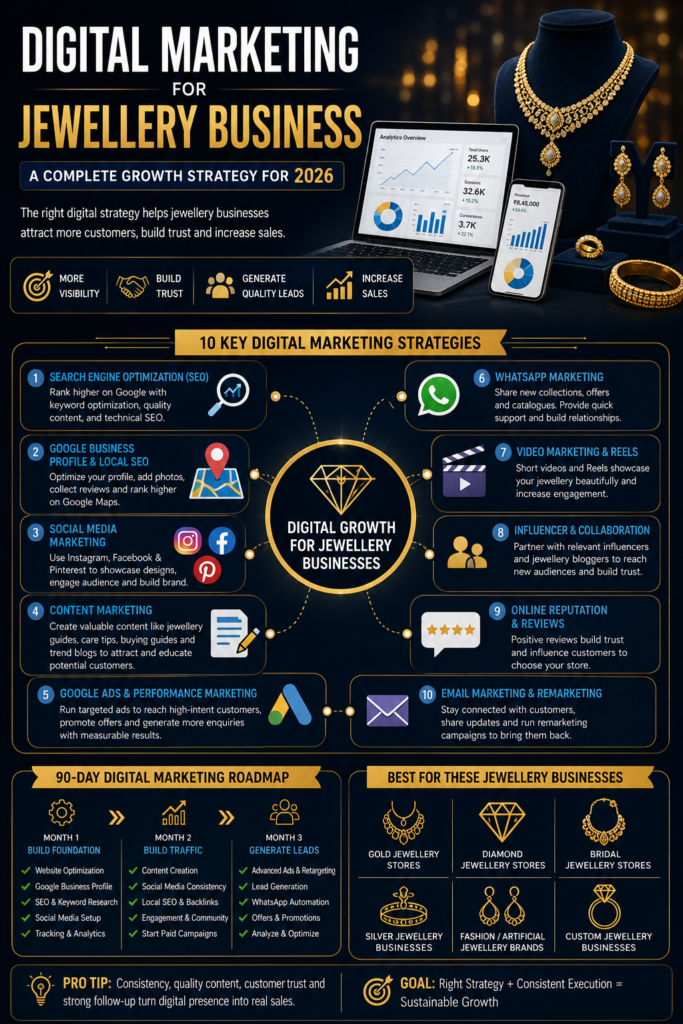
Customers don’t always walk into a jewellery showroom simply because they pass by it.
Their buying journey often begins much earlier.
Someone planning a wedding may search for bridal jewellery. Someone looking for an engagement ring may compare different designs online. A customer interested in gold jewellery may search for jewellery stores nearby before deciding where to visit.
This creates several digital touchpoints for jewellery businesses.
A potential customer might:
- Search Google for a jewellery shop
- Discover a store on Google Maps
- Visit its website
- Browse Instagram
- Watch product videos
- Read customer reviews
- Send a WhatsApp enquiry
- Compare products and prices
- Finally visit the showroom
A successful digital marketing for jewellery business strategy should therefore connect all these touchpoints instead of depending on just one platform.
The objective isn’t simply to get likes or website visitors.
The real objective is to turn online visibility into:
Attention → Trust → Enquiry → Store Visit → Purchase → Repeat Customer
How Customers Search for Jewellery Today
Search behaviour varies depending on the customer’s needs.
A local customer might search:
- “gold jewellery shop near me”
- “best jewellery shop in Delhi”
- “diamond jewellery store near me”
- “bridal jewellery shop”
- “22 carat gold jewellery”
- “jewellery shop near me”
A customer in the research stage may search:
- “how to choose a diamond ring”
- “22K vs 24K gold”
- “best jewellery for wedding”
- “how to check gold purity”
- “diamond buying guide”
These searches represent different stages of the buying journey.
Someone searching for “how to choose a diamond ring” may not be ready to purchase today. But someone searching for “diamond ring shop near me” may already be looking for a store.
A good jewellery marketing strategy should address both audiences.
This is one reason digital marketing for jewellery business needs to combine SEO, content, social media, local search, paid advertising, and conversion optimization.
Build a Strong Jewellery Brand Online
Jewellery is a high-trust purchase.
Customers want to know whether a business is genuine, reliable, transparent, and professional before spending a significant amount of money.
Your online presence should therefore communicate trust before the customer contacts you.
Start with a consistent brand identity.
Your:
- Logo
- Colours
- Photography
- Website
- Social media profiles
- Product presentation
- Packaging
- Store information
should feel like parts of the same brand.
Professional presentation can make a significant difference, particularly for premium jewellery businesses.
However, branding is more than attractive graphics.
Your website and social media should communicate what makes your business different.
For example:
- Heritage and craftsmanship
- Custom jewellery
- Bridal collections
- Contemporary designs
- Certified diamonds
- Traditional gold jewellery
- Personalised service
- Local reputation
A clear positioning makes it easier for customers to remember and choose your business.
Your Website Is Your Digital Showroom
For a jewellery business, a website should do more than display a logo and phone number.
Think of it as a digital showroom that is available 24 hours a day.
A strong jewellery website should include:
Product Categories
Organise products into clear categories such as:
- Gold Jewellery
- Diamond Jewellery
- Bridal Jewellery
- Rings
- Necklaces
- Earrings
- Bangles
- Men’s Jewellery
- Custom Jewellery
High-Quality Product Photography
Jewellery is visual. Poor-quality images can immediately reduce perceived value.
Use clear images showing:
- Different angles
- Product details
- Jewellery being worn
- Close-up craftsmanship
- Packaging where appropriate
Strong Product Descriptions
Don’t simply write:
“Beautiful gold necklace.”
Explain what makes it valuable or relevant.
Mention the design style, occasion, craftsmanship, material information, and other accurate details customers need.
Easy Enquiry Options
Make it simple for visitors to contact your business.
Include:
- Call buttons
- WhatsApp buttons
- Enquiry forms
- Store location
- Opening hours
- Appointment options
A visitor shouldn’t have to search through multiple pages just to find your phone number.
SEO for Jewellery Businesses
Search engine optimization is one of the most valuable long-term components of digital marketing for jewellery business.
SEO helps your website appear when potential customers search for relevant products and services.
For example, a jewellery store in Delhi could target searches related to:
- Jewellery shop in Delhi
- Gold jewellery shop in Delhi
- Bridal jewellery in Delhi
- Diamond jewellery in Delhi
- Jewellery shop near me
But don’t create one page and expect it to rank for everything.
Build useful, focused pages around important categories and locations where relevant.
On-Page SEO
Optimise:
- Page titles
- Meta descriptions
- Headings
- Product descriptions
- Image alt text
- Internal links
- URLs
- Relevant keywords
Avoid writing content exclusively for search engines.
The page should first help the customer.
Local SEO
If your jewellery business has a physical showroom, local SEO should be a major priority.
Your goal is to become visible when people search for jewellery businesses in your area.
This includes your website, Google Business Profile, local citations, reviews, and location-related content.
Technical SEO
Your website should also:
- Load quickly
- Work properly on mobile
- Have a secure HTTPS connection
- Use clean URLs
- Have a logical site structure
- Avoid broken links
- Be easy for search engines to crawl
Technical problems can make even excellent content harder to discover.
Google Business Profile and Local SEO
For local jewellery stores, Google Business Profile can be one of the most important digital assets.
When someone searches:
“jewellery shop near me”
Google may show local businesses through Maps and the local search results.
Your profile should contain accurate and complete information.
Pay attention to:
- Business name
- Primary category
- Address
- Phone number
- Website
- Opening hours
- Photos
- Products
- Services
- Business description
Regularly add high-quality images of your showroom, products, team, and important updates where appropriate.
Customer reviews are also extremely important for trust.
Encourage genuine customers to leave honest reviews, and respond professionally to both positive and negative feedback.
Never purchase fake reviews.
For jewellery businesses, a strong local presence can turn a Google search into an actual showroom visit.
Instagram and Social Media Marketing for Jewellery Businesses
Jewellery and social media are naturally compatible because jewellery is highly visual.
Instagram can be used to showcase:
- New collections
- Bridal jewellery
- Gold designs
- Diamond rings
- Customer stories
- Behind-the-scenes work
- Jewellery-making processes
- Styling ideas
- Festive collections
But posting product photos every day isn’t necessarily a complete strategy.
Your content should have different purposes.
Educational Content
Examples:
“How to choose the right diamond ring?”
“What is the difference between 22K and 24K gold?”
“How should you store gold jewellery?”
Educational content can establish expertise and give customers a reason to follow your brand.
Inspirational Content
Show:
- Bridal looks
- Jewellery combinations
- Styling ideas
- Festival looks
- Wedding inspiration
Product Content
Showcase specific products with high-quality photography and video.
Trust Content
Show:
- Customer testimonials
- Store experience
- Craftsmanship
- Team members
- Behind-the-scenes activities
The combination makes social media more than a catalogue.
Content Marketing for Jewellery Businesses
Content marketing can support both SEO and customer education.
Instead of constantly promoting products, create content that answers questions customers already have.
Some useful article ideas include:
- How to Choose Jewellery for Your Wedding
- 22K vs 24K Gold: What’s the Difference?
- How to Choose an Engagement Ring
- Jewellery Care Tips for Gold and Diamond Jewellery
- How to Choose Bridal Jewellery
- Things to Check Before Buying Gold Jewellery
- Jewellery Gift Ideas for Anniversaries
- How to Choose the Right Necklace for Your Outfit
This type of content can attract customers earlier in the buying journey.
For example, someone reading a bridal jewellery guide today may become a showroom customer several weeks later.
That is the long-term value of content marketing.
Google Ads and Performance Marketing
SEO can take time.
If a jewellery business wants to generate targeted visibility faster, paid advertising can complement organic marketing.
Google Ads can be used to reach people actively searching for relevant products or services.
For example, a local store might target searches related to:
- Gold jewellery shop
- Diamond ring store
- Bridal jewellery
- Jewellery shop near me
But successful advertising isn’t simply about spending more money.
You need:
Relevant keyword → Strong advertisement → Useful landing page → Easy enquiry → Follow-up
Track conversions such as:
- Phone calls
- WhatsApp enquiries
- Form submissions
- Appointment bookings
- Store visits where measurable
Avoid judging an advertising campaign purely by clicks.
A campaign generating 1,000 clicks but no enquiries is not necessarily successful.
WhatsApp Marketing for Jewellery Businesses
WhatsApp is particularly useful for businesses where customers need personal assistance before purchasing.
Customers may want to:
- Ask about availability
- Request product images
- Discuss designs
- Book an appointment
- Ask about customisation
- Get directions
- Follow up on an enquiry
A WhatsApp button on your website and social media can reduce friction.
You can also use WhatsApp to share new collection announcements with customers who have genuinely opted in to receive communications.
Avoid sending excessive promotional messages.
Personal and relevant communication is much more useful than constant advertising.
Video Marketing and Reels
Static images are useful, but video can show jewellery in ways that photographs cannot.
Short-form videos can demonstrate:
- How a necklace looks when worn
- Diamond sparkle under different lighting
- Close-up craftsmanship
- New collections
- Bridal styling
- Jewellery transformations
- Behind-the-scenes production
- Customer experiences
A simple smartphone video can sometimes outperform an overly complicated advertisement if the product is presented clearly.
Focus on good lighting, clean framing, product details, and a strong opening.
Influencer Marketing for Jewellery Brands
Influencer marketing can help jewellery businesses reach highly targeted audiences.
But follower count should not be the only factor.
A creator with 20,000 highly relevant local followers may be more valuable than someone with 500,000 followers who has no connection with your target customers.
Look at:
- Audience location
- Audience interests
- Engagement
- Content quality
- Previous brand collaborations
- Reputation
- Audience demographics
For a bridal jewellery business, wedding creators and local bridal influencers may be particularly relevant.
Always define the objective before the campaign.
Are you trying to generate:
- Awareness?
- Followers?
- Website traffic?
- WhatsApp enquiries?
- Store visits?
- Sales?
The answer should determine the campaign structure.
Reviews and Online Reputation
Trust can determine whether someone contacts your jewellery store or chooses another business.
Reviews can help potential customers understand the experience of previous buyers.
Ask genuine customers for honest feedback after a successful purchase or service experience.
Respond to reviews professionally.
If someone leaves a negative review, don’t argue publicly.
Instead:
- Acknowledge the concern.
- Respond politely.
- Move the conversation privately where appropriate.
- Try to resolve the issue.
- Learn from recurring complaints.
Never create fake reviews or ask people to post misleading experiences.
For a high-value purchase such as jewellery, authenticity matters.
Digital Marketing for Different Types of Jewellery Businesses
Not every jewellery business should use exactly the same strategy.
Gold Jewellery Stores
Focus on:
- Local SEO
- Google Business Profile
- Gold jewellery categories
- Educational content
- Festival campaigns
- Trust-building content
- Customer reviews
Diamond Jewellery Stores
Focus on:
- Product photography
- Educational diamond content
- Engagement and wedding-related searches
- Instagram Reels
- High-quality product pages
- Search advertising
Bridal Jewellery Stores
Wedding-related content can become a major traffic source.
Create content around:
- Bridal jewellery trends
- Wedding jewellery checklists
- Regional bridal styles
- Jewellery matching
- Wedding-season collections
Silver Jewellery Businesses
Social media and visual content can be especially useful for showcasing affordable designs, gifting products, fashion jewellery, and everyday collections.
Custom Jewellery Businesses
Show the process.
Content can include:
Idea → Design → Craftsmanship → Finished Jewellery
This helps customers understand the value behind custom work.
A 90-Day Digital Marketing Plan for a Jewellery Business
A practical strategy doesn’t need to be implemented all at once.
Month 1: Build the Foundation
Start with:
- Website audit
- Google Business Profile optimisation
- Keyword research
- Local SEO
- Social media profile optimisation
- Conversion tracking
- Review strategy
- Content planning
Create the essential website pages and make sure customers can easily contact the business.
Month 2: Build Visibility
Start publishing:
- SEO articles
- Product content
- Instagram Reels
- Educational posts
- Google Business Profile updates
- Local content
Optimise important product and category pages.
Begin building a consistent content schedule.
Month 3: Focus on Leads
Once the foundation is ready, focus more heavily on:
- Google Ads
- Retargeting where appropriate
- High-performing social content
- WhatsApp enquiries
- Lead follow-up
- Conversion optimisation
Analyse what is actually producing enquiries.
Then invest more heavily in the channels producing meaningful results.
Common Digital Marketing Mistakes Jewellery Businesses Should Avoid
Even a good strategy can fail because of simple mistakes.
1. Only Posting Product Photos
Customers need education, inspiration, and trust content too.
2. Ignoring Google Maps
A physical jewellery store should not depend entirely on Instagram.
3. Having a Poor Mobile Website
Many customers research businesses from smartphones.
4. Using Low-Quality Product Images
Jewellery requires strong visual presentation.
5. Buying Fake Reviews
This damages trust and can create serious reputation problems.
6. Targeting Everyone
A bridal jewellery store doesn’t need to advertise equally to every audience.
7. Running Ads Without Tracking
Without conversion tracking, you may not know which campaigns actually generate business.
8. Ignoring Follow-Ups
Generating an enquiry is only the beginning.
A potential customer who doesn’t receive a timely response may simply contact another jewellery store.
9. Copying Competitors
Competitor research is useful, but your brand needs its own positioning.
10. Expecting Immediate SEO Results
SEO is generally a long-term investment. Consistency matters.
How to Measure Digital Marketing Results
Traffic alone doesn’t tell you whether your marketing is working.
A jewellery business should monitor meaningful business metrics.
Organic Search
Track:
- Organic clicks
- Impressions
- Search rankings
- Organic enquiries
Local SEO
Monitor:
- Google Maps visibility
- Calls
- Direction requests
- Website visits
- Profile interactions
Social Media
Measure:
- Reach
- Engagement
- Profile visits
- Website clicks
- WhatsApp enquiries
- Leads
Paid Advertising
Monitor:
- Cost per lead
- Conversion rate
- Enquiry volume
- Revenue where trackable
- Return on ad spend
The most important question isn’t:
“How many people saw my advertisement?”
It is:
“How many qualified customers did our marketing help us reach and convert?”
The Future of Digital Marketing for Jewellery Businesses
Search is becoming more conversational and visual.
Customers may discover businesses through traditional Google results, Maps, social platforms, video, and AI-powered search experiences.
That means jewellery businesses should focus on building a strong digital ecosystem rather than depending on one platform.
Your website should provide useful information.
Your Google Business Profile should establish local visibility.
Your social media should demonstrate products and personality.
Your content should answer customer questions.
Your reviews should build trust.
Your advertising should generate targeted opportunities.
And your follow-up process should turn enquiries into customers.
This integrated approach is where digital marketing for jewellery business becomes much more powerful.
Frequently Asked Questions
1. How can digital marketing help a jewellery business?
Digital marketing can help jewellery businesses become more visible when potential customers search online. SEO, Google Business Profile, social media, content marketing, paid advertising, and WhatsApp can work together to generate awareness, enquiries, appointments, and store visits.
2. What is the best digital marketing strategy for jewellery businesses?
There isn’t one strategy that works for every jewellery business. A strong approach usually combines local SEO, Google Business Profile optimisation, an effective website, social media marketing, content, reviews, and paid advertising where appropriate.
3. How can a jewellery shop get more customers online?
Start by improving your Google Business Profile and website, create useful local SEO content, publish high-quality jewellery photos and videos, collect genuine reviews, maintain an active social media presence, and use targeted advertising when appropriate.
4. Is SEO useful for jewellery businesses?
Yes. SEO can help jewellery businesses appear when customers search for relevant products, services, and local stores. It is especially useful for searches involving jewellery categories, locations, buying guides, and “near me” queries.
5. How can jewellery stores rank on Google Maps?
A jewellery store can improve its local presence by maintaining an accurate Google Business Profile, selecting relevant business categories, adding high-quality photos, collecting genuine customer reviews, keeping business information consistent, and developing relevant local website content.
6. How much should a jewellery business spend on digital marketing?
There is no universal budget. The appropriate investment depends on location, competition, business size, product value, goals, and existing online presence. Start with measurable objectives and increase investment in channels that generate qualified opportunities.
7. How can jewellery businesses generate leads from Instagram?
Use high-quality product videos, Reels, educational content, customer stories, clear calls to action, location information, and easy WhatsApp or website contact options. Track enquiries rather than focusing only on follower growth.
Final Thoughts
Jewellery businesses have something many industries struggle to create: products that naturally attract attention.
But beautiful jewellery alone doesn’t guarantee online visibility.
Customers need to discover your business, understand your products, trust your brand, and have an easy way to contact you.
That’s why successful digital marketing for jewellery business should bring multiple channels together.
SEO can help you get discovered.
Google Business Profile can help local customers find your showroom.
Social media can showcase your products.
Content can demonstrate expertise.
Reviews can build trust.
Paid advertising can create targeted opportunities.
And a well-designed website can turn attention into enquiries.
The goal isn’t to be everywhere simply for the sake of being everywhere.
The goal is to build the right digital presence in the places where your customers are already looking.
For jewellery businesses that want to grow online, the right strategy starts with understanding the customer, the market, the competition, and the unique strengths of the brand.
Upmarke helps businesses build that digital growth strategy through SEO, local SEO, website development, social media marketing, content, and performance marketing—focused on building visibility and generating meaningful business opportunities rather than vanity metrics.

Leave a Reply