
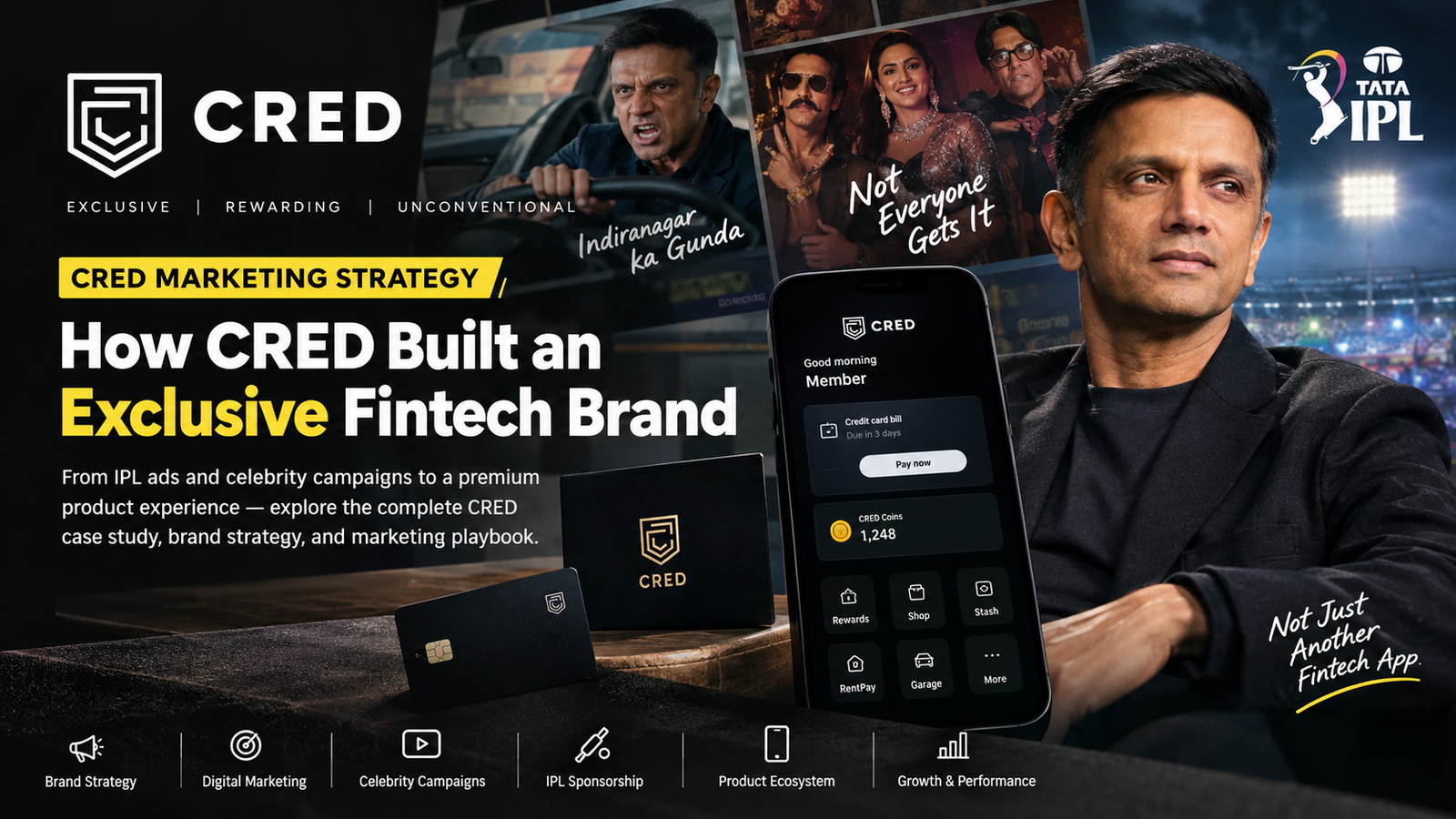
CRED Marketing Strategy Case Study: How CRED Built an Exclusive Fintech Brand
A detailed look at how CRED used exclusivity, cultural marketing, celebrity storytelling, social media and product expansion to build a distinctive fintech brand.
Introduction
Most fintech companies compete on convenience.
Pay faster. Send money instantly. Get cashback. Pay your bills. Open an account.
CRED took a very different route.
Instead of trying to become another mass-market payments platform, CRED built its identity around a simple but unusual idea: make financial discipline feel exclusive, aspirational and rewarding.
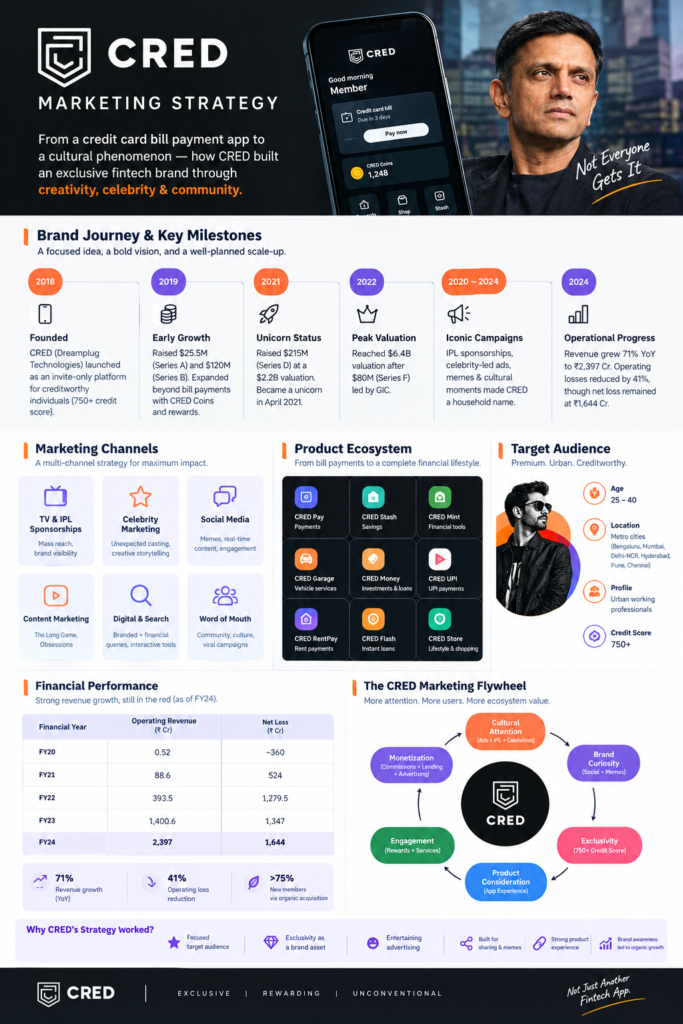
Founded in 2018 by Kunal Shah, CRED entered India’s fintech market as a members-only platform for people with strong credit histories. Its original proposition was straightforward—help members manage and pay their credit card bills while rewarding them for doing so.
But the product alone was not what made CRED famous.
Its marketing did.
From IPL advertising and unexpected celebrity casting to meme-driven social media campaigns and a distinctive visual identity, CRED turned an ordinary financial activity into a recognizable cultural brand.
The Rahul Dravid “Indiranagar ka gunda” campaign became one of the clearest examples of this approach. Instead of showing a celebrity explaining the product, CRED took one of Indian cricket’s most famously composed personalities and placed him in a completely unexpected situation.
That creative contradiction became the marketing.
But CRED’s story is more complicated than a collection of viral advertisements. Behind the campaigns was an ambitious business model, rapid product expansion, significant marketing expenditure and years of financial losses.
By FY24, however, the company had begun showing signs of improving operating economics. Operating revenue reached approximately ₹2,397 crore, while operating losses declined to ₹609 crore. At the same time, consolidated net losses remained substantial at ₹1,644 crore.
This makes CRED an especially useful case study for marketers.
It demonstrates both what exceptional brand building can accomplish—and where brand-led growth becomes difficult to translate into sustainable profitability.
What Is CRED?
CRED is the consumer-facing brand of Dreamplug Technologies Private Limited, a Bengaluru-based fintech company founded in 2018.
The company initially focused on credit card bill payments. Its key differentiation was that access was restricted to consumers meeting a credit-score threshold of 750 or above.
That restriction was more than an onboarding mechanism.
It became part of the brand itself.
Instead of saying:
“Everyone can use our app.”
CRED effectively communicated:
“You qualify for this.”
That subtle change transformed the psychological positioning of the product.
CRED was no longer presented simply as another payment application. It was positioned as a club for financially disciplined consumers.
The original product rewarded timely credit-card payments through CRED Coins, which could be redeemed for rewards and partner offers. Over time, the company expanded into additional financial and lifestyle services, including CRED Pay, CRED Stash, CRED Mint, CRED Garage, CRED Money and CRED UPI.
# The Idea Behind CRED
The foundation of CRED’s strategy came from an observation about the Indian credit market.
People with strong repayment histories are valuable customers.
They generally have better access to credit, higher spending capacity and a demonstrated willingness to repay financial obligations on time.
CRED built its proposition around this audience.
Rather than acquiring the largest possible number of users, the company initially focused on acquiring a specific high-value segment.
This created an interesting strategic equation:
Smaller audience + higher purchasing power + stronger financial profile = potentially higher value per customer.
That became one of the central ideas behind the CRED business model.
# CRED’s Target Audience
CRED’s original eligibility model required a credit score of at least 750.
The core audience identified in the research consists largely of urban working professionals between roughly 25 and 40 years old, particularly in major Indian cities such as Bengaluru, Mumbai, Delhi-NCR, Hyderabad, Pune and Chennai.
From a marketing perspective, this audience is particularly interesting.
CRED was not primarily selling a payment feature.
It was selling a combination of:
- financial discipline
- convenience
- rewards
- status
- premium design
- exclusivity
The credit-score barrier reinforced the last three.
When access to a product is restricted, the restriction itself can become part of the product’s perceived value.
This is one of the most important lessons from CRED’s marketing strategy.
# CRED’s Brand Positioning
CRED’s brand positioning can be understood through three major ideas:
1. Exclusivity
The 750+ credit-score requirement transformed a basic financial utility into something resembling a private club.
Instead of maximizing accessibility, CRED deliberately introduced friction.
That is unusual for a digital product.
Most apps try to remove barriers.
CRED used a barrier as part of its brand identity.
2. Premium Design
CRED differentiated itself visually from mainstream payment applications.
Its early product experience emphasized dark interfaces, minimalist typography, sophisticated animations and a premium visual language.
The goal was not simply to make the application functional.
The experience was designed to make financial management feel more sophisticated.
3. Anti-Advertising
CRED’s advertisements often behaved differently from conventional financial advertising.
Instead of explaining every feature, campaigns frequently used absurd situations, self-aware humor and unexpected celebrity behavior.
The audience was effectively invited to understand the joke before being sold the product.
This created a recognizable communication style.
# The CRED Marketing Strategy
The CRED marketing strategy can broadly be understood as a funnel:
Mass cultural attention → Brand curiosity → Exclusivity → Product consideration → In-app engagement → Monetization
This is important because CRED did not rely exclusively on performance marketing.
It invested heavily in brand building.
The company used television, IPL sponsorships, digital video, social media, celebrity marketing, content marketing and product experience as interconnected parts of the same brand system.
# 1. CRED and IPL Marketing
The Indian Premier League became one of the most important channels in CRED’s brand-building strategy.
At first glance, this seems contradictory.
Why advertise a product with a 750+ credit-score requirement to millions of people?
Because CRED wasn’t necessarily trying to convert every viewer.
It was trying to make the brand culturally visible.
The IPL provided enormous reach, while CRED’s eligibility requirement filtered the audience afterward.
This created a powerful combination:
Mass visibility + selective membership.
The broad audience saw CRED.
The qualifying audience could actually join.
And people who did not qualify could still become familiar with the brand.
This helped transform membership into something aspirational rather than merely functional.
CRED’s IPL strategy therefore demonstrates an important branding principle:
A premium product does not always need premium-sized media targeting.
Sometimes broad cultural visibility can make exclusivity more powerful.
# 2. Celebrity Marketing: CRED’s Biggest Creative Advantage
Celebrity marketing is common in India.
CRED made it unusual.
Instead of simply placing celebrities in advertisements and asking them to endorse the product, CRED often used the gap between a celebrity’s public image and their advertisement persona as the central creative idea.
That distinction became one of the company’s most recognizable marketing assets.
# The “Not Everyone Gets It” Campaign — 2020
One of CRED’s early breakthrough campaigns was “Not Everyone Gets It.”
The campaign featured personalities including Anil Kapoor, Madhuri Dixit, Bappi Lahiri, Alka Yagnik and Udit Narayan.
The concept was deliberately absurd: famous personalities appeared to audition for a CRED commercial and were treated as if they were ordinary candidates.
Instead of behaving like traditional celebrity endorsers, the celebrities became part of the joke.
The campaign established the tone that would become closely associated with CRED:
self-aware, unusual and intentionally different.
# 3. Rahul Dravid: The “Indiranagar Ka Gunda” Moment
If there is one campaign that best explains CRED’s creative philosophy, it is the Rahul Dravid campaign.
Rahul Dravid was famous for his calm personality and disciplined cricketing image.
CRED did the opposite.
The advertisement placed him in Bengaluru traffic, losing his temper and behaving completely out of character.
The phrase associated with the campaign—”Indiranagar ka gunda”—quickly became a cultural reference.
The campaign generated significant social discussion, including reactions from Virat Kohli and other brands that participated in the conversation. The research dossier records more than 3.4 million YouTube views within days.
Why did the campaign work?
Because the joke was instantly understandable.
People already knew Rahul Dravid.
They already had a mental image of him.
CRED simply broke that image.
That created cognitive surprise.
And surprise is highly shareable.
The advertisement was not just communicating:
“Pay your credit card bill using CRED.”
It was giving people something worth talking about.
That difference is critical.
# 4. Neeraj Chopra and Real-Time Cultural Marketing
CRED also demonstrated how brands can respond quickly to cultural moments.
After Neeraj Chopra’s Olympic success, the company created a campaign parodying the intense attention surrounding his newfound celebrity status.
Chopra appeared as multiple exaggerated characters representing different parts of the media and advertising ecosystem.
The campaign worked because it was connected to something already happening in popular culture.
CRED did not have to manufacture the conversation from scratch.
It entered an existing conversation.
This is an important lesson in modern digital marketing:
The fastest route to attention is sometimes to participate in a conversation people are already having.
# 5. Nostalgia Marketing
CRED also understood something important about its audience.
Many of its target consumers were millennials who had grown up with Indian television, Bollywood music and cricket.
That opened the door to nostalgia.
Campaigns featuring personalities such as Bappi Lahiri, Kumar Sanu, Jackie Shroff, Alka Yagnik, Udit Narayan and other familiar cultural figures allowed CRED to connect financial products with memories from an earlier generation.
This was not nostalgia for nostalgia’s sake.
It matched the demographic.
The audience that had purchasing power today was also old enough to recognize the cultural references.
# 6. CRED’s Social Media Strategy
CRED’s social strategy was not simply about posting advertisements.
The brand treated social media as an extension of its creative personality.
Its communication typically relied on:
- humor
- cultural references
- reactive content
- memes
- campaign extensions
- short-form video
- celebrity moments
- brand-to-brand interactions
Its X/Twitter presence was particularly useful for real-time cultural conversations, while YouTube served as an archive for advertisements, extended cuts and original content. Instagram supported visual storytelling and campaign distribution.
The important distinction is that CRED’s social media did not always feel like a sales channel.
It often behaved more like an entertainment brand.
That made users more willing to interact with it.
# 7. Turning Advertising Into Earned Media
This is arguably one of the smartest elements of the CRED marketing strategy.
A traditional advertising campaign has a relatively simple structure:
Brand pays → Advertisement reaches audience.
CRED attempted to create another layer:
Brand pays → Advertisement reaches audience → Audience shares it → Other brands react → Media covers it → More people see it.
That second stage is where the economics become interesting.
A successful CRED campaign could continue generating attention after its paid media placement ended.
The Rahul Dravid campaign is a good example.
Virat Kohli’s reaction and responses from brands such as Zomato helped extend the campaign beyond the original advertisement.
The advertisement became content.
Then the content became conversation.
Then the conversation became additional distribution.
# 8. CRED’s Content Marketing Strategy
CRED did not depend entirely on advertisements.
It also developed original content properties.
Two notable examples were The Long Game and Obsessions.
The Long Game
The series featured conversations with sporting personalities and explored themes such as discipline, resilience, career longevity and performance.
Obsessions
This series explored unusual interests, collections and forms of craftsmanship.
These properties helped CRED build a broader identity around achievement, discipline, taste and individuality rather than limiting the brand to credit-card payments.
This is a useful content-marketing lesson.
A brand does not always need to talk directly about its product.
It can build associations around the values its audience cares about.
# 9. CRED’s Product Expansion
CRED gradually moved beyond credit-card bill payments.
Its ecosystem expanded through products and services including:
- CRED Store
- CRED RentPay
- CRED Stash
- CRED Pay
- CRED Mint
- CRED Flash
- CRED Garage
- CRED Money
- CRED UPI
The strategic objective was to create more reasons for users to return to the application.
The original credit-card bill payment use case naturally created periodic engagement.
Additional products could increase the number of interactions users had with the platform.
For example, CRED Garage extended the product into vehicle-related services, while CRED Money moved toward personal financial management.
This illustrates a broader product strategy:
Acquire through one strong use case → build trust → introduce adjacent services → increase lifetime value.
# 10. CRED’s Business Model
CRED’s business model eventually developed several revenue streams.
Merchant Commissions
Brands can access CRED’s affluent user base through commerce and payment products.
Lending
CRED worked with financial institutions and lending partners to distribute credit-related products.
Advertising
Brands can pay for visibility and placement within the CRED ecosystem.
Convenience Fees
Certain financial transactions can generate service fees.
This diversification was important because CRED’s original bill-payment proposition alone was not necessarily enough to support a large technology company.
The ecosystem approach created more opportunities to monetize the same customer.
# CRED’s Growth and Financial Performance
The CRED story becomes more interesting when marketing is compared with financial performance.
The company spent heavily during its growth phase.
According to the research dossier, operating revenue increased from approximately ₹0.52 crore in FY20 to ₹88.6 crore in FY21, ₹393.5 crore in FY22, ₹1,400.6 crore in FY23 and ₹2,397 crore in FY24.
At the same time, the company continued to report substantial losses.
| Financial Year | Operating Revenue | Net Loss |
|---|---|---|
| FY20 | ₹0.52 Cr | \~₹360 Cr |
| FY21 | ₹88.6 Cr | ₹524 Cr |
| FY22 | ₹393.5 Cr | ₹1,279.5 Cr |
| FY23 | ₹1,400.6 Cr | ₹1,347 Cr |
| FY24 | ₹2,397 Cr | ₹1,644 Cr |
The numbers show why CRED cannot simply be described as a “viral marketing success.”
The business achieved substantial revenue growth, but profitability remained a challenge.
# The Important FY24 Turning Point
FY24 provides a more nuanced picture.
Operating revenue increased to approximately ₹2,397 crore.
Operating losses declined from approximately ₹1,024 crore to ₹609 crore, a reduction of about 41%.
At the same time, marketing expenditure declined by around 36%, while reported customer acquisition cost declined by around 40%.
The research also records that more than 75% of new members were acquired organically.
However, consolidated net loss increased to approximately ₹1,644 crore.
The research attributes the difference partly to non-cash ESOP expenses and tax adjustments.
Therefore, one should not interpret the FY24 results as proof that CRED had become profitable.
A more accurate conclusion is:
CRED’s operating economics were improving, even though bottom-line profitability remained under pressure.
That distinction matters.
# CRED’s Customer Acquisition Strategy
CRED’s acquisition strategy evolved over time.
In its earlier growth phase, the company spent heavily on awareness and advertising.
The research records advertising expenditure of approximately ₹973 crore in FY22.
Later, the strategy shifted toward more efficient acquisition and retention.
By FY24:
- Marketing expenditure had declined.
- CAC had fallen approximately 40%.
- More than 75% of new members were reported as organic.
- Monthly transacting users increased.
- Payment volume expanded substantially.
The important lesson is that brand investment can eventually reduce dependence on paid acquisition—but only if the brand creates enough organic demand.
CRED appears to have reached a stage where its brand itself became an acquisition asset.
# CRED’s SEO and Search Strategy
Although CRED became famous for television and social campaigns, search was another important part of its digital ecosystem.
The company’s website architecture included dedicated product sections and financial resources.
The research identifies branded queries such as:
- CRED login
- CRED app download
- CRED bill pay
- CRED customer care
- CRED Garage
It also identifies non-branded financial queries around areas such as credit scores and credit-card payments.
Interactive financial calculators are particularly interesting from an SEO perspective.
Instead of publishing only informational articles, interactive tools can capture users who already have a specific financial problem to solve.
This creates a useful SEO funnel:
Search query → Helpful tool/content → Brand discovery → Product consideration → App adoption
For marketers, this is a strong example of how SEO can support product-led acquisition.
# CRED’s Performance Marketing Strategy
CRED also used performance marketing, including app-install campaigns, search advertising, retargeting and digital advertising.
However, the research explicitly notes that detailed channel-level media spending is not publicly disclosed in audited filings. Therefore, specific claims about exact channel allocation should be treated cautiously.
The broader strategic direction is clearer.
As the brand became stronger, CRED could rely more heavily on:
- organic discovery
- direct traffic
- branded searches
- social sharing
- word of mouth
- existing-user engagement
This reduced the pressure to purchase every new customer through paid media.
# CRED’s Competitive Position
CRED competes in a market dominated by large, open-access platforms such as PhonePe, Google Pay and Paytm.
But the companies approach the market differently.
| Factor | CRED | Mass Payment Apps |
|---|---|---|
| Audience | Premium/credit-active consumers | Broad consumer market |
| Entry | Selective | Generally open |
| Brand | Exclusive and design-led | Functional and accessible |
| Communication | Humor and cultural storytelling | Utility and convenience |
| Core Differentiator | Membership + rewards | Transaction volume |
| Growth Logic | High-value users | Mass adoption |
This distinction is central to understanding CRED.
CRED did not necessarily try to win by having the largest audience.
It tried to win by making its audience more valuable per customer.
# Why CRED’s Marketing Worked
There is no single reason behind CRED’s success.
It was the combination of several decisions.
1. The Product Had a Clear Identity
CRED knew who it was for.
That made its marketing more focused.
2. Exclusivity Became Part of the Brand
The 750+ credit-score requirement was not hidden.
It became part of the consumer conversation.
3. Advertising Was Entertaining
People had a reason to watch the advertisement even before they cared about the product.
4. Celebrity Casting Was Strategic
CRED did not simply buy celebrity attention.
It used celebrity expectations as creative material.
5. Campaigns Were Designed for Sharing
The advertisements were built to survive outside television.
They could become memes, tweets, reactions and news stories.
6. The Brand Stayed Consistent
Whether the consumer saw a television advertisement, social post or product interface, the overall personality remained recognizable.
# What CRED Did Differently
CRED’s marketing strategy can be summarized through ten major differentiators:
1. It turned a restriction into a marketing asset.
The credit-score requirement could have been seen as a limitation.
CRED turned it into exclusivity.
2. It made financial services entertaining.
Credit-card payments are not naturally exciting.
CRED wrapped them in culture and humor.
3. It used celebrity contradiction.
The unexpected behavior of familiar celebrities became the creative hook.
4. It used mass media to build niche aspiration.
The IPL provided huge reach, while the product remained selective.
5. It built a recognizable tone of voice.
The brand did not sound like a conventional financial company.
6. It connected advertising with social media.
Campaigns were designed to continue after the commercial ended.
7. It invested in content beyond direct selling.
The Long Game and Obsessions expanded the brand’s cultural territory.
8. It expanded the product ecosystem.
More products created more reasons to return.
9. It eventually improved acquisition efficiency.
The reported decline in CAC and growth in organic acquisition indicate that brand awareness had become commercially useful.
10. It understood that brand and product experience must reinforce each other.
Premium advertising alone would not have been enough.
The product itself had to feel consistent with the premium positioning.
# The Challenges in CRED’s Strategy
A good case study should not only celebrate what worked.
CRED’s strategy also created challenges.
High Marketing Costs
Building a premium national brand through IPL sponsorships and celebrity advertising is expensive.
The company’s financial history demonstrates the cost of this approach.
Profitability Pressure
Despite strong revenue growth, CRED continued to report significant net losses.
FY24’s ₹1,644 crore net loss shows that revenue growth alone does not guarantee profitability.
Limited Addressable Audience
Exclusivity strengthens positioning, but it can also restrict the total addressable market.
A company cannot indefinitely grow user numbers if a significant proportion of consumers are structurally excluded.
Reward Economics
Rewards can attract users quickly.
But rewards also cost money.
As the company scales, maintaining attractive rewards while protecting margins becomes increasingly difficult.
Regulatory Risk
Financial technology businesses operate in a heavily regulated environment.
The research highlights the impact of RBI changes around the Bharat Bill Payment System and peer-to-peer lending during 2024. These changes affected areas of CRED’s ecosystem, including bill-payment infrastructure and CRED Mint.
This demonstrates an important fintech lesson:
Marketing strategy cannot be separated from regulatory reality.
# What Marketers Can Learn From CRED
CRED’s story offers several practical lessons for brands outside fintech.
Lesson 1: Don’t Try to Appeal to Everyone
One of CRED’s strongest decisions was knowing its audience.
A brand does not always need maximum reach.
It needs the right reach.
Lesson 2: Make Your Differentiator Visible
If your product has something unusual about it, do not hide it.
CRED’s eligibility requirement became part of its brand story.
Lesson 3: Entertainment Can Be a Distribution Strategy
A good advertisement gets attention.
A great advertisement gives people a reason to share it.
That difference can dramatically expand distribution.
Lesson 4: Use Familiar Things in Unexpected Ways
CRED’s celebrity strategy worked because audiences already knew the personalities.
The surprise came from seeing them behave differently.
For smaller brands, the same principle can be applied without celebrities:
Take something familiar to your audience and present it from an unexpected angle.
Lesson 5: Build a Brand People Can Recognize Without Seeing the Logo
CRED’s humor, visual identity and creative style became recognizable.
That is a much stronger position than simply being remembered as another advertiser.
Lesson 6: Brand Awareness Should Eventually Support Acquisition
Branding is not valuable only because people remember you.
The ultimate goal is to make future acquisition easier and more efficient.
CRED’s reported improvement in organic acquisition and CAC illustrates this relationship.
Lesson 7: Don’t Confuse Viral Reach With Business Success
This may be the most important lesson.
A campaign can receive millions of views and still fail commercially.
CRED’s financial performance shows why marketers need to connect:
Attention → Acquisition → Activation → Retention → Revenue → Profitability
Not simply:
Views → Likes → Shares
# CRED Marketing Strategy: The Bigger Picture
CRED’s success is not simply a story about funny advertisements.
It is a story about brand architecture.
The company combined:
A selective audience
↓
A differentiated product
↓
A premium user experience
↓
High-impact cultural advertising
↓
Social amplification
↓
Product expansion
↓
Multiple monetization channels
This created a flywheel.
The brand attracted attention.
Attention attracted users.
The user base attracted merchants and financial partners.
More partners created more services.
More services created more reasons for users to return.
And a stronger ecosystem created more opportunities to monetize each member.
That is the deeper lesson behind the CRED case study.
# Final Verdict: Is CRED a Successful Marketing Case Study?
Yes—but with an important qualification.
CRED is one of India’s strongest examples of how a brand can differentiate itself in a crowded digital category.
It demonstrated that financial services do not have to communicate like traditional financial services.
It showed that exclusivity can be a growth mechanism.
It showed that celebrity advertising can be used as storytelling rather than simple endorsement.
It showed how a television campaign can become social content.
And it showed how brand investment can eventually contribute to organic acquisition.
But CRED also demonstrates the limits of brand-led growth.
High awareness does not automatically produce profitability.
Viral campaigns do not automatically prove revenue attribution.
And a strong brand cannot eliminate the need for sound unit economics, product value and regulatory compliance.
The most useful way to understand CRED is therefore not:
“CRED became successful because of funny ads.”
It is:
CRED built a differentiated audience, wrapped that audience in a distinctive brand, used culture to create attention, and then built a broader financial ecosystem around that attention.
That is what makes CRED one of the most interesting marketing case studies in Indian fintech.
# Frequently Asked Questions About CRED Marketing Strategy
What is CRED’s marketing strategy?
CRED’s marketing strategy combines premium brand positioning, exclusivity, celebrity-led advertising, IPL sponsorships, social media, content marketing, product-led engagement and organic word of mouth.
Why is CRED’s advertising so popular?
CRED’s advertisements often use unexpected celebrity behavior, humor, cultural references and self-aware storytelling. This makes the advertisements entertaining enough to be shared independently of the product.
Who is CRED’s target audience?
CRED originally focused on financially disciplined, credit-active consumers, with membership eligibility tied to a credit score of 750 or above. The research identifies urban working professionals as the core audience.
Why does CRED advertise during the IPL?
The IPL provides massive cultural reach. CRED uses that reach to build brand awareness and aspiration while its eligibility criteria filter the audience afterward.
What made the Rahul Dravid CRED advertisement successful?
The campaign used a strong contrast between Rahul Dravid’s established calm public image and an exaggerated angry persona. That unexpected transformation generated conversation and social sharing.
What are CRED’s main revenue streams?
The business has expanded into merchant commissions and payment processing, lending-related services, advertising and brand placements, and convenience fees from certain financial services.
Is CRED profitable?
The available FY24 figures in the research dossier do not support calling CRED profitable. Operating losses improved to approximately ₹609 crore, but consolidated net loss was approximately ₹1,644 crore.
What is the biggest lesson from CRED’s marketing strategy?
The biggest lesson is that differentiation matters. CRED did not try to communicate like every other fintech company. It created a distinctive audience, personality and cultural identity—and made those differences visible through every major marketing channel.
# Conclusion
CRED’s marketing journey is a powerful example of what happens when a company stops treating marketing as a communication function and starts treating it as part of the product experience.
The company did not simply advertise credit-card payments.
It created a perception around them.
Financial discipline became status.
Bill payment became a reward mechanism.
Celebrity advertising became entertainment.
IPL sponsorship became brand-building.
Social media became a distribution engine.
And an initially narrow financial product gradually became a broader consumer financial ecosystem.
There are still unanswered questions around long-term profitability, regulatory changes and the economics of serving an intentionally limited audience.
But from a marketing perspective, CRED has already established an important precedent:
In a crowded category, being different is not enough. Your difference has to be recognizable, repeatable and valuable to the customer.
That is the real CRED marketing lesson.

Daksh Toor
At UPMARKE, the approach starts with understanding the business, identifying growth opportunities and connecting the right digital channels to those objectives.
Frequently Asked Questions About CRED Marketing Strategy
What is CRED’s marketing strategy?
CRED’s marketing strategy combines premium brand positioning, exclusivity, celebrity-led advertising, IPL sponsorships, social media, content marketing, product-led engagement and organic word of mouth.
Why is CRED’s advertising so popular?
CRED’s advertisements often use unexpected celebrity behavior, humor, cultural references and self-aware storytelling, making them entertaining enough to be shared independently of the product.
Who is CRED’s target audience?
CRED originally focused on financially disciplined, credit-active consumers, with membership eligibility tied to a credit score of 750 or above. The supplied research identifies urban working professionals as the core audience.
Why does CRED advertise during the IPL?
The IPL provides massive cultural reach. CRED uses that reach to build brand awareness and aspiration while its eligibility criteria filter the audience afterward.
What made the Rahul Dravid CRED advertisement successful?
The campaign used a strong contrast between Rahul Dravid’s established calm public image and an exaggerated angry persona. That unexpected transformation generated conversation and social sharing.
What are CRED’s main revenue streams?
The supplied article identifies merchant commissions and payment processing, lending-related services, advertising and brand placements, and convenience fees from certain financial services.
Is CRED profitable?
The available FY24 figures in the supplied research do not support calling CRED profitable. Operating losses improved to approximately ₹609 crore, but consolidated net loss was approximately ₹1,644 crore.
What is the biggest lesson from CRED’s marketing strategy?
The biggest lesson is differentiation. CRED did not communicate like every other fintech company; it created a distinctive audience, personality and cultural identity and made those differences visible across major marketing channels.
We don’t just market businesses. We understand them.
UPMARKE approaches growth by understanding the business first, then connecting the right digital channels to its objectives.

Leave a Reply