
Campa Cola Case Study: How an Indian Cola Brand Made a Comeback
Campa Cola is one of the most interesting comeback stories in Indian FMCG. This case study covers its creation, decline and Reliance-led revival through pricing, distribution, digital, sports and nostalgia marketing.
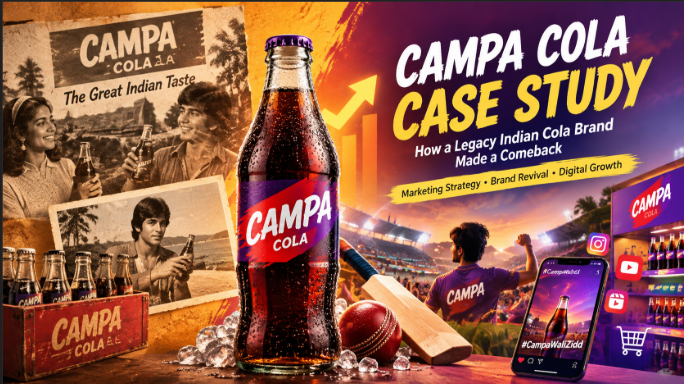
A brand that once competed for space alongside some of the biggest names in India’s soft drink market eventually disappeared from mainstream retail. For years, Campa Cola existed largely as a memory for consumers who grew up with it. Then, decades later, it came back.
But the modern story is not simply about nostalgia. It is a case study in brand revival, disruptive pricing, distribution strategy, digital marketing, sports marketing, celebrity branding, nostalgia marketing, and supply-chain scale.
When Reliance Retail acquired the Campa brand in 2022, it acquired an established identity that already had recognition among Indian consumers. The challenge was to transform that historical familiarity into modern relevance. This case study examines how the brand was created, why it became popular, what caused its decline, why Reliance brought it back, and how its marketing is attempting to challenge Coca-Cola and PepsiCo.
Campa Cola Case Study: Quick Overview
| Category | Details |
|---|---|
| Brand | Campa Cola |
| Original Launch | 1977 |
| Original Company | Pure Drinks Group |
| Founder/Promoter | Charanjit Singh |
| Origin | New Delhi, India |
| Original Positioning | Indian alternative to foreign cola |
| Historical Tagline | “The Great Indian Taste” |
| Reliance Acquisition | 2022 |
| Reported Acquisition Value | ₹22 crore |
| Modern Relaunch | March 9, 2023 |
| Current Operator | Reliance Consumer Products Limited |
| Key Price Point | ₹10 for 200 ml PET |
| Major 2025 Campaign | Campa Wali Zidd |
| Brand Ambassador | Ram Charan |
| Major Sports Platform | Cricket / IPL |
| Modern Positioning | “Naye India Ka Apna Thanda” |
The Story of Campa Cola Begins in 1977
In 1977, Coca-Cola left India following regulatory changes related to the Foreign Exchange Regulation Act, creating a major gap in the carbonated soft drink market. Pure Drinks, previously involved in Coca-Cola’s bottling and distribution in India, found itself with manufacturing infrastructure, distribution capabilities and a workforce that could no longer depend on Coca-Cola. Instead of letting those assets sit idle, the company created its own cola: Campa Cola.
It entered with the positioning “The Great Indian Taste.” More than a slogan, Campa represented an Indian alternative at a time when foreign beverage brands had largely disappeared. The launch benefited from:
- An existing market for carbonated soft drinks
- Established bottling infrastructure
- Existing distribution relationships
- Consumers already familiar with cola
- The absence of Coca-Cola
- A rapidly developing domestic beverage industry
The brand did not have to convince consumers that cola was a category. Campa simply had to become one of the brands they chose.
Why Campa Cola Became Popular
Early growth was not the result of one campaign, but of several advantages working together.
Existing Bottling Infrastructure
Pure Drinks had previously worked with Coca-Cola and understood the operational requirements of producing and distributing carbonated beverages, which gave Campa an important head start. Instead of building a beverage ecosystem from zero, it repurposed bottling facilities, returnable glass bottles, distribution routes, technical employees, retail relationships and production knowledge.
Campa Cola’s Product Strategy
The research dossier describes the historical flavour profile as sweet, relatively low-acid and vanilla-forward. Consumers already had expectations of what a cola should taste like, so Campa provided a familiar drink under a domestic brand. Campa Orange and Campa Lemon followed in the early 1980s, letting the company compete across multiple occasions.
Campa Cola’s Advertising Strategy in the 1980s
A product can be functional, but a brand has to create an emotion. In the late 1970s and 1980s, Campa used print, cinema and television to associate the drink with youth, entertainment, leisure and modern lifestyles. One notable campaign: “Life is full of Campa Cola times.” Campa was selling moments.
This emotional positioning helped Campa establish relevance among younger urban consumers.
The Salman Khan Connection
In 1983, a Campa advertisement filmed in the Andaman Islands featured a young Salman Khan, then only 15. It portrayed adventure, youth, leisure and an aspirational lifestyle, connecting Campa with youth, adventure, cinema, travel and modern Indian culture. Decades later, it became part of the brand’s nostalgia value.
Campa Cola vs Thums Up: India’s Domestic Cola Battle
Parle Exports developed Thums Up, another major domestic cola. The two developed different personalities.
- Campa: urban leisure, youth, social occasions, a sweeter profile, modern lifestyle imagery
- Thums Up: adventure, strength, high carbonation, a distinctive spicy flavour, masculine positioning
Competing products do not necessarily need different categories. They need different reasons for consumers to choose them. Both sold cola, but different identities.
What Went Wrong With Campa Cola?
Campa’s decline cannot be explained by competition alone. The return of multinationals after liberalization changed the environment. Coca-Cola returned in 1993 and acquired Parle’s portfolio, including Thums Up, Limca, Gold Spot and Maaza, gaining an established Indian distribution network. Pepsi was also expanding aggressively. Campa suddenly faced companies with enormous financial resources, powerful marketing and sophisticated distribution. But external competition was only part of the problem.
Internal Problems Weakened the Brand
Following the death of promoter Charanjit Singh, the Pure Drinks Group became involved in succession and estate disputes. The resulting management problems affected its ability to invest in manufacturing, retail infrastructure, marketing, distribution, refrigeration and brand development.
The Importance of Retail Refrigeration
Consumers generally prefer carbonated beverages cold. During the 1990s, Coca-Cola and Pepsi invested heavily in branded refrigerators and coolers at retail stores, so a shopper would see chilled bottles prominently displayed. Campa lacked the financial ability to deploy cooling at comparable scale, and could lose the consumer at the final stage of the buying journey.
The Disappearance of Campa Cola
By the late 1990s and early 2000s, Campa had lost much of its mainstream visibility. Between 2000 and 2001, major New Delhi bottling facilities associated with the brand were closed, and the brand gradually disappeared from mainstream retail. For younger consumers, Campa effectively stopped existing. For older consumers, the product disappeared. The memory did not, and it would become one of the brand’s greatest assets.
The ₹22 Crore Acquisition That Changed Everything
In August 2022, Reliance Retail acquired the Campa brand, trademarks and intellectual property from Pure Drinks, widely reported at approximately ₹22 crore. Reliance was building its FMCG business through Reliance Consumer Products Limited. A new beverage brand would need years of investment in awareness, distribution, trust, packaging, marketing and retail relationships. Campa already had historical recognition, which Reliance could combine with its own manufacturing, retail and distribution capabilities.
The Modern Relaunch of Campa Cola
Reliance Consumer Products relaunched Campa Cola, Campa Orange and Campa Lemon on March 9, 2023. It was designed as a modern FMCG launch, with new packaging and a contemporary visual identity while retaining elements of historical recognition.
Campa Cola’s ₹10 Pricing Strategy
The brand introduced a 200 ml PET bottle at around ₹10. The strategy was not simply about being cheaper but about lowering the barrier to trial. In mass-market FMCG, that can encourage:
- Trial
- Repeat purchases
- Impulse buying
- Retailer stocking
- Student consumption
- Tier-2 and Tier-3 market penetration
The dossier also identifies higher retailer margins as part of the strategy: approximately 6–8% in certain channels, compared with lower typical margins for established competitors.
Why Retailers Matter in Campa’s Strategy
A beverage company needs its product to be available, visible, affordable, chilled and profitable for the retailer. Reliance’s retail ecosystem gives Campa access to modern retail while its B2B and distribution infrastructure supports independent retailers, a major advantage over a startup building distribution from zero.
Reliance’s Distribution Advantage
General Trade
Kirana stores remain critical. Campa uses retailer incentives and distribution partnerships to increase availability.
Modern Retail
Reliance’s own network, such as Smart Bazaar, Reliance Fresh and Smart Point, provides direct consumer access.
E-Commerce
Campa products can be sold through online grocery platforms.
Quick Commerce
Platforms such as Blinkit, Zepto and Instamart offer fast delivery routes.
Institutional and Food-Service Channels
Restaurants, events and other consumption occasions. The result is a multi-channel strategy rather than dependence on one route to market.
Campa Cola’s Digital Marketing Strategy
Today’s consumers discover products through digital platforms. Campa uses Instagram, YouTube, Connected TV, OTT, quick-commerce apps and digital advertising, connecting the brand with cricket, food, youth culture, festivals, entertainment, humour, motivation and everyday consumption. Social media lets the brand communicate repeatedly rather than depending entirely on large television campaigns.
Campa and Cricket Marketing
Cricket can help a mass-market beverage reach Indian consumers at enormous scale. Campa has used cricket partnerships and IPL-related media for national visibility. Consumers watch matches while eating snacks and drinking beverages, so Campa becomes part of the occasion rather than advertising around it. This is occasion-based marketing: not only “Who should buy Campa?” but “When should people drink Campa?”
The “Campa Wali Zidd” Campaign
In 2025, Campa introduced “Campa Wali Zidd” featuring Ram Charan. Earlier marketing was strongly tied to nostalgia; this introduced determination, associating Campa with people who refuse to give up. Instead of only “Remember Campa?”, the brand could ask “What does Campa represent today?”
Campa Cola’s Nostalgia Marketing Strategy
For older consumers, Campa can trigger memories of childhood, summer holidays, family outings, school and college years, old advertisements, glass bottles and 1980s pop culture. But nostalgia alone would not build a modern mass-market brand. Campa can appeal to two audiences:
- Older consumers: Campa = memory.
- Gen Z: Campa = retro culture + Indian identity + affordable modern beverage.
Nostalgia becomes a visual and cultural aesthetic.
Campa Cola’s Gen Z Strategy
- Affordable pricing: a ₹10 entry point attracts students and younger consumers.
- Short-form video: Reels and digital video communicate through entertainment.
- Cricket: mass reach and cultural relevance.
- Celebrity association: Ram Charan as a contemporary face.
- Quick commerce: younger consumers are comfortable with app-based purchases.
Campa’s Product Portfolio Expansion
- Campa Cola: the flagship cola
- Campa Orange: citrus-flavoured carbonated beverage
- Campa Lemon: lemon-lime carbonated beverage
- Campa Cricket: functional isotonic beverage for sports and hydration
- Campa Power Up: caffeinated energy segment
- Campa Sure: packaged drinking water
If Campa remained only a cola, growth would be limited to one category. Adjacent categories increase consumption occasions and retail presence.
Campa Cola vs Coca-Cola and Pepsi
| Factor | Campa | Coca-Cola / PepsiCo |
|---|---|---|
| Brand Heritage | Strong Indian heritage | Global heritage |
| Price Strategy | Aggressive value pricing | Established price architecture |
| Retail Backing | Reliance ecosystem | Large established distribution |
| Sports Marketing | Cricket-focused | Major global and Indian sports properties |
| Nostalgia | Very strong | Strong but different |
| Manufacturing Scale | Rapidly expanding | Mature and extensive |
| Gen Z Strategy | Modern + retro | Established youth marketing |
| Portfolio | Expanding rapidly | Extremely diversified |
Campa does not need to beat established brands at everything. Its advantages: Indian heritage + aggressive pricing + Reliance distribution + nostalgia + modern marketing.
The Real Business Strategy Behind Campa Cola
At a deeper level, the revival represents a broader FMCG strategy. Reliance can use Campa as a high-frequency consumer product that helps expand its FMCG distribution network. Beverage purchases happen frequently, creating retail relationships that can potentially support other Reliance Consumer Products, making Campa valuable beyond cola revenue.
Reliance’s Supply Chain Advantage
Reliance has significant industrial and manufacturing capabilities. The research dossier highlights access to petrochemical infrastructure and PET-related raw materials, which can help packaging economics and supply-chain control. For a mass-market beverage sold in millions of units, small cost differences matter.
Campa Cola’s Biggest Marketing Lessons
Lesson 1: Brand Equity Can Survive a Long Absence
The name retained emotional recognition, showing the long-term value of brand memory.
Lesson 2: Nostalgia Is a Marketing Asset
A forgotten brand may keep valuable associations. The challenge is converting them into modern relevance.
Lesson 3: Price Can Accelerate Trial
The ₹10 positioning creates a simple proposition with little friction.
Lesson 4: Distribution Can Be More Powerful Than Advertising
A product that is everywhere can outperform one that is famous but hard to find. The revival is as much a distribution story as a marketing story.
Lesson 5: Retailers Are Part of the Marketing Funnel
Retailers decide what is stocked, displayed and recommended; an attractive commercial proposition can influence visibility.
Lesson 6: Heritage Brands Need New Meaning
“We are back” is not enough. The shift from nostalgia to determination through “Campa Wali Zidd” shows the need for a contemporary narrative.
Lesson 7: Digital Marketing Extends Mass-Media Campaigns
Television and cricket create awareness; Reels, memes, short videos, creator content, product posts and quick-commerce promotions continue the conversation.
What Made the Campa Cola Revival Different?
Reliance did not rebuild the original company as it was. It combined three assets: historical brand equity (people already knew the name), modern infrastructure (manufacturing, distribution, retail) and modern marketing (digital media, sports, celebrity, quick commerce).
Campa Cola’s Current Business Momentum
According to the research dossier, Campa’s gross sales crossed approximately ₹4,700 crore in FY 2025–26, while Reliance continued investing heavily in beverage manufacturing capacity. The dossier also reports substantial capital committed to expanding production and double-digit market share in selected regional and Tier-2 markets.
These figures should be understood in context: detailed regional volumes, unit economics and proprietary financial information are not publicly disclosed. What is clear is that Campa has moved beyond a simple nostalgia relaunch and become a serious participant in India’s beverage market.
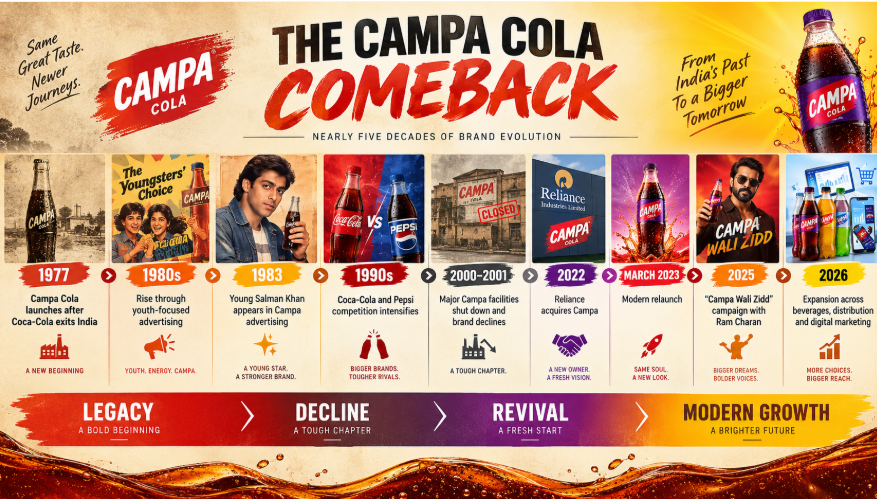
The Campa Cola Comeback in One Timeline
- 1949–1950 Pure Drinks becomes associated with Coca-Cola bottling and distribution in Northern India.
- 1977 Coca-Cola exits India following regulatory changes; Pure Drinks launches Campa Cola.
- 1980s Expansion through television, cinema and print advertising.
- 1983 The Andaman Islands commercial features a young Salman Khan.
- 1989–1990 Pepsi enters India; competition intensifies.
- 1991–1993 Economic liberalization changes the beverage industry.
- 1993 Coca-Cola returns and acquires Parle’s beverage portfolio.
- 2000–2001 Major Campa bottling facilities in Delhi shut down.
- 2000s–2021 Campa largely disappears from mainstream retail.
- August 2022 Reliance acquires Campa’s brand and IP.
- March 9, 2023 Campa officially relaunches.
- 2023–2024 Distribution expands; value proposition developed aggressively.
- 2025 “Campa Wali Zidd” launches with Ram Charan.
- 2025–2026 Expansion in manufacturing, categories, sports marketing and geography.
SWOT Analysis of Campa Cola
Strengths
- Strong historical recognition
- Indian heritage
- Powerful nostalgia factor
- Reliance’s distribution ecosystem
- Aggressive pricing
- Growing manufacturing capacity
- Strong cricket association
- Expanding portfolio
Weaknesses
- Legacy perception among some consumers
- Taste comparisons with established colas
- Uneven chilled availability
- Much smaller historical scale
- Need to keep modernizing perception
Opportunities
- Tier-2 and Tier-3 cities
- Rural consumption
- Gen Z
- Quick commerce
- Energy drinks
- Sports beverages
- Packaged water
- Indian diaspora markets
- Nostalgia-led digital campaigns
Threats
- Coca-Cola’s distribution strength
- PepsiCo’s marketing capabilities
- Price competition
- Retailer exclusivity
- Consumer taste loyalty
- Heavy competitor ad spend
What Can Other Brands Learn From Campa Cola?
A common mistake is believing that brand revival means bringing back the old logo and packaging. Campa’s story suggests a successful revival requires:
If you only bring back the old identity, consumers may remember you. If you combine it with a strong modern value proposition, they may actually buy from you.
Final Analysis: Why Campa Cola Is More Than a Nostalgia Story
The deeper case study is how a dormant brand can get a second life when combined with the right business infrastructure. In the 1970s Campa benefited from a market vacuum; in the 1980s it built cultural relevance through advertising; in the 1990s it struggled against global competition and internal challenges; in the 2000s it largely disappeared; in 2022 Reliance acquired it; from 2023 it returned with a fundamentally different growth engine.
The modern strategy combines affordable pricing, retail distribution, manufacturing scale, cricket, celebrity marketing, nostalgia, digital media, quick commerce and product expansion. That makes Campa one of the most fascinating Indian FMCG case studies of recent years.
For marketers, entrepreneurs and FMCG companies, it is a case study in how brand equity can become a growth asset decades after a product disappears.
How UPMARKE Reads This Case
This section is UPMARKE analysis, not source-derived fact. We don’t just look at the marketing channel. We look at the business. Campa’s story fits that lens: Understand (the brand’s dormant memory), Identify (distribution and price as the gaps), Strategise (heritage plus modern positioning), Execute (retail, cricket, digital) and Measure (market share and sales, where disclosed).
 ★✦
Daksh Toor
Daksh Toor is a digital marketing strategist focused on understanding how businesses can use SEO, social media, content and digital experiences as part of a connected growth system.
At UPMARKE, his approach starts with understanding the business, identifying growth opportunities and connecting the right digital channels to those objectives.
Sources & Editorial Note
Source-derived: facts in this article come from the source article and its referenced research dossier; the financial figures are as reported there. Brand reference: campabeverages.com. UPMARKE analysis: the lessons, comparisons and strategic interpretation. Detailed regional volumes and unit economics are not publicly disclosed.
Frequently Asked Questions About Campa Cola
When was Campa Cola launched?
Campa Cola was launched in India in 1977 by the Pure Drinks Group after Coca-Cola exited the Indian market.
Who originally owned Campa Cola?
It was developed and operated by the Pure Drinks Group under promoter Charanjit Singh.
Who owns Campa Cola now?
The brand is operated by Reliance Consumer Products Limited, part of the Reliance group.
When did Reliance acquire Campa Cola?
Reliance Retail acquired the brand, trademarks and IP in August 2022, widely reported at approximately ₹22 crore.
When was Campa Cola relaunched?
On March 9, 2023, along with Campa Orange and Campa Lemon.
What was Campa Cola’s famous tagline?
One of its most famous historical taglines was “The Great Indian Taste.”
What is Campa Wali Zidd?
A modern Campa campaign centered on determination, resilience and personal ambition, featuring actor Ram Charan.
Why did Campa Cola disappear?
Increased competition after liberalization, Coca-Cola’s return, promoter and succession disputes, factory closures and limited investment in modern retail refrigeration and distribution.
Why is Campa Cola successful again?
It combines historical recognition with aggressive pricing, Reliance’s distribution network, manufacturing scale, sports marketing, digital campaigns and nostalgia-driven branding.
What is the biggest lesson from the Campa Cola case study?
Brand equity alone is not enough, but combined with distribution, pricing, product strategy and modern marketing it can create a powerful revival opportunity.
Conclusion
The Campa Cola story spans almost five decades of Indian business history. It began as a domestic response to a major change in India’s beverage market, became a recognizable youth brand, declined as competition intensified, disappeared, and returned with one of India’s largest business groups behind it. That makes it a fascinating example of brand revival and FMCG marketing strategy in India.
Its future depends on whether Reliance can convert the curiosity around the comeback into long-term loyalty. But Campa Cola is no longer just a memory from India’s past. It has become a modern challenger in India’s beverage market.
Looking at your own brand’s next chapter?
We don’t just market businesses. We understand them.
Talk to UPMARKE
Leave a Reply