The way people discover brands is changing. For years, businesses focused mainly on Google rankings, social media audiences, paid advertising, and traditional content marketing. Those channels still matter, but another layer of digital discovery is becoming increasingly important: AI-powered search and conversational answers.
People are now asking AI tools questions such as:
- “Which digital marketing agency should I hire?”
- “What are the best marketing strategies for jewellery businesses?”
- “How can I get more customers online?”
- “Which SEO agency is good for a small business?”
Instead of simply receiving a page of links, users can receive a detailed answer, comparison, explanation, or recommendation.
This is where ChatGPT Optimization becomes important.
ChatGPT Optimization is the process of making your brand, website, content, and online information easier for AI systems to understand, evaluate, and potentially reference when answering relevant questions.
It is closely connected with SEO and Answer Engine Optimization (AEO), but the objective is slightly different. SEO focuses heavily on search engine visibility, while ChatGPT Optimization focuses on making your brand clear, relevant, useful, and trustworthy within AI-powered conversations.
In 2026, this can become an important part of building long-term brand visibility.
What Is ChatGPT Optimization?
At its core, ChatGPT Optimization means creating a stronger digital identity for your business so that AI systems can better understand what your brand does, who it serves, what it specializes in, and why it may be relevant to a particular question.
Traditional SEO asks:
“How can I rank this page higher?”
ChatGPT Optimization asks another important question:
“How can I make my brand easier for AI systems to understand when someone asks a question related to my industry?”
That requires more than inserting keywords into articles.
AI needs context.
It needs to understand your services, expertise, location, industry, customer base, reputation, and the information available about your business across the web.
For example, imagine you own a jewellery business.
Simply publishing dozens of pages containing the phrase “best jewellery store” is not a complete ChatGPT Optimization strategy.
A stronger approach would include helpful jewellery buying guides, product information, educational content, customer questions, local business information, reviews, expert insights, and consistent brand information.
This creates a much stronger foundation for ChatGPT Optimization.
Why Brand Visibility Is Changing in 2026
Search behavior is becoming more conversational.
A potential customer may previously have searched:
“digital marketing agency Delhi”
Now, they may ask:
“I run a small jewellery business in Delhi. Which digital marketing strategies should I use to get more customers?”
The second question provides significantly more context.
This is important because AI-powered systems can understand questions based on meaning and intent rather than simply matching individual keywords.
A well-planned ChatGPT Optimization strategy helps businesses prepare for this change.
However, there is an important point to understand.
There is no secret technique that guarantees ChatGPT will recommend your company.
You cannot simply optimize one page and expect your brand to appear in every relevant AI response.
Instead, ChatGPT Optimization is about creating strong signals around your business through useful content, expertise, consistent information, and a trustworthy digital presence.
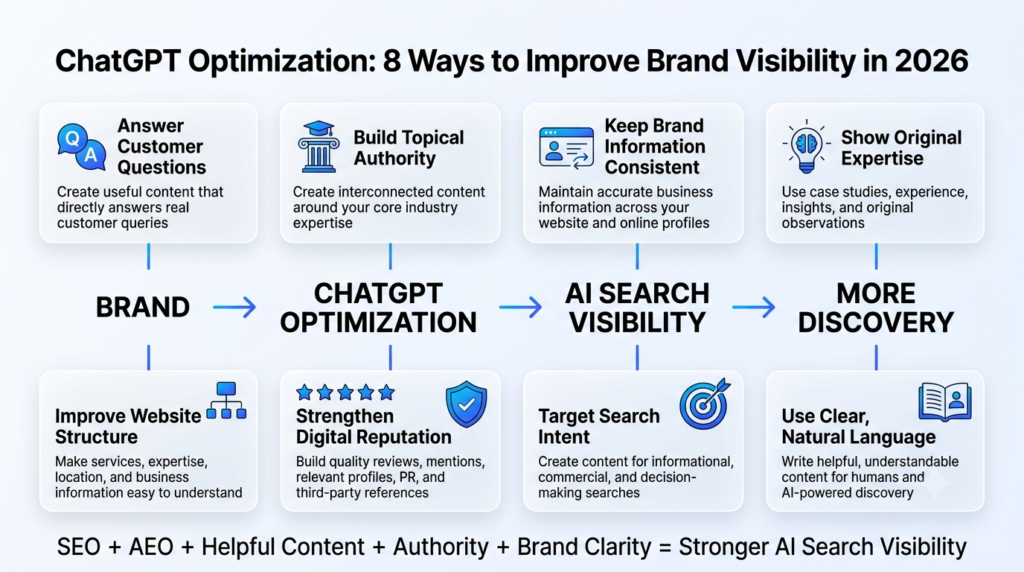
1. Create Content That Answers Real Customer Questions
One of the most important parts of ChatGPT Optimization is answering the questions your customers are already asking.
Think about what people want to know before they purchase your product or service.
For a digital marketing agency, these questions might include:
- How much does SEO cost for a small business?
- Is SEO better than Google Ads?
- How can a local business generate more leads?
- What should a jewellery business post on Instagram?
- How long does SEO take to show results?
- What is AEO?
- How can businesses appear in AI search?
Instead of creating generic promotional articles, build content that genuinely answers these questions.
This approach makes ChatGPT Optimization more useful because the content gives AI systems clear information about your expertise.
It also supports traditional SEO and AEO.
The best content does not feel as though it was written for an algorithm. It feels like an experienced professional is sitting across the table and explaining something to a customer.
That should be the goal of ChatGPT Optimization.
2. Build Strong Topical Authority
AI systems need context.
If your website publishes one article about SEO, another about restaurants, another about fitness, and another about cryptocurrency, your overall expertise can become difficult to understand.
A focused content strategy is stronger.
For example, a digital marketing agency targeting jewellery businesses could create a content cluster around:
- Digital marketing for jewellery businesses
- SEO for jewellery stores
- Social media marketing for jewellers
- Google Business Profile strategies
- AEO for jewellery businesses
- AI search for jewellery brands
- Content marketing for jewellery businesses
- Local SEO for jewellery stores
This type of topical structure creates stronger context around your expertise.
It also makes ChatGPT Optimization much more natural because your website repeatedly demonstrates knowledge in a specific area.
Instead of trying to become an expert in everything, ChatGPT Optimization works better when your brand develops recognizable areas of expertise.
3. Keep Your Brand Information Consistent
Brand consistency is often ignored when businesses think about ChatGPT Optimization.
Imagine your website says that your company specializes in SEO, AEO, web design, and performance marketing.
Your LinkedIn profile says you are primarily a web development company.
A business directory describes you as a general advertising agency.
Another platform lists different services.
This creates confusion.
A strong ChatGPT Optimization strategy should make your important business information consistent across your digital footprint.
Keep details such as these accurate:
- Business name
- Services
- Industry specialization
- Location
- Website
- Team information
- Business description
- Areas served
You do not need to copy the exact same sentence everywhere.
The important thing is that the underlying information remains consistent.
When your digital presence tells the same overall story, ChatGPT Optimization becomes more effective because your brand has a clearer identity.
4. Publish Original Insights and Experience
The internet is already full of generic content.
AI-generated articles have made this problem even bigger.
That makes original experience increasingly valuable.
If you have worked with a particular type of business, explain what you learned.
If a campaign produced an interesting result, turn that experience into a case study.
If you tested two strategies and one performed better, explain what happened and why.
This is one of the strongest areas where ChatGPT Optimization overlaps with E-E-A-T principles.
For example, instead of writing:
“SEO is important because it improves online visibility.”
You could explain a real observation:
“Many service businesses struggle because their websites target broad keywords but fail to answer location-specific customer questions.”
The second example contains an actual insight.
It provides more depth and demonstrates experience.
That makes original experience an important part of ChatGPT Optimization.
5. Strengthen Your Website Structure
Your website remains one of your most important digital assets.
A visually attractive homepage is useful, but design alone is not enough.
Your website should clearly answer:
Who are you?
What do you offer?
Who do you serve?
Where do you operate?
Why should customers trust you?
What evidence supports your expertise?
Good ChatGPT Optimization starts with making these answers easy to discover.
Use descriptive page titles, logical headings, clear service pages, useful internal links, author information where relevant, and well-organized content.
Do not hide important business information inside images or vague marketing statements.
If a human visitor struggles to understand your business, an AI system can also have difficulty understanding it.
Clear website architecture therefore becomes an important part of ChatGPT Optimization.
6. Use Natural Language Instead of Keyword Stuffing
One common mistake is treating ChatGPT Optimization exactly like old-school keyword stuffing.
Repeating a phrase dozens of times does not automatically make content authoritative.
In fact, excessive repetition can make an article uncomfortable to read.
Use natural language.
Explain concepts.
Give examples.
Answer related questions.
Use terminology that your customers actually understand.
For example, an article about SEO for jewellery businesses can naturally discuss local search, product pages, Google Business Profile, customer reviews, content marketing, technical SEO, and online reputation.
The subject becomes much richer without forcing the same phrase into every sentence.
Effective ChatGPT Optimization should improve content quality rather than reduce it.
The goal is to make the content useful for both people and AI-powered discovery.
7. Build Your Digital Reputation
Your website is only one part of your online presence.
A complete ChatGPT Optimization strategy should consider the broader digital ecosystem around your business.
Depending on your industry, this can include:
- Google Business Profile
- Business directories
- Industry websites
- PR coverage
- Guest contributions
- Customer reviews
- Social media profiles
- Relevant third-party websites
The goal is not to create hundreds of low-quality profiles.
Quality matters more than quantity.
A small number of relevant, credible, accurate references can be more valuable than hundreds of spammy listings.
This is another reason why ChatGPT Optimization should be treated as a brand-building activity rather than simply another keyword strategy.
Your website tells one part of your story.
Your wider digital presence should support that story.
8. Create Content Around Search Intent
Understanding search intent is another important part of ChatGPT Optimization.
Consider these three searches:
“What is SEO?”
“SEO agency for jewellery business”
“Should I hire an SEO agency for my jewellery store?”
They represent different stages of the customer journey.
The first is informational.
The second is commercial.
The third is decision-oriented.
Your content strategy should address all three.
Create educational content for people who are learning.
Create service pages for people comparing solutions.
Create case studies, guides, and comparison content for people who are closer to making a decision.
This gives your brand more opportunities to become relevant to different conversations.
A strong ChatGPT Optimization strategy considers the complete customer journey rather than targeting only one keyword.
9. Use FAQs Strategically
FAQs are not a magic ranking trick, but they are extremely useful for organizing information.
Think about the questions your customers repeatedly ask your sales team.
Then answer them directly on your website.
For a digital marketing agency, these questions could include:
- How long does SEO take?
- What does a digital marketing agency do?
- Do I need SEO if I already use Google Ads?
- Can SEO generate leads for local businesses?
- What is the difference between SEO and AEO?
- How does AI search affect businesses?
Clear FAQ content supports users because they can quickly find answers.
It can also support ChatGPT Optimization because your website contains direct answers to natural-language questions.
When creating FAQs, focus on real customer problems rather than inventing questions simply to insert keywords.
Useful questions create useful content.
10. Make Your Content Easy to Understand
Complex writing does not automatically demonstrate expertise.
In many cases, the opposite is true.
If you can explain a complicated marketing concept in simple language, that demonstrates understanding.
This is especially relevant to ChatGPT Optimization because AI-powered conversations are generally based around questions and answers.
Use:
- Short paragraphs
- Clear headings
- Examples
- Bullet points
- Definitions
- Comparisons
- Step-by-step explanations
Avoid unnecessary jargon.
For example, instead of saying:
“AEO represents a paradigm shift in semantic information retrieval.”
You could say:
“AEO helps businesses create content that directly answers the questions people ask search engines and AI tools.”
The second version is easier to understand.
Clear communication should be a core principle of ChatGPT Optimization.
11. Build Entity and Brand Clarity
A business should be more than a collection of keywords.
Your brand needs an identity.
AI systems should ideally be able to understand relationships between your business, services, industry, location, people, and expertise.
For example:
UPMARKE → Digital Marketing Agency → SEO → AEO → Web Design → Social Media → Performance Marketing
If your website, social profiles, business listings, and content consistently support those relationships, your brand becomes easier to understand.
This is why ChatGPT Optimization should involve more than publishing blog posts.
It should include the overall information architecture of your brand.
A clear brand entity can make your digital presence stronger across multiple discovery channels.
12. Use Case Studies to Demonstrate Expertise
Case studies are powerful because they provide context and evidence.
Instead of simply saying:
“We provide excellent SEO services.”
show what you actually did.
Explain:
- The original problem
- The strategy
- The implementation
- The challenges
- The results
- The lessons learned
Case studies can become valuable assets in a ChatGPT Optimization strategy because they provide detailed information about your expertise.
They also help potential customers understand how you work.
For an agency, even a small case study can be more convincing than several generic claims.
Real examples make your brand more memorable and credible.
ChatGPT Optimization vs SEO: Are They the Same?
No.
SEO primarily focuses on improving visibility within search engines.
ChatGPT Optimization focuses on making your brand and content understandable and relevant within AI-powered conversations.
However, the two strategies overlap significantly.
A technically strong website, useful content, good internal linking, topical authority, consistent business information, and a trustworthy digital reputation can support both.
That means businesses should not abandon SEO.
Instead, ChatGPT Optimization should be viewed as an additional layer of a broader digital marketing strategy.
Think of SEO as helping people discover your content through traditional search.
Think of ChatGPT Optimization as helping your brand become better prepared for conversational and AI-driven discovery.
Both can work together.
Common ChatGPT Optimization Mistakes
Businesses often make several mistakes when starting ChatGPT Optimization.
Writing Only for AI
If your content sounds robotic, customers will notice.
Always write for people first.
Publishing Huge Amounts of Generic Content
More content does not automatically equal more authority.
Ten genuinely useful articles can be more valuable than one hundred shallow ones.
Making Unsupported Claims
Do not repeatedly call your company “the best” without evidence.
Explain what makes your business different and provide proof where possible.
Ignoring Your Existing Digital Footprint
Your website cannot tell one story while your social profiles and directories tell another.
Keep important information accurate.
Expecting Instant Results
ChatGPT Optimization is not a shortcut.
It is part of a long-term content, authority, and brand strategy.
Focusing Only on One Keyword
AI conversations are not limited to one exact keyword.
Customers can ask the same question in many different ways.
Build content around topics, entities, questions, and intent rather than one phrase alone.
How to Start ChatGPT Optimization for Your Business
If your business has never worked on ChatGPT Optimization before, start with the basics.
Step 1: Audit Your Existing Digital Presence
Check your website, Google Business Profile, social media profiles, directories, and other important platforms.
Look for inconsistencies.
Step 2: Identify Your Core Expertise
Determine the topics your business genuinely wants to be known for.
Do not try to cover everything.
Step 3: Research Customer Questions
Talk to customers and sales teams.
Find out what people actually ask before making a purchase.
Step 4: Create Helpful Content
Build articles, FAQs, guides, comparison pages, case studies, and service content around those questions.
Step 5: Improve Website Structure
Make your services, expertise, location, contact information, and business identity easy to understand.
Step 6: Strengthen Your Reputation
Build relevant reviews, mentions, partnerships, PR, and credible third-party references.
Step 7: Keep Everything Consistent
Review your digital presence regularly and update outdated information.
This gives your ChatGPT Optimization strategy a solid foundation.
How to Measure Brand Visibility in AI Search
Traditional SEO provides familiar metrics such as rankings, impressions, clicks, and organic traffic.
AI-powered discovery requires a broader view.
Businesses can monitor:
- Branded search growth
- Organic visibility
- Direct traffic
- Referral traffic
- Brand mentions
- Customer questions influenced by AI
- Leads generated through content
- Growth in branded searches
- Visibility across relevant AI prompts
You can also periodically test relevant questions to understand how your industry and competitors are represented.
However, do not treat one AI answer as a permanent ranking.
AI responses can change based on the question, context, model, information available, and other factors.
The purpose of ChatGPT Optimization is to strengthen your overall digital presence rather than chase one isolated AI response.
The Future of ChatGPT Optimization in 2026
The biggest change is not simply that people are using AI.
It is that people are becoming more comfortable asking complete questions instead of searching for individual keywords.
Customers want explanations.
They want comparisons.
They want recommendations.
They want solutions.
They want answers that are relevant to their specific situation.
That makes ChatGPT Optimization increasingly relevant for brands that want to remain visible as digital discovery evolves.
Businesses that only focus on individual keywords may miss this shift.
Businesses that build genuine expertise, useful content, consistent information, and a strong digital reputation can position themselves for multiple discovery channels.
That is why ChatGPT Optimization should not be treated as an isolated marketing trick.
It should become part of a broader strategy involving SEO, AEO, content marketing, branding, digital PR, reputation management, and customer experience.
Final Thoughts
Brand visibility in 2026 is no longer only about appearing at the top of a traditional search results page.
It is also about being understood.
When customers ask questions about your industry, your brand should have a clear digital identity behind it.
Your website should explain what you do.
Your content should demonstrate expertise.
Your business profiles should provide consistent information.
Your reputation should support your claims.
And your content should genuinely help the people you want to reach.
That is the real opportunity behind ChatGPT Optimization.
You cannot guarantee that ChatGPT will recommend your business. No legitimate ChatGPT Optimization strategy can promise that.
What you can do is make your brand more useful, credible, relevant, understandable, and discoverable across the digital ecosystem.
As AI-powered discovery continues to evolve, businesses that invest in ChatGPT Optimization alongside SEO and AEO can build a stronger foundation for long-term visibility.
For brands serious about growth in 2026, ChatGPT Optimization is not simply another marketing buzzword. It is becoming an important way to think about how your brand is understood in an increasingly AI-driven internet.

Leave a Reply