
Established on-line is no longer a choice for small businesses. One of the first things that people usually do when they need a product or service is search on Google. They might type in “digital marketing agency near me,” “best salon in Delhi,” “bakery near me,” or “plumber in my area. The intent of these searches is typically local, so it is likely that the searcher is looking to contact, visit, or purchase from a local business.
This is where Local SEO in 2026 comes into play. Local SEO increases the visibility of small businesses in Google Search and Google Maps when they are looking for products or services in their area. Even a small business can play in the big boys game with a good strategy and make the internet a source of phone calls, visitors, inquiries and customers within its target area.
What Is Local SEO?
The definition of local SEO, or local search engine optimization, is to optimize a business online such that it shows up in local search queries. Traditional SEO can get a website to people all over the world, while Local SEO is concerned with obtaining customers who are looking for a business in a specific area.
For instance, if a user types the keyword “SEO agency” into the search engine, they have a wide search intent. But if someone types in “SEO agency in Delhi” or “SEO agency near me”, they’re more likely to have a local intent. Local SEO encompasses a number of activities, such as optimizing your Google Business Profile, optimizing your website, gathering authentic reviews, ensuring that your business information is correct, producing valuable local material, and establishing online authority.
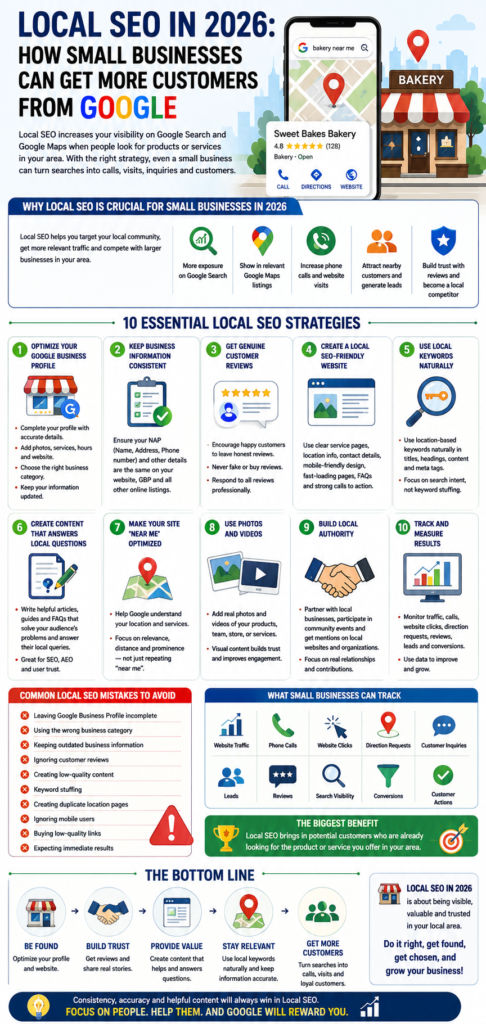
Why Local SEO is crucial for Small Businesses in 2026?
Often small business can have small budgets and it is not always possible to out compete larger companies for the most competitive keywords in the market. The good thing about local SEO is that it offers you a chance to target a certain community and locality. A local business could target more relevant search queries, as opposed to competing on a broader keyword, nationally.
For instance, if you have a small clothes shop in Delhi, you don’t have to be looking for “clothes shop in India.” It can be more advantageous to show up when a person types in “women’s clothing store in Delhi” or clicks on “Find a clothing store near me”.
Local SEO can assist small businesses in the following ways:
- Get more exposure on Google Search.
- Show in relevant Google Maps listings
- Increase phone calls.Increase calls by phone.
- Increase website visits
- Attract nearby customers
- Use customer reviews to help build trust.
- Generate qualified leads
- Become a competitor to larger businesses in the local community
The greatest benefit is that Local SEO brings in a potential customer base who are looking for the product or service you are providing.
Optimize Your Google Business Profile
The most crucial aspect of Local SEO is the creation and optimization of a Google Business Profile. The profile can contain business details like the business name, the type of business, address/s or service area, telephone number, website address, hours, photos, services, and customer reviews – all of which can be important for eligible businesses.
A full and genuine profile enables prospective customers to better comprehend the business before they reach out. It’s important for businesses to review their profile, to ensure that all the information is accurate. Update hours of operation, phone numbers, web addresses or service information if they change, as soon as possible. The business category is also of significance. Select a category that is representative of the business’s primary activity instead of picking one because it seems to be a popular category.
Maintain consistency and integrity of Business Information. One of the key parts to local search optimization is consistency. Information about your business needs to be correct on your website, Google Business Profile and other legitimate online listings.
Pay attention to details such as:
- Business name
- Address
- Phone number
- Website
- Opening hours
- Services
- Business category
Misaligned information can lead to customer confusion and make it more difficult for customers to discern what information is accurate and what is not. For instance, having different phone numbers on your website and Google Business Profile can leave a prospective customer with doubt about whether to reach out to you. Maintaining the accuracy of information helps to ensure a positive customer experience as well as a trustworthy online identity.
Get Genuine Customer Reviews
Local reviews play a crucial role in both local business exposure and customer choices. People check out ratings and reviews before deciding on a local business. Small businesses should establish a straightforward procedure to request honest customer feedback from only their true customers who have used their products or services.
But it is important for businesses to never falsely post reviews or influence ratings. Genuine is more valuable as it is a true customer experience. It’s also good practice to reply to reviews. Appreciate positive feedback and respond professionally to negative feedback. By providing a thoughtful response, potential customers will see that the business is focused on customer experience.
Create a Local SEO-Friendly Website
While having a Google Business Profile is valuable, having a business website is essential for a solid local SEO strategy. Your website provides Google and your potential customers more information about your business. Any website for the local business should be able to convey what the business is, what services are offered, which locations the business serves, and how customers can contact them.
There are a number of important elements at the website:
- Clear service pages
- Location information
- Contact details
- Mobile-friendly design
- Fast-loading pages
- Create clear calls to action. Make clear calls to action.
- Frequently asked questions
- Useful and original content
A digital marketing agency, for instance, could create individual pages for SEO services, social media marketing, Google Ads, and content marketing. This helps users and search engines to have a clearer understanding of the services offered.
Use Local Keywords Naturally
While keywords are important, it’s critical for businesses not to overuse them. Avoid using the same location keyword in the same place on a page. For instance, if you own a business in Delhi, you would naturally employ keywords like “digital marketing services in Delhi,” “SEO services for Delhi businesses,” or “local digital marketing strategies.”
The content should respond to the user’s question, and not just attempt to stuff keywords in it. It’s more important to have search intent than to repeat a phrase a million times. When the content is helpful, it is likely to be helpful for the company’s customers and search engines.
Develop Content that responds to Local Questions.
When content marketing answers the questions and solves the problems of the audience, it can help boost Local SEO.
Some ideas for a local digital marketing company to write articles include:
- How much does a small business spend on SEO?
- What can a local company do to attract more people to Google?
- So, what is Local SEO and why is it important?
- What are some tips for optimizing a Google Business Profile for businesses?
- Which are the top digital marketing strategies for local businesses?
This kind of content can gain the attention of people at various phases of the purchase process. It can also be used for Answer Engine Optimization (AEO) as it directly provides answers to user questions that they may use search engines and AI platforms to question.
Make your site “Near Me” optimised.
Local search behavior is a component of “near me” searches. When they are looking for a nearby option, people will use phrases like “restaurant near me”, “gym near me”, “dentist near me”, or “digital marketing agency near me”. Adding “near me” on the website over and over again is not something businesses should do. When it comes to local results, Google takes into account relevance, distance, and prominence. Rather, businesses ought to be clear about their location and services, keep accurate business information and establish a solid local presence. The idea is for Google to easily see what the business is and where it is based.
Lightly using photos and videos.
A Google Business Profile with visual content can be more helpful to prospective customers. Businesses can upload relevant images and videos that display their product and/or service, team, workplace, store or other authentic elements of their business.
A restaurant can feature their menu items, interior, etc. A salon can demonstrate what it can do and how it can work within the space. A shop can display its clothes and the interior. Top-tier, genuine imagery can give customers an idea of what to expect before they go in or call the company.
Local SEO, AEO and GEO will be around in 2026.
Search is getting more and more conversational. Users are searching longer, using AI-powered search experiences to find info. This is why it is beneficial for small businesses to consider something other than just conventional SEO. AEO (Answer Engine Optimization) is dedicated to offering a direct response to queries from users. Generative Engine Optimization (GEO) is the generation of information that is useful and understandable, especially for AI-powered search experiences.
All three strategies can be implemented by a small business, if they develop correct, clear and valuable information regarding the services, location, knowledge, products and customers questions. A business that operates in a specific area, for instance, might develop a valuable guide that answers common questions customers might have about their services rather than a page stuffed with location-specific terms.
Build Local Authority
Local SEO isn’t just for your site. Your reputation online might be important too. Local authority can be developed by way of authentic relationships, relevant mentions, partnerships, involvement in the community and helpful contributions to local websites or organisations.
A local business can partner with another relevant business, join a community event or donate their expertise to a community publication. It’s about real visibility and connections, not about purchasing low-quality backlinks or generating fake mentions.
Track Local SEO Results
It is necessary to regularly measure SEO. It’s good to have that ranking… but you want business results!
Small businesses can monitor:
- Website traffic
- Phone calls
- Website clicks
- Direction requests
- Customer inquiries
- Leads
- Reviews
- Search visibility
- Conversions
When traffic grows but inquiries fail, the business could benefit from enhancing its website, service pages, calls to action, and/or customer experience. Avoiding common local SEO mistakes is an excellent way to better serve your customers. There are simple errors that many small businesses make which are limiting their visibility on a local level.
Common Local SEO Mistakes to Avoid
It is advisable to avoid leaving the Google Business Profile incomplete. It is better not to leave the Google Business Profile incomplete.
- The inappropriate use of business category.
- Maintaining obsolete business data
- Ignoring customer reviews
- Creating low-quality content
- Keyword stuffing
- Making copies of location pages
- Ignoring mobile users
- Buying low-quality links
- Expecting immediate results
Local SEO is an ongoing process. It’s more important to be consistent and accurate than to cut corners—value is added in the content and experience of the customer.
So, how can small businesses gain more customers from Google? It’s not just a matter of being ranked number one. The ultimate goal of a successful local SEO strategy is to make the right people find your business at the right time.
Optimize your Google Business Profile. Ensure that your business information is correct and complete. Construct a functional website, develop service and location-centric marketing information, solicit authentic reviews, incorporate real photos, and respond to frequently asked questions. Most importantly, ensure that it is easy for your customers to take action. When someone searches your business on Google, they should be able to get a clear idea of what you’re offering, your location, and the amount of information they need to access, and how to reach out to you.
Conclusion
Local SEO in 2026 is among the best digital marketing tactics for small businesses aiming to draw in purchasers from Google. It can help businesses gain visibility, build trust, create inquiries and connect with potential customers searching for their products or services. It’s all about having a good Google Business Profile, having a functional website, having genuine reviews, publishing relevant content, and having local keywords that have been used in a natural way, and having a good customer experience.
With the continual development of search, businesses should not worry about gaming the system, but should be more concerned about offering clear, helpful and trustworthy information. A small business’s Local SEO isn’t just a matter of driving more traffic to its website. It’s about understanding how to get the right customers from Google and put local search into action to find legitimate business opportunities.
Frequently Asked Questions About Local SEO in 2026
1. What is Local SEO in 2026?
In essence, Local SEO 2026 is a strategy to enhance a business’s online visibility to ensure it shows up in local search results on Google Search and Google Maps. It involves optimizing Google Business Profile, website optimization, local content, reviews, and ensuring business information is accurate.
2. How can Local SEO help small businesses?
Local SEO can help small businesses become more visible when potential customers search for relevant products or services nearby. This can lead to more calls, website visits, inquiries, direction requests, and customers.
3. Is Google Business Profile important for Local SEO?
Yes. A properly maintained Google Business Profile is an important part of local search visibility. Businesses can provide information such as their category, hours, website, phone number, services, photos, and customer reviews.
4. How long does Local SEO take to work?
There is no guaranteed timeframe for Local SEO results. Results depend on factors such as competition, location, website quality, business reputation, reviews, and the existing strength of the online presence. Consistent optimization is generally more effective than expecting immediate results.
5. Do reviews help Local SEO?
Genuine reviews can contribute to a business’s prominence and can strongly influence customer trust. Businesses should encourage real customers to leave honest reviews and respond professionally to feedback.
6. Does adding “near me” keywords improve rankings?
Not necessarily. Repeating “near me” throughout website content does not automatically improve rankings. Businesses should focus on accurate location information, relevant services, useful content, and a strong overall local presence.
7. Is Local SEO useful for service-area businesses?
Yes. Service-area businesses can use Local SEO to reach customers within the areas they serve. Their online profiles and website should accurately explain their services and service areas.
8. Do service-area businesses need to be concerned with Local SEO?
Yes. Local SEO is useful for service-area businesses to attract customers in their service areas. Their online profiles and webpage should accurately describe their services and their service areas.
9. How do you acknowledge that you are user-friendly?10. Who is the competition for you?
Typically, SEO is used to increase the visibility of a website in search results, and Local SEO concentrates on optimizing your web page for geographic search queries. Local SEO focuses more on locality and Google Business Profile, on reviews and on local relevance.
10. Is it possible for small businesses to achieve Local SEO in a competitive landscape like that of large companies?
Yes. Unlike large businesses, small businesses can target certain areas and certain audiences without having to be at direct competitive battle with the big boys for large national keywords. Smaller businesses can benefit from a strong local presence to connect with customers in their service areas.
11. Will Local SEO continue to be relevant in 2026?
Yes. Even in this day and age, local SEO is significant since customers are still searching for local products, services and businesses using Google. With a shift toward conversational and AI-powered searches, companies with accurate and reliable local data can boost their online presence.

Leave a Reply