
Often small businesses have big visions with limited resources. In small businesses, the marketer is typically responsible for a number of roles, as compared to large businesses that have a dedicated group for marketing, sales, customer service, content management and data analysis. Time and money are two of the most precious assets for any small company. This is where AI automation for small businesses comes into play. Using AI to reduce repetitive tasks allows businesses to save time, lower marketing expenses, boost productivity, and concentrate more on growth.
AI automation is revolutionizing business digital marketing strategies. AI tools can assist with tasks that were once hours-long manual work like content planning, customer communication, data analysis, email marketing, and social media management. AI is not a replacement for humans, though. Its most important benefit is to enable them to work more efficiently and quickly.
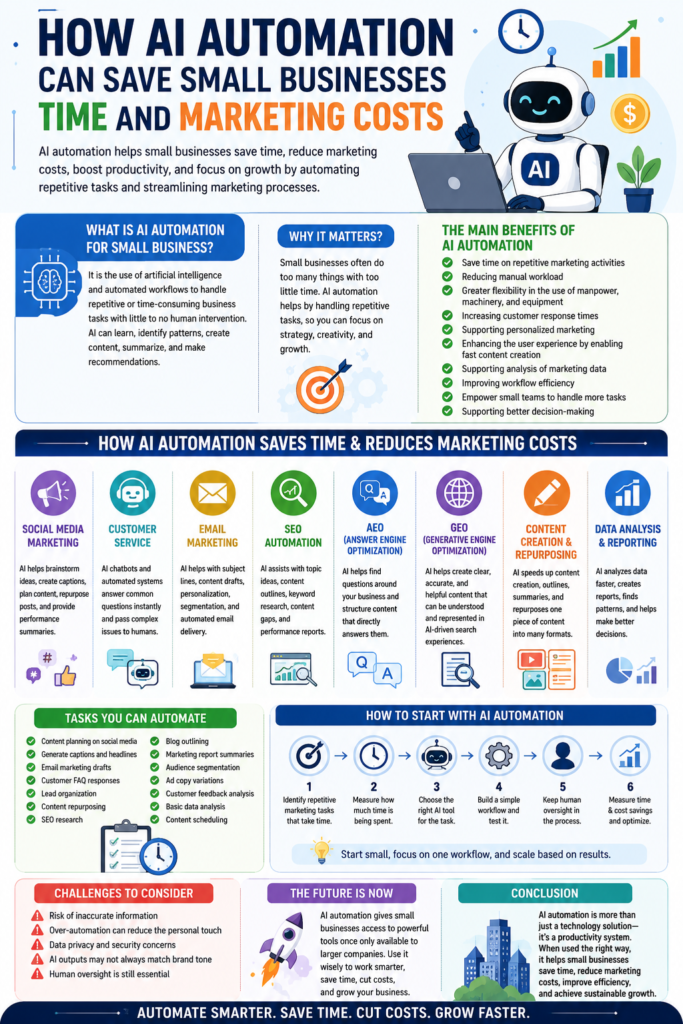
What Is AI Automation for Small Business?
AI automation for small businesses is the ability to do repetitive or time-consuming business operations using artificial intelligence and automated workflows with little to no human intervention. Traditional automation typically operates based on a set of predetermined rules, while AI-driven automation can learn, identify patterns, create content, summarize, and make recommendations.
For instance, an old-fashioned system might be able to automatically email people when they finish filling out a form. An AI-based system has the potential to take it one step further by reading through the customer’s data, figuring out what their interests might be, responding, and even structuring the lead for future communication. This has made AI automation especially beneficial for small businesses as it enables small teams to do more with less work.
Why AI Automation Matters to Small Businesses?
The challenge is common to small businesses: too many things to do, too little time. The business owner has to deal with customers, make content, and keep an eye on social media, email, and the website, as well as generate leads and analyze marketing performance.
It can be a time-consuming and inconsistent marketing process to do all these things by hand. With AI automation, some repetitive aspects of these tasks can be automated, freeing up time for business owners and marketing teams to focus on tasks that call for human judgment and creativity.
The main benefits of AI automation include:
- Save time on repetitive marketing activities
- Reducing manual workload
- Greater flexibility in the use of manpower, machinery, and equipment
- Increasing customer response times
- Supporting personalized marketing
- Enhancing the user experience by enabling fast content creation
- Supporting analysis of marketing data
- Improving workflow efficiency
- Empower small teams to handle more tasks
- Supporting better decision-making
The aim is not just to ‘automate as much as you can’. The aim is to automate the correct tasks and free up time for employees for high-value-added tasks.
How AI Automation Saves Small Businesses Time
Here are some ways AI automation can save time for small business owners. One of the primary benefits of AI automation is time. Many of the marketing activities are repetitive and follow similar processes that recur weekly or monthly.
Take note of social media marketing. A business can need to investigate subjects, develop captions, design material concepts, prepare hashtags, set materials, and review engagement. AI can help brainstorm ideas, plan content, generate captions, repurpose content, and provide performance summaries. We’re not starting from scratch every time, as AI can help marketers develop a draft or generate multiple ideas. The human marketer can then check the output and adjust as needed, add brand personality, and publish it. It can be the same way with blogs and e-mail marketing. AI can help generate topic ideas, create outlines, summarize research, suggest headlines, and develop first drafts. This makes the initial content production process quicker.
AI Automation Can Reduce Marketing Costs
Marketing can be costly if businesses over-depend on manual marketing or if they outsource all marketing activities. Small businesses might find that they don’t have the funds to have their own content writer, social media specialist, customer support representative, email marketer, SEO specialist, or data analyst. Some of these costs can be minimized with AI automation, which can boost the productivity of teams. By leveraging AI-powered tools, one employee can accomplish some repetitive tasks more quickly, enabling the company to get more done without hiring additional people.
A small online store, for instance, could leverage AI to help them with product descriptions, email drafts, social media content ideas, customer FAQs, and marketing reports. Instead of having the business pay for different tasks separately, it can set up a workflow for the business that involves using AI for multiple aspects of the marketing process. But, businesses must not see AI as a substitute to professional skills. If the content is poorly made, information is wrong or it is too automated, it can be detrimental to a brand. However, it is important to note that human input is critical, especially for customer-centric material and key business decisions.
AI Automation for Social Media Marketing
One of the areas where AI automation for small business can save time is social media. Regular content is needed to maintain a consistent presence on Instagram, Facebook, LinkedIn, YouTube or other platforms. Content ideas, captions, content calendars, post variations, audience insights, performance summaries, and more are all areas where AI can assist in various aspects of social media management.
For instance, a business may have one educational blog article and convert it into a number of social media posts. AI can assist in finding key points, generating short-form article concepts, and fine-tuning the message for various platforms.
This repurposing of content can save a lot of time in terms of creating new content. Another way businesses can utilize automation is to plan out content ahead of time. A team can develop the content and schedule it as per the marketing calendar instead of publishing it manually one by one.
AI Automation for Customer Service
Customer service can be time-consuming, especially if customers have repetitive inquiries. Automated systems and AI-enabled chatbots can be helpful in responding to common product/service queries, pricing, shipping, availability, business hours, or any other frequently asked information. For instance, if an online enterprise gets a handful of enquiries regarding delivery, a machine can provide fundamental details instantly. More complex problems are then passed on to a human representative.
This can help them respond faster and have more time to focus on complicated customer issues. But at the same time, customer service shouldn’t be entirely robotic. If a customer has to deal with a very unusual or sensitive matter but is unable to speak to a real person, they may become frustrated. The ideal solution is to take a hybrid approach, using automation along with an ability to quickly access human support.
AI Automation for Email Marketing
Automation can save time with email marketing, too. AI can help with subject lines, campaign ideas, personalization, audience segmentation, and even the initial drafts of emails for businesses. Companies can segment their customer base into various groups, such as those who have previously made a purchase or interacted with their business, and send each group a unique email.
For instance, an online fashion shop can make various e-mail campaigns for the shoppers interested in casual garments, accessories, or seasonal collections. AI can assist marketers in coming up with different versions of the content, and automation can take care of the delivery. This can help make email marketing more relevant without having to spend time building each email.
AI Automation for SEO
SEO is an ongoing process of researching, creating content, optimizing, and monitoring performance. Many of these processes can be aided by AI. AI can help small businesses come up with ideas for content topics, determine content gaps, draft article outlines, analyze content performance, develop FAQ ideas, and summarize performance reports.
A local digital marketing agency might, for instance, gather and apply AI to determine frequent inquiries businesses have regarding SEO. It might then develop content to respond to these questions, and present it in a clear and systematic way. But AI-created content should also be reviewed before it can be published. Businesses must include original experience, accurate information, examples, and useful insights in their content in order to make it truly useful for users.
AI Automation for AEO
AEO, or Answer Engine Optimization, is all about creating content that will be valuable to websites that directly respond to a user’s query. With search engines and AI-powered platforms becoming more and more commonplace, individuals are becoming more inclined to ask full questions. People are more likely to ask full questions these days, and that means businesses need to make content that directly answers them.
AI can be used to potentially brainstorm questions surrounding a business and structure content around these questions. A small accounting company might produce material to answer questions like:
So what is an Accountant for a small business?
- What is the price of accounting software?
- When should a small business hire an accountant?
- How can a professional bookkeeper help you?
Question and answer structures can be more easily understood by users and answer engines with clear structures.
AI Automation for GEO
GEO, or Generative Engine Optimization, is about enhancing the way the business and its information can be understood or represented in the context of AI-driven search experiences.
For small businesses, it implies the creation of information that is clear, accurate, helpful, and reliable regarding your brand, products, services, knowledge, and location.
AI can help in content research, topic structuring, FAQ generation, and identifying content gaps. However, GEO must not be seen as a “content factory” for AI content. It’s important that businesses offer valuable information, prove their expertise, ensure consistent brand information, and create original content. The importance of human experience and credible information in establishing trust cannot be overlooked.
Leveraging AI automation to boost personalized marketing efforts.Enhancing personalized marketing with AI automation.
The use of personalization can help in making marketing more effective, as customers are more inclined to respond to information that resonates with them. AI can interpret customer behavior and enable businesses to detect patterns. An online store, for instance, can locate customers who consistently look at a specific group and develop targeted promotions. AI can aid in segmenting audiences and produce various versions of messages for marketers. These messages can then be passed on to automation at the right time. This decreases manual effort and assists organizations in moving away from 1 size-fits-all marketing.
Which Marketing Tasks can be automated for Small Businesses?
While not all marketing activities require automation, there are certain tasks that are repetitive that can be helped by AI.
Common examples include:
- Content planning on social media.
- Generate captions and headlines for your work.
- Email marketing drafts
- Customer FAQ responses
- Lead organization
- Content repurposing
- SEO research
- Blog outlining
- Marketing report summaries
- Audience segmentation
- Ad copy variations
- Customer feedback analysis
- Basic data analysis
- Content scheduling
The key is figuring out what are the things can be done that take a lot of time but not much human creativity.
Starting Use of AI Automation
Complicated automation systems are not a necessity right now, as they are for small businesses. Sometimes doing the easy thing is the better thing! First of all, pick out repetitive tasks that last several hours per week. Then ask yourself if AI can help with these tasks. Begin with one workflow, evaluate its outcomes, and calculate the amount of time saved.
A useful process is:
- Define repetitive marketing activities.
- Time how much time they spend on them.
- Choose an appropriate AI tool.
- Design a basic process.
- Maintain human oversight in the process.
- Calculate time and cost savings.
- Optimize process performance based on results.
This will help businesses to avoid the costs associated with technology that is not addressing a genuine problem.
Challenges of AI Automation for Small Businesses
While AI automation offers numerous advantages, there are still areas where it falls short. There is a possibility of inaccurate information, repetition, inappropriate recommendations, or messaging that does not reflect the brand tone and voice. Other factors to consider are privacy and data security. Organizations must take care of which customer data they provide to third-party AI systems and be aware of the data practices and privacy policies of the AI tools they employ.
The other problem is over-automation. Numerous customer interactions can come across as automated, potentially dampening the personal touch that defines small businesses. Therefore, there is still a need for human supervision in the process.
AI Automation for Small Businesses: The Future is Now
The Future of AI Automation for Small Businesses. AI automation is going to play an even greater role in digital marketing. The increased availability of these tools will give small businesses access to features, that were previously available only to larger companies, at a lower cost and with greater ease of use. It will not be the business that has the most AI that will get the competitive edge. It will be a part of businesses that leverage AI effectively.
AI helps a small marketing team conduct research quickly, generate content faster, analyze information, automate repetitive communications, and optimize workflow. Human beings are then allowed to concentrate on strategy, creativity, relationships and decision-making. Pairing this can help small businesses become more efficient without sacrificing their identity.
Conclusion
Small businesses can save time, save some marketing expenses, and do more with fewer people by automating some aspects of their marketing with AI. AI can be used for social media marketing, e-mail marketing, SEO, AEO, GEO, customer service, content creation, data analysis, etc.AI can assist in various marketing activities, such as social media marketing, e-mail marketing, SEO, AEO, GEO, customer service, content creation, and data analysis.
The best approach is not to go overboard with automation. Instead, businesses should look for repetitive tasks and automate where appropriate, and leave humans to do tasks that demand creativity, empathy, expertise, and judgment.
When implemented properly, AI automation is more than just a technology solution. It becomes a productivity system that enables the small business to spend less time doing repetitive work, more time in building relationships, more time productively improving their products and/or services, and more time attracting customers and growing their business. AI automation for small businesses can be a game-changer, transforming the use of limited time and resources for a more effective and powerful marketing campaign in a competitive digital landscape.

Leave a Reply