
SEO vs Google Ads is one of the most common questions businesses ask when they want more traffic, leads, sales, and visibility online. Both can put your business in front of people searching on Google, but they work in very different ways.
SEO vs Google Ads is not really about choosing between free traffic and paid traffic. It is about understanding your business goals, budget, competition, timeline, and customer journey.
SEO can build long-term organic visibility. Google Ads can generate targeted traffic almost immediately. The right choice depends on what you need right now and where you want your business to be six months or two years from now.
In this guide, we will break down SEO vs Google Ads, including cost, speed, traffic quality, ROI, scalability, long-term value, competition, and when each strategy makes sense in 2026.
What Is SEO?
SEO, or Search Engine Optimization, is the process of improving your website so that it can appear higher in Google’s organic search results.
When someone searches for a product, service, problem, or business, Google evaluates thousands of signals to determine which pages deserve visibility.
SEO focuses on improving those signals.
A strong SEO strategy can include:
- Keyword research
- Technical SEO
- On-page optimization
- Content creation
- Internal linking
- Website speed optimization
- Mobile optimization
- Digital PR and backlinks
- Local SEO
- Google Business Profile optimization
- Helpful and experience-based content
- Conversion rate optimization
The biggest difference in SEO vs Google Ads is that SEO focuses on earning organic visibility rather than paying for every click.
For example, if you operate a digital marketing agency and create a useful page targeting “digital marketing agency in Delhi,” SEO can help that page appear organically when potential customers search for that service.
You don’t pay Google every time someone clicks the organic result.
However, SEO is not actually free. You still need to invest in strategy, content, technical improvements, tools, expertise, and time.
What Are Google Ads?
Google Ads is Google’s paid advertising platform.
Businesses can create advertisements that appear on Google Search and across Google’s advertising network.
With Search campaigns, advertisers can target people based on keywords, locations, audiences, devices, and other signals.
For example, if someone searches for:
“best digital marketing agency near me”
a business running a relevant Google Search campaign may be eligible to show an advertisement above or around the organic results.
This is one of the biggest advantages in the SEO vs Google Ads discussion.
Google Ads can put your business in front of potential customers much faster than traditional SEO.
You can create a campaign, define your budget, select targeting options, write your advertisements, and begin generating qualified visits once the campaign is active.
But there is an important catch.
When you stop paying for Google Ads, the paid traffic generally stops too.
SEO works differently because the visibility you earn can continue producing traffic after the initial work has been completed.
SEO vs Google Ads: The Biggest Difference
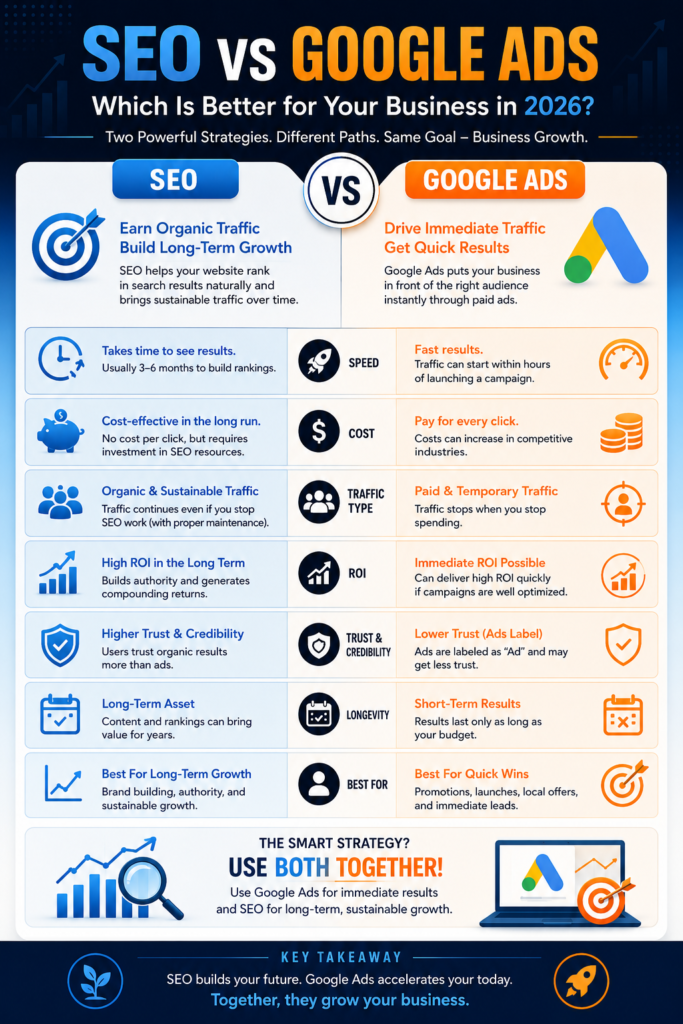
The simplest way to understand SEO vs Google Ads is this:
SEO earns visibility. Google Ads buys visibility.
SEO is generally a long-term investment.
Google Ads is generally a short-term traffic acquisition channel.
That does not mean one is automatically better.
A business launching a new product next week may benefit heavily from Google Ads. A company building a strong online presence for the next five years may want to invest heavily in SEO.
Many successful businesses eventually use both.
SEO vs Google Ads: Speed
When comparing SEO vs Google Ads, speed is one of the clearest differences.
Google Ads can start generating impressions and clicks soon after a campaign becomes active.
SEO normally takes longer.
A new website with little authority may need months of consistent optimization and content development before it starts competing for valuable keywords.
The exact timeframe depends on factors such as:
- Website authority
- Competition
- Search intent
- Content quality
- Technical SEO
- Backlink profile
- Industry
- Location
- Keyword difficulty
- Search demand
If your business needs leads immediately, Google Ads can be attractive.
If you are building a sustainable acquisition channel, SEO can become more valuable over time.
Winner for speed: Google Ads
Winner for long-term visibility: SEO
SEO vs Google Ads: Cost
Cost is another major factor in SEO vs Google Ads.
Google Ads usually works through an advertising budget. Depending on the campaign and bidding strategy, you may pay when someone clicks your advertisement or according to another campaign-specific pricing model.
The cost per click can vary significantly.
Highly competitive industries can have expensive keywords, while less competitive searches may cost considerably less.
SEO does not normally charge you for every organic click.
But that does not make SEO free.
You may spend money on:
- SEO professionals
- Content writers
- SEO software
- Developers
- Link building
- Content production
- Technical audits
- Website improvements
The difference is where the investment goes.
With Google Ads, you are continuously funding paid visibility.
With SEO, you are investing in an asset: your website, content library, authority, and organic visibility.
Short-term paid acquisition: Google Ads
Long-term organic asset building: SEO
SEO vs Google Ads: ROI
ROI is where the SEO vs Google Ads comparison becomes more complicated.
There is no universal winner.
A Google Ads campaign can produce excellent ROI if:
- Your landing page converts well
- Your keywords have strong commercial intent
- Your average customer value is high
- Your campaign is properly optimized
- Your conversion tracking works correctly
SEO can produce excellent ROI when:
- Your website earns consistent organic traffic
- Your content ranks for valuable keywords
- Your conversion rate is healthy
- Your organic visibility continues growing
- Your customer acquisition cost decreases over time
Imagine a company spends ₹50,000 on Google Ads and generates ₹2,00,000 in attributable revenue.
That campaign may be profitable.
Now imagine another company invests ₹50,000 per month into SEO. During the first few months, the traffic increase may be modest. Later, dozens or hundreds of pages may generate organic visits without a direct cost per click.
The ROI picture can therefore change over time.
This is why businesses should evaluate SEO vs Google Ads using customer acquisition cost, conversion rate, customer lifetime value, and revenue rather than traffic alone.
SEO vs Google Ads: Traffic Quality
Traffic volume is not enough.
The real question is whether visitors are likely to become customers.
Google Ads allows advertisers to target searches with strong commercial intent.
For example:
- Buy gold jewellery online
- Hire SEO agency
- Emergency plumber near me
- Best accounting software
- Digital marketing agency Delhi
These searches can indicate that the person is already considering a purchase.
SEO can also capture high-intent searches, but it can additionally bring visitors through informational content.
For example:
- What is SEO?
- How does Google Ads work?
- How to improve website rankings
- SEO checklist for beginners
These visitors may not be ready to buy today.
However, informational visitors can become future customers when you build trust through useful content.
So in SEO vs Google Ads, neither automatically produces better traffic.
The quality depends heavily on targeting and search intent.
SEO vs Google Ads: Trust and Credibility
Organic search results can provide strong credibility.
Many users recognize advertisements immediately and may prefer organic results because they perceive them as more natural or trustworthy.
SEO can help your brand become visible across multiple stages of the customer journey.
For example, a potential customer might first discover your blog through an informational search.
Later, they may search your brand name.
Eventually, they may visit your service page and contact you.
That repeated exposure can strengthen brand recognition.
Google Ads can also build visibility, but the “Ad” label distinguishes paid placements from organic results.
For businesses focused on authority and long-term brand presence, SEO can therefore play an important role.
Advantage: SEO
SEO vs Google Ads: What Happens When You Stop Paying?
This is one of the most important differences in SEO vs Google Ads.
Suppose you spend ₹1,000 per day on Google Ads.
When the campaign is paused, your paid traffic can drop immediately.
SEO does not work that way.
If your website ranks for valuable keywords, those rankings may continue sending visitors even if you reduce your SEO spending.
That does not mean rankings are permanent.
Competitors publish new content. Google’s algorithms evolve. Search behavior changes. Your competitors may build stronger websites.
SEO requires ongoing maintenance.
Still, the visibility can have a longer lifespan than an individual advertising click.
Winner: SEO
SEO vs Google Ads for New Businesses
New businesses often need customers quickly.
That makes Google Ads an attractive option.
A new company can use paid search to test:
- Keywords
- Offers
- Locations
- Landing pages
- Pricing
- Customer demand
- Messaging
At the same time, the business can begin building its SEO foundation.
This combination is often smarter than waiting several months for organic rankings.
For a new business, the practical approach to SEO vs Google Ads is not necessarily “choose one.”
Instead:
Use Google Ads for immediate demand and SEO for future demand.
SEO vs Google Ads for Local Businesses
Local businesses can benefit from both strategies.
A local service business may use Google Ads to target searches such as:
“SEO agency near me”
or
“digital marketing agency in Delhi.”
At the same time, local SEO can help the business appear organically through relevant searches and Google Business Profile visibility.
Local SEO can involve:
- Google Business Profile optimization
- Local landing pages
- Reviews
- NAP consistency
- Local citations
- Location-specific content
- Local backlinks
- Service-area optimization
For local businesses, SEO vs Google Ads is often less about choosing one and more about controlling different parts of the search journey.
SEO vs Google Ads for E-commerce
E-commerce businesses can use both channels effectively.
Google Ads can help promote products to people actively searching for them.
SEO can help product pages, category pages, buying guides, comparison pages, and informational content attract organic traffic.
For example, an online jewellery store might target paid searches around products with strong purchase intent while creating SEO content around jewellery buying guides, styling ideas, product comparisons, and care instructions.
This creates multiple entry points into the website.
The best SEO vs Google Ads strategy for e-commerce usually depends on margins, product demand, competition, repeat purchases, and customer lifetime value.
SEO vs Google Ads: Which Is Better for Long-Term Growth?
If your primary objective is long-term organic visibility, SEO usually has the stronger advantage.
A successful SEO campaign can build a growing library of content and landing pages.
Each useful page can target a different search opportunity.
Over time, your website can potentially rank for hundreds or thousands of relevant searches.
Google Ads does not build organic rankings simply because you advertise.
You are purchasing traffic rather than directly creating organic authority.
That makes SEO especially valuable for businesses that want a sustainable search strategy.
Long-term growth winner: SEO
SEO vs Google Ads: Which Is Better for Immediate Leads?
If you need leads immediately, Google Ads usually has the advantage.
A properly structured campaign can target people who are already searching for your products or services.
You can control:
- Daily budget
- Geographic targeting
- Ad messaging
- Landing pages
- Keywords
- Scheduling
- Bidding
- Conversion tracking
SEO cannot normally provide the same speed.
However, fast traffic does not automatically mean profitable traffic.
Poor targeting can waste an advertising budget quickly.
So Google Ads should always be connected to conversion tracking and a strong landing-page strategy.
Immediate lead generation winner: Google Ads
SEO vs Google Ads: Which One Should You Choose in 2026?
There is no universal answer to the SEO vs Google Ads question.
Instead, ask yourself five questions.
1. Do you need customers immediately?
If yes, Google Ads may be the better starting point.
2. Can you wait several months for organic growth?
If yes, SEO becomes more attractive.
3. Is your industry extremely competitive?
You may need a combination of SEO and paid advertising.
4. Do you have a limited long-term budget?
SEO may provide stronger compounding value, although it still requires investment.
5. Do you want sustainable organic visibility?
SEO should be part of your strategy.
The best answer for many businesses is SEO + Google Ads.
SEO vs Google Ads: The Best Strategy Is Often Both
Instead of treating SEO vs Google Ads as an either-or decision, businesses can use the two channels together.
Google Ads can provide immediate data.
SEO can provide long-term visibility.
For example, paid search data can reveal which keywords generate conversions.
You can then use those insights to improve your SEO content strategy.
Likewise, SEO can identify valuable keywords that may later be tested through paid campaigns.
This creates a feedback loop.
Google Ads → keyword data → SEO content → organic traffic → more conversions
That combination can be especially powerful for competitive markets.
A Practical 2026 SEO and Google Ads Strategy
A balanced strategy can look like this:
Phase 1: Research
Identify:
- Target customers
- Commercial keywords
- Informational keywords
- Competitors
- Search intent
- Geographic opportunities
Phase 2: Launch Google Ads
Start with high-intent searches.
Track:
- Click-through rate
- Cost per click
- Conversion rate
- Cost per lead
- Revenue
- Return on ad spend
Phase 3: Build SEO
Create and optimize:
- Service pages
- Product pages
- Location pages
- Blog content
- Comparison content
- FAQs
- Helpful guides
Phase 4: Improve Conversion Rate
Traffic is useless if visitors do not take action.
Improve:
- Headlines
- Calls to action
- Forms
- Trust signals
- Testimonials
- Page speed
- Mobile experience
- Landing-page structure
Phase 5: Scale What Works
Increase investment in keywords, pages, campaigns, and offers that generate profitable results.
This approach makes the SEO vs Google Ads debate much more practical.
SEO vs Google Ads: Quick Comparison
| Factor | SEO | Google Ads |
|---|---|---|
| Speed | Slow to moderate | Fast |
| Long-term value | High | Limited after spending stops |
| Cost model | Investment-based | Advertising-based |
| Organic visibility | Yes | No |
| Immediate traffic | No | Yes |
| Brand authority | Strong potential | Moderate |
| Keyword control | Indirect | High |
| Long-term scalability | High | Depends on budget |
| Testing speed | Moderate | Fast |
| Best for | Sustainable growth | Immediate demand |
Final Verdict: SEO vs Google Ads
So, SEO vs Google Ads: which is better for your business in 2026?
The honest answer is: it depends on your goals.
Choose SEO when you want:
- Long-term organic traffic
- Sustainable search visibility
- Brand authority
- Lower dependence on paid clicks
- A growing content asset
- Compounding marketing value
Choose Google Ads when you want:
- Immediate visibility
- Faster lead generation
- Precise paid targeting
- Rapid keyword testing
- Quick campaign feedback
- Short-term demand capture
For many businesses, the smartest strategy is not choosing between SEO vs Google Ads.
It is combining them.
Use Google Ads to capture demand today while SEO builds your organic visibility for tomorrow.
That gives your business both speed and sustainability.
In 2026, search marketing is becoming more competitive, more data-driven, and more fragmented. Businesses that rely on only one traffic source can become vulnerable. A strong strategy combines SEO, paid search, useful content, conversion optimization, brand building, and a clear understanding of customer intent.
SEO vs Google Ads is not really a battle. The strongest businesses know when to use both.
Frequently Asked Questions About SEO vs Google Ads
Is SEO better than Google Ads?
SEO can be better for businesses focused on long-term organic visibility, while Google Ads can be better for businesses that need immediate traffic and leads. The best choice depends on your goals, budget, competition, and timeline.
Is Google Ads better than SEO for a new business?
Google Ads can be useful for a new business because it can generate targeted traffic quickly. However, SEO should also be started early because organic rankings can take time to develop.
Is SEO cheaper than Google Ads?
SEO may become more cost-effective over the long term because organic clicks do not have a direct cost per click. However, SEO still requires investment in content, technical optimization, expertise, and website improvements.
Can SEO and Google Ads be used together?
Yes. Combining SEO and Google Ads can create a stronger search strategy. Google Ads can provide immediate traffic and keyword data while SEO builds long-term organic visibility.
How long does SEO take to work?
There is no fixed SEO timeline. Results depend on competition, website authority, content quality, technical health, backlinks, search intent, and the keywords being targeted. Many businesses should think in terms of months rather than days.
Which gives better ROI, SEO or Google Ads?
Neither automatically provides better ROI. ROI depends on factors such as conversion rate, customer value, keyword intent, competition, acquisition cost, and campaign quality. SEO can provide strong long-term ROI, while Google Ads can generate profitable immediate demand.
Should I invest in SEO or Google Ads first?
If you need leads immediately, Google Ads can be a practical starting point. If you are building long-term visibility, start SEO early. If your budget allows, using both can provide a stronger balance between immediate and future growth.
Is SEO still worth it in 2026?
Yes. SEO remains valuable because people continue using search engines to discover businesses, products, services, information, and solutions. Modern SEO should focus on helpful content, technical quality, search intent, user experience, authority, and visibility across evolving search experiences.

Leave a Reply